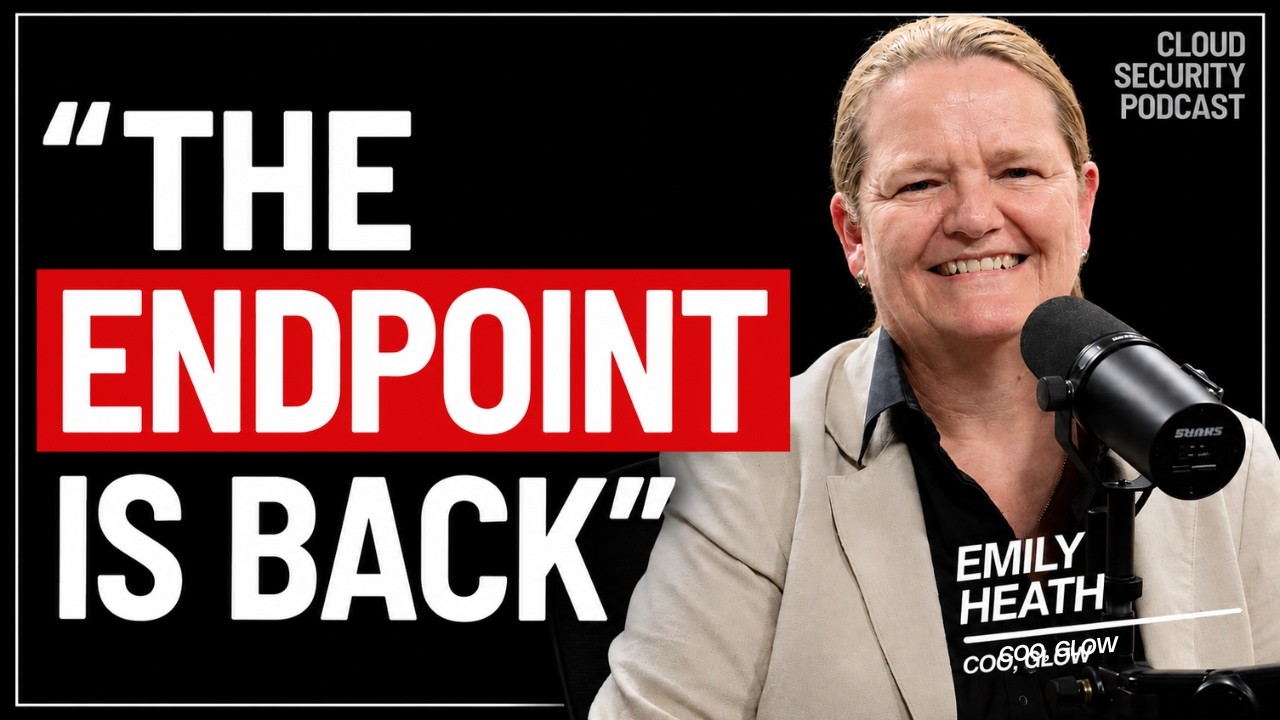
Endpoint Security is the Future of AI Prevention
Keywords
Summary
169 words
Critical Evaluation
Value of the Information & Strength of the Argument
The value of the information lies in its practical, practitioner-oriented perspective. Emily Heath draws on her extensive experience as a CISO to articulate a clear and compelling argument for why endpoint security is critical in the AI era. She effectively challenges the industry’s focus on prompt injection, reframing it as a DLP problem and redirecting attention to the more significant risk of unregulated AI tooling. The argumentation is coherent and well-structured, moving from the problem (EDR blindness) to the solution (AI-driven prevention) and finally to a concrete framework (three layers). However, the discussion is largely anecdotal, relying on a single customer example (60,000 software pieces) and the capabilities of her own company’s product, which introduces a promotional bias. The reasoning is sound but would be strengthened by more empirical evidence or references to independent research.
Scientific Rigor, Source Quality, Title Accuracy
The scientific rigor is moderate. The episode is an expert opinion piece, not a peer-reviewed study. The arguments are based on professional experience and industry observations, which are valuable but not empirically validated. The sources cited are limited to the podcast’s own website, bootcamp, newsletter, and LinkedIn page, which are not primary research sources. The title accurately reflects the content, as the entire episode is dedicated to the thesis that endpoint security is the future of AI prevention. The discussion does not reference external studies or reports, which limits its scientific grounding. The adéquation between title and content is strong, but the lack of external sources reduces the overall rigor.
260 words
Title / Content Match
The title accurately reflects the core thesis of the episode: the endpoint is the critical battleground for AI security, and prevention is the future.
Quality & Reliability
7/10
The discussion is based on the professional experience of a former CISO, providing practical insights. However, it is largely anecdotal and promotional, lacking empirical data or references to independent studies.
Chapters
- Introduction: The Endpoint's Moment
- Emily Heath's Background: From CISO to VC to Glow COO
- Why Prompt Injection is Just a DLP Problem
- The Hidden Danger of Unregulated AI Plugins
- Why EDRs Are Blind to Modern AI Configurations
- Moving from Detection & Response to True Prevention
- Discovering 60,000 Unique Pieces of Software
- Shrinking the Attack Surface Against Frontier Models
- Solving the CMDB and Device Reconciliation Nightmare
- The Importance of 100% Explainable AI Decisions
- The 3 Layers of AI Security: Code, SaaS, and Endpoint
- Agentless Security vs. Lightweight Collectors
- The Evolving Role of the CISO and IT Collaboration
- The "You Laugh, You Lose" Cybersecurity Joke Challenge
Cited Sources
- Cloud Security Podcast Website — Official website of the podcast, providing additional resources and episodes.
- Cloud Security Bootcamp — Training program offered by the podcast hosts.
- Cloud Security Newsletter — Newsletter for cloud security updates.
- Cloud Security Podcast LinkedIn — LinkedIn page for the podcast.
Concurring Sources
- Gartner: Top Trends in Cybersecurity 2024 — Gartner highlights the importance of AI in security and the need for new approaches, aligning with the episode's thesis.
Dissenting Sources
Contribution & Novelties
The episode provides a fresh perspective on AI security by shifting the focus from prompt injection to the endpoint. It introduces the concept of ‘unregulated AI packages’ and highlights the limitations of traditional EDRs in this new context. The three-layer framework (foundations, context, action) offers a practical roadmap for CISOs. The discussion on reducing the attack surface with AI assistance is a notable contribution.
Pour aller plus loin :
- Endpoint Detection and Response (EDR) — Provides background on EDR technology and its evolution.
- Model Context Protocol (MCP) — Official site for MCP, a protocol for AI tool integration, relevant to the discussion of AI plugins.
- CISO (Chief Information Security Officer) — Overview of the CISO role, relevant to the evolving responsibilities discussed.
122 words
Radar Profile
The radar profile shows a balanced distribution across all dimensions, with slightly higher scores in information quantity and quality, reflecting the episode's substantive discussion. The technical level is moderate, suitable for a professional audience. The overall reliability is adequate, given the expert opinion nature.