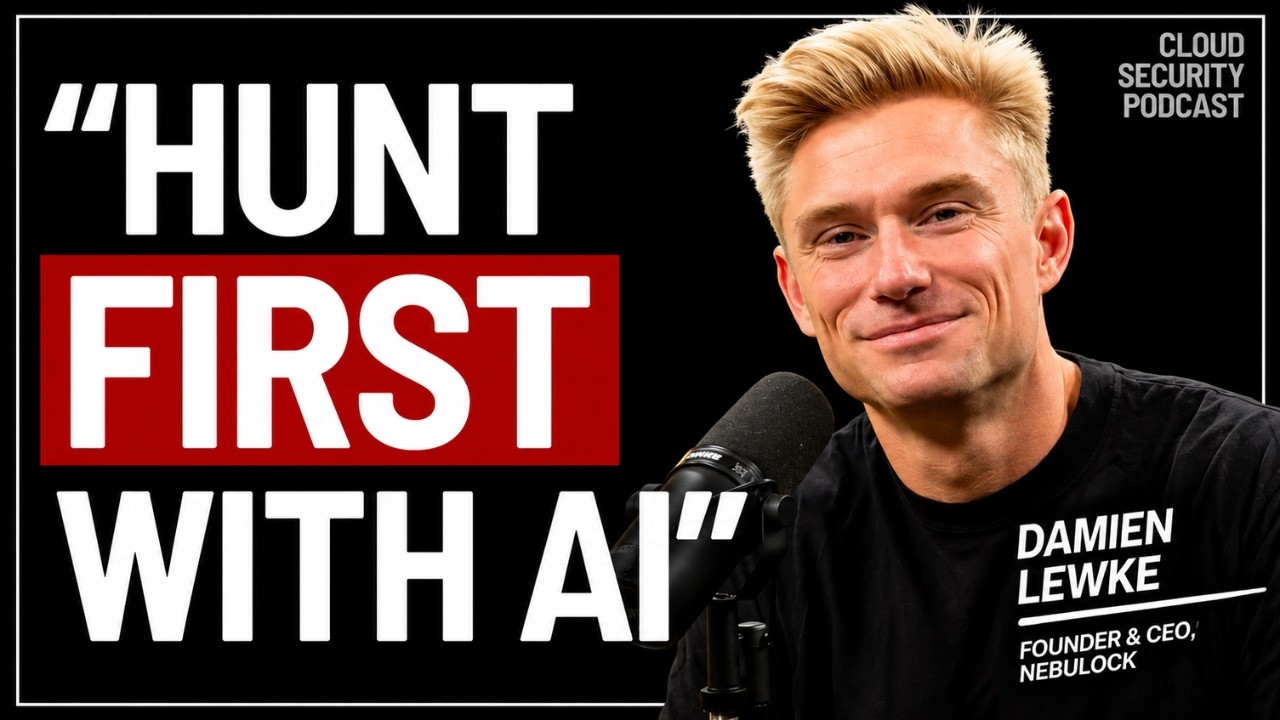
The "Hunt First" AI Security Strategy | Damien Lewke, Nebulock
Keywords
Summary
141 words
Critical Evaluation
Value of the Information & Strength of the Argument
The value of the information is high for practitioners interested in modern security operations. Lewke provides a clear framework for shifting from alert-based to telemetry-based hunting, supported by concrete examples like the Okta token scenario. The argumentation is coherent and well-structured, building from the problem of alert fatigue to the solution of AI-augmented hunting. However, the discussion is largely based on anecdotal evidence and the speaker’s own platform’s metrics, which may introduce bias. The argument that AI democratizes threat hunting is compelling, but the lack of independent validation weakens the overall persuasiveness.
Scientific Rigor, Source Quality, Title Accuracy
The scientific rigor is moderate. The speaker cites statistics (82% of intrusions without malware, 89% rise in AI-augmented attacks) without providing sources, and the discussion is based on personal experience rather than peer-reviewed research. The quality of sources is limited to the podcast’s own website and social media links, with no external references to academic or industry reports. The title accurately reflects the content, focusing on the ‘Hunt First’ strategy. The episode is a mix of expert opinion and product promotion, which should be considered when evaluating the reliability of the claims.
199 words
Title / Content Match
The title accurately reflects the core topic of the episode, focusing on the 'Hunt First' strategy in AI security.
Quality & Reliability
7/10
The podcast features an experienced security professional with a strong background (DoD, CrowdStrike, Arctic Wolf) and provides concrete examples and metrics from their platform. However, it is primarily a promotional discussion for Nebulock, with limited independent verification of claims.
Chapters
- Introduction: The Problem with Reactive Security Alerts
- Damien Lewke’s Background (DoD, CrowdStrike, Arctic Wolf, Nebulock)
- Why Breaches Happen in Silence: The Value of Telemetry Over Alerts
- How AI Democratizes Elite Threat Hunting for Small Teams
- Defining the "Hunt First" Mindset and Methodology
- Surfacing Active Intrusions Using Cross-Domain Context
- The Importance of Transparency in AI Decision Making
- When NOT to Use AI for Detections (The Power of Heuristics)
- The Best First AI Security Use Case: Hunting Shadow AI & MCPs
- Detecting Rogue AI Agents via Tempo, Breadth, and Automation Signatures
- The Future of SIEM: Data Gravity vs. Purpose-Built Security Analytics
- Disagreeing with Gartner: Why Threat Hunters Are More Vital Than Ever
- The 89% Rise in AI-Augmented Attacks and Taking Action
- The "You Laugh, You Lose" Cybersecurity Joke Challenge
Cited Sources
- Cloud Security Podcast — Main website for the podcast, providing additional episodes and resources.
- Cloud Security Bootcamp — Educational resource mentioned in the description for cloud security training.
- Cloud Security Newsletter — Newsletter for cloud security updates, mentioned in the description.
- Cloud Security Podcast LinkedIn — LinkedIn page for the podcast, used for community engagement.
Concurring Sources
- CrowdStrike 2024 Global Threat Report — Industry report that supports the rise of AI-augmented attacks and the importance of proactive hunting.
Dissenting Sources
- Gartner on Threat Hunting — The speaker disagrees with Gartner's prediction that AI will reduce the need for human threat hunters, arguing that human expertise remains essential.
Contribution & Novelties
The episode provides a novel perspective on integrating AI into threat hunting, emphasizing a ‘Hunt First’ mindset that prioritizes proactive telemetry analysis over reactive alert handling. It offers practical guidance for implementing AI-driven hunting in small teams and highlights the importance of transparency in AI outputs. The discussion on detecting shadow AI and rogue AI agents via behavioral signatures (tempo, breadth) is particularly timely.
Pour aller plus loin :
- Threat hunting — Foundational concept for proactive security.
- SIEM — Understanding the limitations of traditional alert-based systems.
- Model Context Protocol (MCP) — Official site for MCP, relevant to shadow AI detection.
100 words
Radar Profile
The radar profile shows high scores in information quantity and technical level, reflecting the in-depth discussion of security concepts. The lower score in reliability indicates the promotional nature of the content and lack of independent verification.
💬 No comments were provided for analysis.