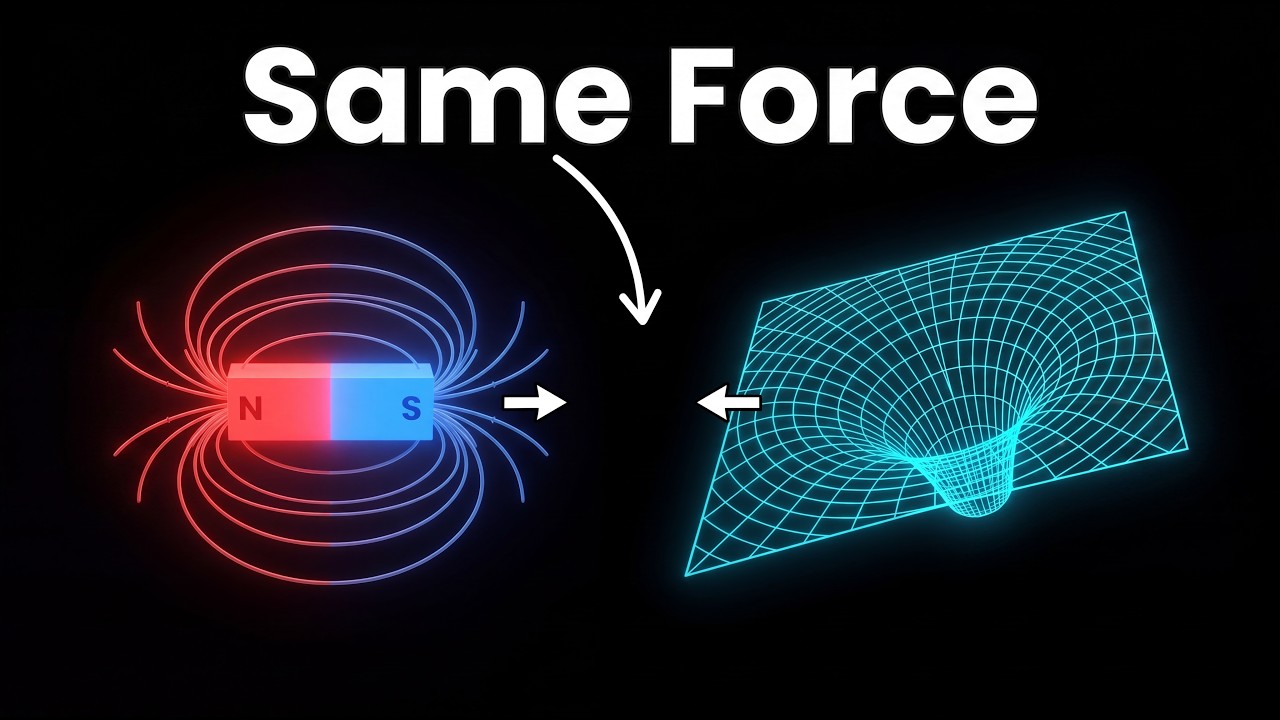
The Hidden Connection Between Magnetism and Relativity!
Keywords
Summary
164 words
Critical Evaluation
Value of the Information & Strength of the Argument
The video provides exceptional value by offering a clear, rigorous, and self-contained derivation of a subtle topic. It goes beyond superficial explanations, explicitly calculating the charge density transformation and the resulting electric field, and verifying the force transformation with a numerical example. The argumentation is solid, building logically from the force law to the field transformations and the tensor formalism. It also honestly addresses the limitations of the ’length contraction’ explanation and the non-eliminability of magnetic fields in certain cases, demonstrating a deep understanding of the subject.
Scientific Rigor, Source Quality, Title Accuracy
The video demonstrates high scientific rigor. It cites primary sources (Einstein’s 1905 paper) and standard textbooks (Feynman, Purcell, Griffiths) in the description. The derivations are performed on screen, and the results are checked against known formulas. The title accurately reflects the content, which is a detailed exploration of the relativistic nature of magnetism. The video’s commitment to accuracy is further evidenced by the creator’s request for corrections in the comments.
172 words
Title / Content Match
The title accurately reflects the content, which thoroughly explains the deep connection between magnetism and special relativity.
Quality & Reliability
9/10
The video provides a rigorous, step-by-step derivation of the relativistic origin of magnetism, with explicit calculations and checks against known results. It correctly identifies the limitations of the 'length contraction' slogan and the non-eliminability of magnetic fields in certain cases. The presentation is consistent with established physics, and the creator invites corrections, indicating a commitment to accuracy.
Chapters
- One current, two explanations that should not both work
- Einstein opens his 1905 paper with the same asymmetry
- Rebuilding the magnetic force from scratch
- Change frames and the magnetic push must vanish
- Counting the same charges on the right slice of time
- The general rule for mixing E and B between observers
- One tensor behind both fields, and the two invariants
- What the slogan gets wrong about magnets — and what comes next
Cited Sources
- On the Electrodynamics of Moving Bodies (1905) — Einstein's original paper, which opens with the magnet-conductor asymmetry that motivates the video's central question.
- The Feynman Lectures on Physics, Vol. II, Ch. 13-6 — Feynman's discussion of the relativity of magnetic and electric fields, a key reference for the field transformation approach.
Concurring Sources
- The Feynman Lectures on Physics, Vol. II, Ch. 13-6 — Feynman's treatment of the relativity of fields, which the video's derivation aligns with.
- On the Electrodynamics of Moving Bodies (1905) — Einstein's paper, which the video's opening problem is based on.
Contribution & Novelties
The video’s original contribution lies in its pedagogical approach: it derives the relativistic origin of magnetism from first principles, explicitly calculating the charge density transformation and the resulting electric field, rather than relying on the common but incomplete ’length contraction’ slogan. It also provides a clear numerical example to verify the force transformation and uses the Lorentz invariants to classify fields, clarifying when magnetic fields can and cannot be transformed away. This provides a deeper and more accurate understanding than typical popular science explanations.
Pour aller plus loin :
- Lorentz transformation — The coordinate transformation between inertial frames, central to the video’s derivations.
- Electromagnetic tensor — The tensor formalism used to unify electric and magnetic fields.
- Relativistic electromagnetism — A broader overview of how electromagnetism is formulated in special relativity.
130 words
Radar Profile
The radar profile shows a very high score in information quantity and quality, reflecting the video's dense and accurate content. The technical level is also high, indicating a sophisticated treatment. The overall reliability is strong, supported by the rigorous derivations and cited sources.