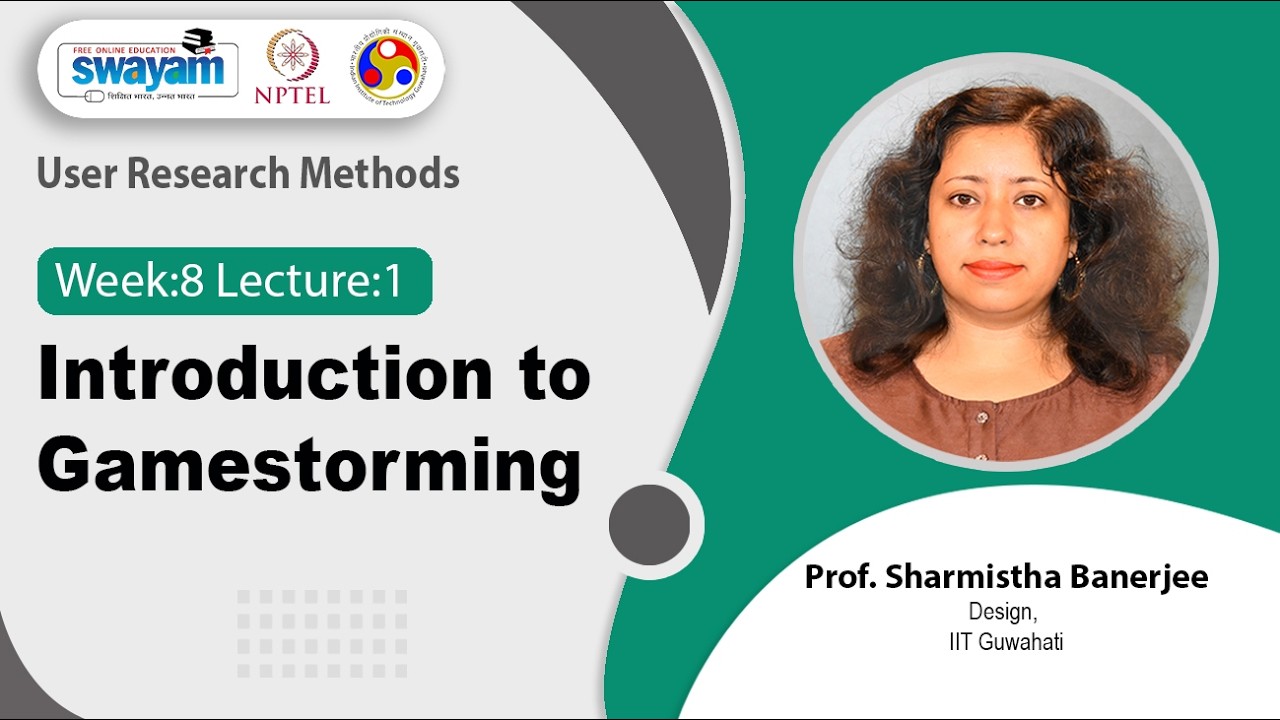
Lec 37: Introduction to Gamestorming
Keywords
Summary
145 words
Critical Evaluation
Value of the Information & Strength of the Argument
The lecture provides valuable insights into gamestorming as a structured alternative to unstructured brainstorming. The argumentation is solid, grounded in game design principles and supported by a practical case study. The presenter effectively demonstrates how rules, goals, and feedback loops create a flow state that enhances creativity and participation. The emphasis on psychological safety and equal participation addresses common pitfalls in group ideation. The case study is detailed and realistic, showing the application of each step and its outcomes. However, the lecture lacks empirical evidence or references to studies validating the effectiveness of gamestorming, which would strengthen the argument. Overall, the value lies in its practical guidance and clear explanation of the methodology.
Scientific Rigor, Source Quality, Title Accuracy
The lecture is scientifically rigorous in its structure and presentation, but it does not cite external sources or references, which limits its scholarly depth. The content is based on established concepts from game design and collaborative problem-solving, but the lack of citations makes it difficult to verify claims. The title accurately reflects the content, as the lecture is indeed an introduction to gamestorming. The description provides links to the course and playlist, but these are not specific to the lecture’s content. No comments were provided for analysis.
215 words
Title / Content Match
The title accurately reflects the content, as the lecture provides a comprehensive introduction to gamestorming, covering its principles, mechanics, and a practical example.
Quality & Reliability
7/10
The lecture is an academic presentation by a professor at IIT Guwahati, providing a structured introduction to gamestorming. It is based on established concepts from game design and collaborative problem-solving, but lacks explicit citations to external sources. The content is coherent and practical, with a detailed case study, but the scientific rigor is moderate due to the absence of references and empirical evidence.
Key Moments
Markers derived by PSI from the transcript: the creator did not define chapters.
- Introduction to gamestorming as a facilitation methodology for user research.
- Explanation of game mechanics: rules, goals, turns, and time limits.
- Discussion on why gamestorming works: psychological safety, tangible artifacts, rapid iteration, and equal participation.
- Introduction of the four pillars of gamestorming: rules, goals, feedback loops, and flow state.
- Case study begins: redesigning a university library with a 90-minute gamestorming session.
- Warm-up activity: creating trading cards to flatten hierarchy and set norms.
- Empathy building: understanding student experience through a four-quadrant analysis.
- Cover story game: imagining a future headline to envision the library's direction.
- Rapid sketching: six ideas in eight minutes to diverge and generate concepts.
- Convergence: affinity mapping and dot voting to prioritize ideas and create a pilot plan.
Cited Sources
- User Research Methods - Course Page — Course page for the NPTEL course on User Research Methods, which includes this lecture.
- Playlist: User Research Methods — YouTube playlist containing all lectures of the course.
Concurring Sources
- Gamestorming: A Playbook for Innovators, Rulebreakers, and Changemakers — The book by Dave Gray et al. is a key reference for gamestorming, aligning with the lecture's principles.
- Flow: The Psychology of Optimal Experience — The concept of flow, as defined by Csikszentmihalyi, is central to the lecture's explanation of optimal engagement.
Contribution & Novelties
The lecture provides a structured introduction to gamestorming, emphasizing its application in user research. It offers a clear framework with four pillars and a detailed case study, making the methodology accessible. The novelty lies in the practical demonstration of how game mechanics can be applied to create psychological safety and flow, leading to innovative solutions. The lecture also highlights the importance of tangible artifacts in sustaining ideation.
Pour aller plus loin :
- Gamestorming: A Playbook for Innovators, Rulebreakers, and Changemakers — A foundational book on gamestorming, providing a comprehensive collection of games and techniques.
- Flow (psychology) — The concept of flow, as described by Mihaly Csikszentmihalyi, is central to the lecture’s explanation of optimal engagement.
- Design thinking — Gamestorming is often used within design thinking processes to foster creativity and collaboration.
131 words
Radar Profile
The radar profile shows high scores in quantity of information and technical level, indicating a content-rich lecture with a moderate depth. The quality and reliability scores are slightly lower, reflecting the lack of external citations. Overall, the lecture is informative and practical, but could benefit from more rigorous sourcing.