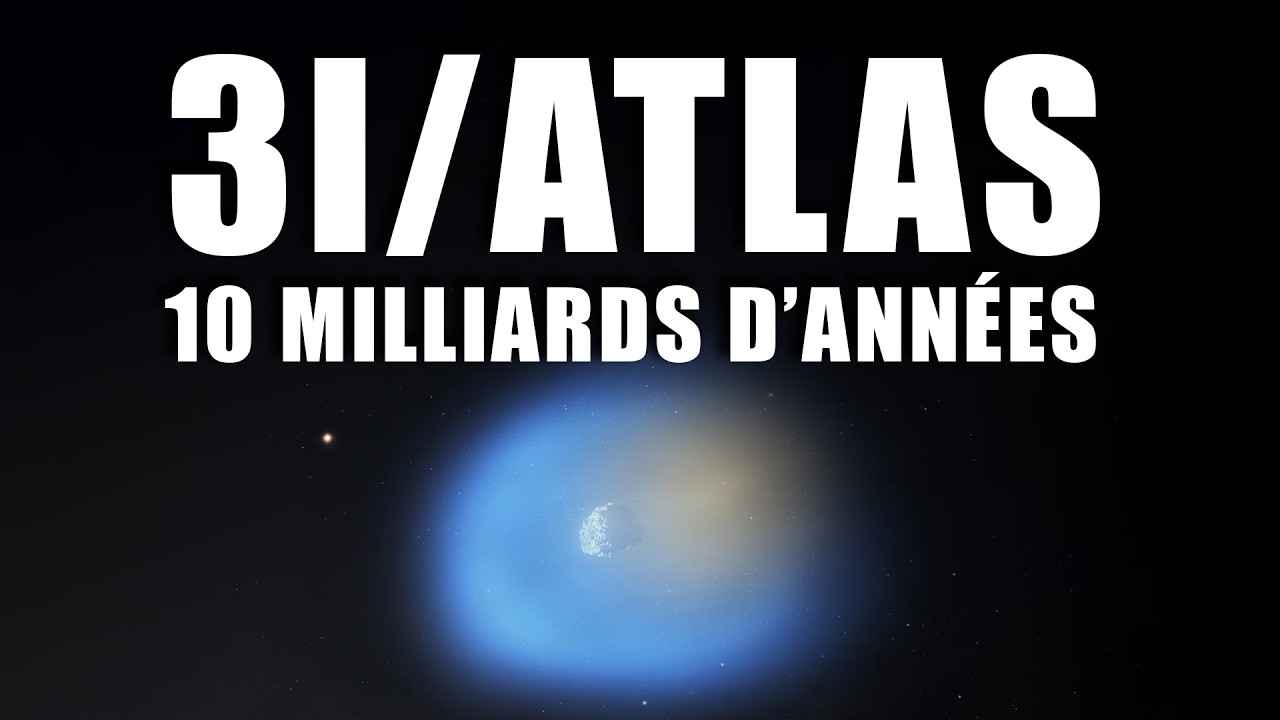
L'objet interstellaire 3I ATLAS nous réserve encore des MYSTÈRES ! DNDE 437
Keywords
Summary
109 words
Critical Evaluation
Value of the Information & Strength of the Argument
The video provides valuable information on the latest research about 3I/ATLAS, explaining complex isotopic analysis in an accessible manner. The argumentation is solid, linking the isotopic ratios to galactic chemical evolution models. The coverage of other space news is informative, with clear explanations of technical developments. The host’s enthusiasm is evident, but the presentation remains objective, acknowledging uncertainties in the study.
Scientific Rigor, Source Quality, Title Accuracy
The video cites the preprint on Research Square for the 3I/ATLAS study, which is appropriate but not peer-reviewed. Other sources include reputable space news outlets. The title accurately reflects the content, focusing on the mysteries of 3I/ATLAS. The video maintains a good balance between scientific rigor and accessibility, though some claims are speculative and clearly presented as such.
134 words
Title / Content Match
The title accurately reflects the main topic of the video, focusing on the mysteries of 3I/ATLAS, and the content delivers on this promise.
Quality & Reliability
8/10
The video presents recent findings about interstellar object 3I/ATLAS, based on a preprint study using JWST data, and covers other space news with references to official sources. The information is generally accurate and well-contextualized, though the study is not yet peer-reviewed and some claims are speculative.
Key Moments
Markers derived by PSI from the transcript: the creator did not define chapters.
- Introduction to the episode and main topic: 3I/ATLAS age study.
- Recap of 3I/ATLAS discovery and previous observations.
- Explanation of isotopic analysis using JWST data.
- Discussion on deuterium enrichment and implications for formation temperature.
- Carbon isotope ratios and galactic chemical evolution.
- LandSpace's BF-20 engine tests and Jutu-4 rocket plans.
- ESA's call for spaceplane concepts and European startups.
- Starcloud's shift to 88,000 satellite constellation for orbital computing.
Cited Sources
- 3I ATLAS study on Research Square — Preprint study on the age and composition of 3I/ATLAS.
- LandSpace's BF-20 engine reaches 220 tons — Article about LandSpace's engine test.
- ESA calls on European startups to design spaceplane — News about ESA's call for spaceplane concepts.
- Starcloud files plans for 88,000 satellite constellation — News about Starcloud's constellation filing.
Concurring Sources
- NASA's page on interstellar objects — General information on comets and interstellar objects.
- ESA's space safety page — ESA's efforts on space debris and safety.
Dissenting Sources
- No discordant sources found — The video's claims align with current scientific consensus, though the study is not yet peer-reviewed.
External References
Contribution & Novelties
The video brings attention to a recent preprint suggesting that 3I/ATLAS is one of the oldest objects known, providing insights into early galactic chemistry. It also highlights the rapid progress in reusable rocket technology in China and Europe, and the growing trend of orbital data centers.
Pour aller plus loin :
- Interstellar object — Background on interstellar objects.
- Deuterium — Explanation of deuterium and its significance.
- Carbon-13 — Isotope used in the study.
- James Webb Space Telescope — The telescope used for observations.
- Kessler syndrome — Relevant to satellite constellation concerns.
91 words
Radar Profile
The radar profile shows high scores in information quantity, quality, and reliability, with a slightly lower technical level, indicating a well-balanced and accessible presentation of complex topics.
💬 Positif. Sur les 30 commentaires analysés, la majorité exprime de l'intérêt et de l'appréciation pour la vulgarisation, avec quelques préoccupations concernant les méga-constellations et le syndrome de Kessler.