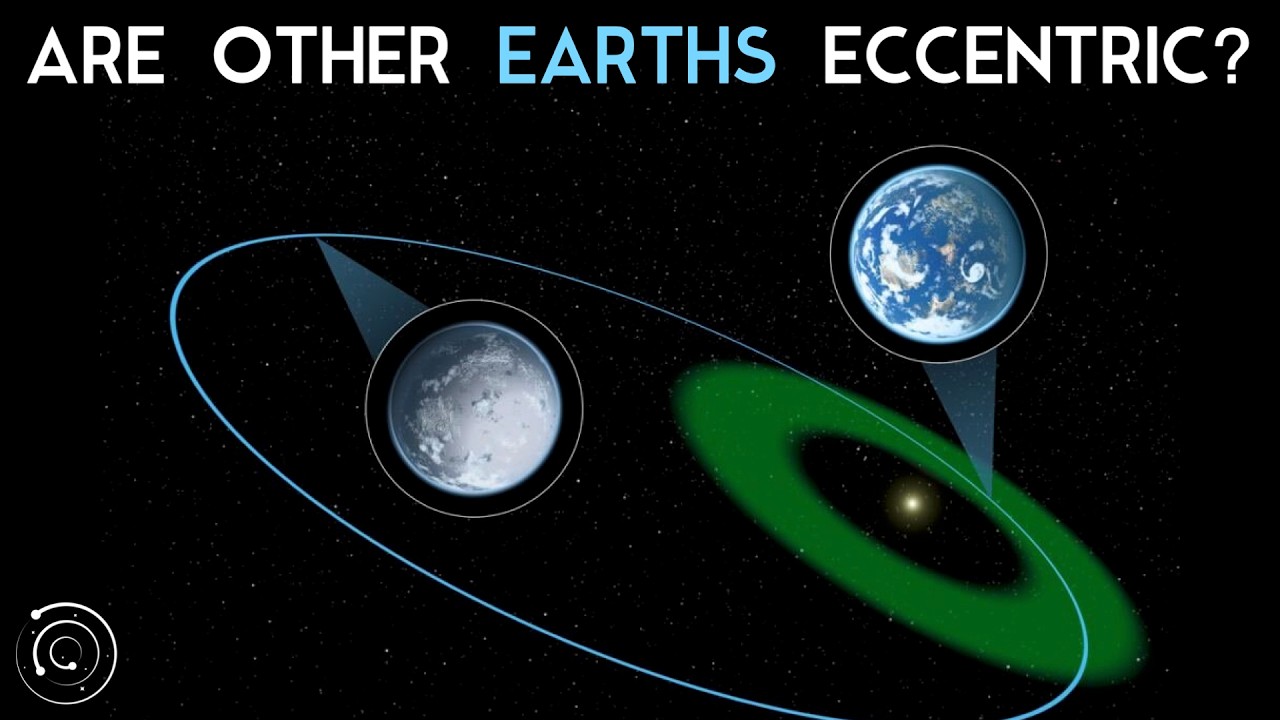
Earth-Like Exoplanets Just Got Even More Earth-Like
Keywords
Summary
199 words
Critical Evaluation
Value of the Information & Strength of the Argument
The video provides a high-value, original scientific result: the first measurement of eccentricity distribution for Earth-like exoplanets. The argumentation is rigorous and transparent, walking through the methodology step-by-step, including the mathematical derivations behind the photo-eccentric effect. The presenter clearly explains the assumptions and limitations (e.g., the restriction to low-mass stars) and acknowledges the small sample size. The reasoning is logical and the conclusions are appropriately cautious, with the occurrence rate of eccentric Earths given as a rough estimate. The video also contextualizes the result within the broader search for habitable exoplanets and the Fermi paradox, adding intellectual depth.
Scientific Rigor, Source Quality, Title Accuracy
The scientific rigor is high: the research is peer-reviewed (Nature Astronomy) and the presenter is a leading expert. The video cites the relevant paper (arXiv link) and mentions prior work (e.g., the 2020 study by Eagle Palsky et al., the 2013 paper by Kipping on eccentric exoplanets). The methodology is clearly explained and the limitations are acknowledged. The title is accurate and not sensationalized. The video includes a sponsorship segment (NordVPN) which is clearly marked and does not affect the scientific content.
195 words
Title / Content Match
The title accurately reflects the content: the video presents evidence that Earth-like exoplanets tend to have Earth-like (near-circular) orbits, making them more Earth-like than previously known.
Quality & Reliability
9/10
The video presents original research by the Cool Worlds Lab, published in Nature Astronomy, with a detailed methodological explanation. The presenter is a leading researcher in the field, and the content is consistent with established scientific methods and peer-reviewed literature.
Key Moments
Markers derived by PSI from the transcript: the creator did not define chapters.
- Introduction: The Copernican principle and the question of Earth's uniqueness.
- Discussion of orbital eccentricity and its importance for climate stability.
- Sponsorship segment (NordVPN).
- Introduction to exoplanets and the sample of Earth proxies.
- Definition of Earth proxies and the need to measure their eccentricities.
- Explanation of the photo-eccentric effect and how it works.
- Method for measuring stellar densities using Gaia data for low-mass stars.
- Results: 16 of 17 Earth proxies have near-circular orbits; one is eccentric.
- Big picture: implications for habitability and the Fermi paradox.
- Outro and credits.
Cited Sources
- Paper: 'The Eccentricities of Earth-like Exoplanets' (arXiv) — The research paper presented in the video, to be published in Nature Astronomy.
- NordVPN (sponsor) — Sponsorship link mentioned in the video.
Concurring Sources
- Gaia Data Release 3 — The Gaia mission provides the stellar density measurements used in the study.
- Exoplanet Archive (NASA) — The catalog of exoplanets used to identify Earth proxies.
Contribution & Novelties
The video presents a novel observational result: the first measurement of the eccentricity distribution of Earth-like exoplanets. This is a significant step in understanding the prevalence of Earth-like orbits, which is crucial for assessing habitability. The study uses a clever combination of techniques (photo-eccentric effect, Gaia stellar densities) to overcome the limitations of radial velocity measurements for small planets. The finding that most Earth proxies have near-circular orbits is surprising and has implications for the Fermi paradox.
Pour aller plus loin :
- Photo-eccentric effect — The technique used to measure eccentricities from transit light curves.
- Gaia mission — The space observatory providing stellar parallax and density data.
- Eccentricity (orbit) — The parameter describing the shape of an orbit.
- Milankovitch cycles — The effect of orbital variations on Earth’s climate, mentioned in the video.
133 words
Radar Profile
The radar profile shows high scores across all dimensions, with particularly strong performance in information quality and reliability, reflecting the original peer-reviewed research and clear presentation. The technical level is high but accessible, and the quantity of information is substantial for a 21-minute video.
💬 Très positif. Sur les 30 commentaires analysés, l'enthousiasme est unanime : les spectateurs saluent la clarté des explications, la rigueur mathématique, et félicitent l'équipe pour la publication dans Nature Astronomy. Plusieurs commentaires expriment une admiration personnelle pour le narrateur et la chaîne.