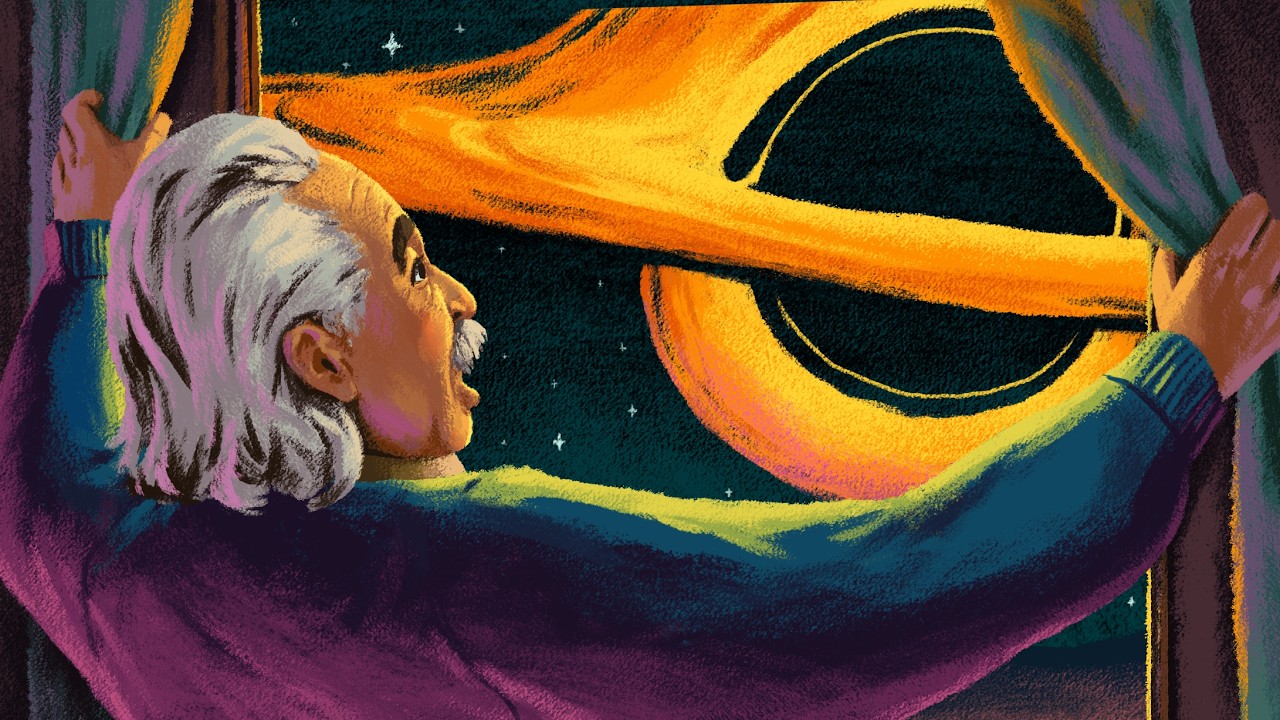
Something Strange Happens When You Follow Einstein's Math
Keywords
Summary
160 words
Critical Evaluation
Value of the Information & Strength of the Argument
The video provides substantial value by demystifying advanced concepts in general relativity, such as coordinate singularities and maximal extensions. It argues effectively that the Schwarzschild solution, despite its simplicity, predicts a rich structure of black holes, white holes, and parallel universes. The argumentation is solid, building logically from the field equations to the Penrose diagram, and it correctly distinguishes between mathematical predictions and physical reality. The use of expert commentary (Prof. Geraint Lewis) adds authority and clarifies subtle points, such as the nature of singularities and the time-reversal symmetry of the equations.
Scientific Rigor, Source Quality, Title Accuracy
The video demonstrates high scientific rigor by consulting experts and referencing primary sources, including Einstein’s 1915 paper and Hamilton’s textbook. The description provides a comprehensive list of references and additional resources. The title accurately reflects the content, which is a deep dive into the mathematical consequences of Einstein’s equations. The video also acknowledges the speculative nature of wormholes and white holes, maintaining a clear boundary between established physics and theoretical possibilities. The inclusion of a sponsor segment (Incogni) is clearly marked and does not detract from the scientific content.
196 words
Title / Content Match
The title accurately reflects the content: the video explores the surprising consequences of Einstein's field equations, including black holes, white holes, and wormholes.
Quality & Reliability
9/10
High-quality science communication with expert consultations (Prof. Geraint F. Lewis, Prof. Juan Maldacena) and references to primary literature (Einstein 1915, Hamilton 2021). The video clearly distinguishes between established physics and speculative extensions, and uses accurate visualizations. Minor caveat: some simplifications for accessibility, but overall rigorous.
Key Moments
Markers derived by PSI from the transcript: the creator did not define chapters.
- Introduction to the paradox of observing objects falling into a black hole.
- Explanation of Newton's concerns about action at a distance and Einstein's solution via spacetime curvature.
- Derivation of the Schwarzschild metric and identification of the event horizon and singularity.
- Discussion of the Chandrasekhar limit and neutron star collapse, leading to black hole formation.
- Explanation of coordinate singularities and the waterfall model of space flowing into a black hole.
- Introduction of Kruskal-Szekeres and Penrose diagrams to map the full spacetime structure.
- Revelation of the white hole and parallel universe in the maximal extension, and the Einstein-Rosen bridge.
- Conclusion on the hypothetical nature of wormholes and the implications of the simplest solution.
Cited Sources
- Einstein, A. (1915). Die feldgleichungen der gravitation. — Original paper presenting the field equations of general relativity.
- Hamilton, A. J. S. (2021). General Relativity, Black Holes, and Cosmology — Textbook reference for advanced concepts in general relativity.
- Newton’s Letters via The Newton Project — Primary source for Newton's views on action at a distance.
- Relativity Playlist by ScienceClic — Educational videos on relativity, used for visualizations.
- Why Time and Space Swap by ScienceClic — Video explaining the behavior of light cones near a black hole.
- Black Hole Events by PBS Space Time — Playlist on black hole physics.
- Additional References — Compilation of further references on white holes and related topics.
Concurring Sources
- Thorne, K. (1995). Black Holes & Time Warps: Einstein's Outrageous Legacy. — Book that discusses the history and physics of black holes, supporting the video's narrative.
- Cox, B., & Forshaw, J. (2023). Black holes: the key to understanding the universe. — Book mentioned in the description as an inspiration, covering similar topics.
External References
Contribution & Novelties
The video excels at making the abstract mathematics of general relativity tangible through intuitive visualizations and clear explanations. It uniquely connects the Schwarzschild solution to the concepts of white holes and parallel universes, emphasizing that these are not just science fiction but direct mathematical consequences. The use of Penrose diagrams is particularly effective in conveying the global structure of spacetime. The video also clarifies common misconceptions, such as the nature of the event horizon singularity.
Pour aller plus loin :
- Penrose diagram — Visual tool for representing the causal structure of spacetime.
- Kruskal–Szekeres coordinates — Coordinate system that removes the coordinate singularity at the event horizon.
- Einstein–Rosen bridge — Theoretical wormhole solution connecting two regions of spacetime.
- Chandrasekhar limit — Maximum mass for a white dwarf star, beyond which collapse to a neutron star or black hole occurs.
- General relativity — Einstein’s theory of gravity, foundational to the video’s content.
150 words
Radar Profile
The radar profile shows high scores across all dimensions, indicating a well-balanced and comprehensive video. The strength lies in the quantity and quality of information, with a slightly lower but still strong technical level, reflecting the video's accessibility without sacrificing depth.
💬 Très positif. Sur les 30 commentaires analysés, la grande majorité exprime une admiration pour la clarté des explications et la qualité des animations, avec plusieurs commentaires soulignant une compréhension nouvelle de concepts complexes.