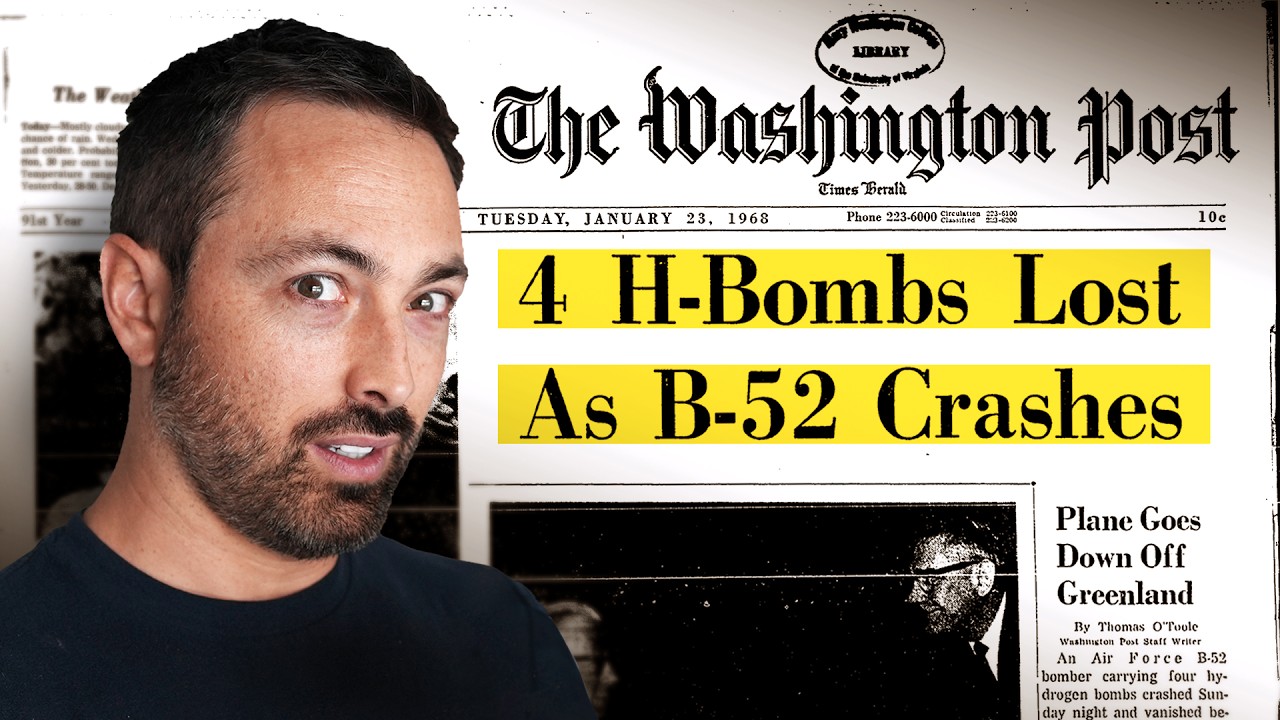
How Humanity Almost Destroyed Itself
Keywords
Summary
158 words
Critical Evaluation
Value of the Information & Strength of the Argument
The video provides valuable information by compiling and presenting a series of well-documented nuclear accidents and near-misses, many of which are not widely known. The argumentation is solid, as it builds a compelling case that the threat of nuclear war is not solely from intentional use but also from accidents and miscommunication. The narrative is structured logically, moving from specific incidents to broader implications, and it effectively uses primary sources such as declassified reports and interviews. The inclusion of expert commentary and archival footage strengthens the credibility of the presentation.
Scientific Rigor, Source Quality, Title Accuracy
The video demonstrates high scientific rigor by referencing declassified reports, official military documents, and reputable news outlets. The sources are clearly cited in the description, allowing viewers to verify the information. The title accurately reflects the content, which focuses on historical near-misses and accidents involving nuclear weapons. The video does not sensationalize the events but presents them in a factual manner, though it does acknowledge uncertainties where they exist. Overall, the sourcing is thorough and appropriate for the subject matter.
185 words
Title / Content Match
The title accurately reflects the content, which focuses on historical near-misses and accidents involving nuclear weapons.
Quality & Reliability
8/10
The video relies on declassified reports, official military documents, and credible journalistic sources, and it clearly distinguishes between confirmed facts and unverified claims. The historical narrative is consistent with established scholarship, though some details (e.g., the exact number of lost weapons) remain uncertain.
Key Moments
Markers derived by PSI from the transcript: the creator did not define chapters.
- Introduction to the topic of nuclear accidents and near-misses.
- The 1966 Palomares B-52 crash and the loss of four hydrogen bombs.
- Explanation of how hydrogen bombs work and why they didn't detonate.
- The search for the missing bomb and the contamination of the Spanish coastline.
- Definition of 'Broken Arrow' and the 1961 Goldsboro incident.
- The 1968 Thule crash and the 1965 loss of a bomb off Japan.
- The 1980 Damascus Titan II missile explosion.
- The Cuban Missile Crisis and the role of Vasili Arkhipov.
- The 1983 false alarm and Stanislav Petrov's decision.
- The 1995 Norwegian rocket incident and the conclusion on nuclear risk.
Cited Sources
- Atomic Archive — List of Broken Arrows
- Broken Arrows Report — Official list of nuclear weapon accidents
- Declassified Goldsboro Report — Report on the 1961 Goldsboro incident
- Operation Chrome Dome — Details on the military operation
- CIA Website — Information on the K-129 submarine recovery
- Cataclysmic cargo: The hunt for four missing nuclear bombs after a B-52 crash — Washington Post article on the Palomares incident
- THE LAST FLIGHT OF HOBO 28 — Documentary about the Palomares crash
- The Voice of Larry Messinger — Interview with the pilot of the B-52
- Even Without Detonation, 4 Hydrogen Bombs From ’66 Scar Spanish Village — New York Times article on Palomares
- Decades Later, Sickness Among Airmen After a Hydrogen Bomb Accident — New York Times article on health effects
- Picture of ReVelle — Image of Lieutenant Jack ReVelle
- NPR Interview with ReVelle — Audio of ReVelle's account
Concurring Sources
- Atomic Archive — List of Broken Arrows
- Declassified Goldsboro Report — Report on the 1961 Goldsboro incident
- Cataclysmic cargo: The hunt for four missing nuclear bombs after a B-52 crash — Washington Post article on the Palomares incident
Dissenting Sources
- No discordant sources found — The video's claims are consistent with the cited sources and established historical accounts.
External References
Contribution & Novelties
The video synthesizes a wide range of historical incidents into a coherent narrative, highlighting the often-overlooked risk of accidental nuclear war. It provides a compelling argument that the greatest danger lies not in deliberate use but in accidents and false alarms. The inclusion of declassified reports and personal accounts adds depth and credibility.
Pour aller plus loin :
- Broken Arrow (nuclear) — Wikipedia article on nuclear weapon accidents.
- Cuban Missile Crisis — Overview of the crisis and the role of Vasili Arkhipov.
- Stanislav Petrov — Biography of the officer who averted a potential nuclear war.
- Nuclear weapons and the United States — Background on US nuclear arsenal and policies.
109 words
Radar Profile
The radar profile shows high scores in information quantity and quality, reflecting the video's comprehensive coverage and reliable sourcing. The technical level is moderate, making it accessible to a general audience while still providing depth. The overall reliability is strong, supported by declassified documents and credible journalism.
💬 Très positif. Sur les 30 commentaires analysés, les spectateurs expriment une profonde gratitude envers les héros comme Vasili Arkhipov et Stanislav Petrov, et saluent la qualité de la production et des animations.