Why Don’t Railroads Need Expansion Joints?
Keywords
Summary
152 words
Critical Evaluation
Value of the Information & Strength of the Argument
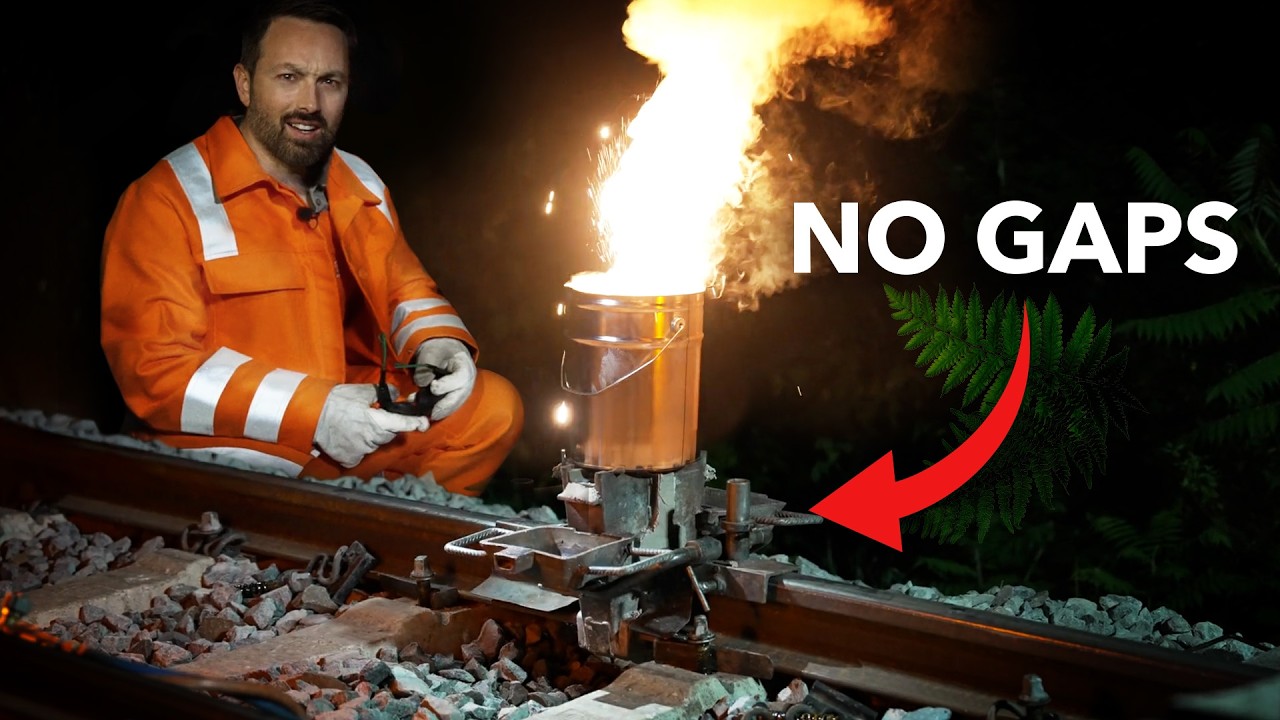
The video provides substantial value by demystifying an industrial process rarely seen in detail. It combines on-site footage, expert commentary, and clear explanations of underlying physics and metallurgy. The argumentation is solid: the claim that continuous welded rail is safe and effective is supported by demonstrations of the welding process, stress-strain principles, and real-world testing (bending press). The video effectively builds a case for why thermal expansion is managed through mechanical restraint, using clear analogies and visual aids. The inclusion of a practical demonstration of brittle martensite strengthens the explanation of why cooling rates matter. The narrative is well-structured, moving from problem to solution to underlying science, making it both engaging and informative.
Scientific Rigor, Source Quality, Title Accuracy
The video demonstrates high scientific rigor by collaborating with industry experts (Goldschmidt) and showing actual testing procedures. It references external sources such as Practical Engineering’s video, Wikipedia articles on stress-strain curves and related topics, and educational videos on metallurgy. The title accurately reflects the content, which thoroughly answers the question posed. The video’s claims are grounded in observable demonstrations and expert testimony, enhancing its credibility. The presence of a sponsorship segment is clearly indicated and does not detract from the scientific content. Overall, the sources are appropriate and the title-content alignment is strong.
221 words
Title / Content Match
The title accurately reflects the core question addressed, with the video explaining the engineering solution of continuous welded rail and the role of mechanical restraint.
Quality & Reliability
9/10
High-quality production with direct access to industry experts and facilities, demonstrating processes and testing. Claims are supported by demonstrations and references to external sources, though some promotional content is present.
Chapters
Cited Sources
- Practical Engineering: Why Railroads Don't Need Expansion Joints — Referenced as an excellent complementary video on the same topic.
- Stress–strain curve - Wikipedia — Referenced for the stress-strain relationship.
- The Efficient Engineer: Understanding Metals — Referenced for understanding metal properties.
- moodlemech: Properties and Grain Structure — Referenced for grain structure in metals.
- bhadeshi123: Martensitic transformation — Referenced for martensitic transformation.
- Stratford Works - Wikipedia — Referenced for historical context.
- Electric Tram 1881 - Wikipedia — Referenced for early tram rail welding.
- Water Quenched Steel - Wikipedia — Referenced for quenching process.
- Synagoge 1922 - Wikipedia — Referenced for historical images.
Concurring Sources
- Practical Engineering: Why Railroads Don't Need Expansion Joints — Provides a complementary explanation of the same topic, reinforcing the video's claims.
- The Efficient Engineer: Understanding Metals — Supports the metallurgical explanations regarding metal properties and grain structure.
External References
Contribution & Novelties
The video offers a rare, behind-the-scenes look at industrial thermite welding, providing detailed visual and explanatory content that is not commonly available. It bridges the gap between theoretical metallurgy and practical application, making complex concepts accessible. The demonstration of the welding process, including the see-through mold, offers unique educational value.
Pour aller plus loin :
- Thermite - Wikipedia — Provides background on the thermite reaction and its applications.
- Continuous welded rail - Wikipedia — Explains the concept and engineering considerations of CWR.
- Martensite - Wikipedia — Details the microstructure and properties of martensite in steel.
- Stress–strain curve - Wikipedia — Explains the relationship between stress and strain in materials.
109 words
Radar Profile
The radar profile shows high scores across all dimensions, indicating a well-rounded and reliable video. The strength in 'quantite_information' and 'qualite_information' reflects the comprehensive coverage and expert input, while 'niveau_technique' and 'fiabilite_globale' are also high, demonstrating both depth and credibility.
💬 Très positif : Sur les 30 commentaires analysés, la grande majorité exprime une admiration pour la qualité de la vidéo, la précision des explications et le travail des professionnels du rail, avec quelques remarques humoristiques sur les cigarettes des ouvriers.