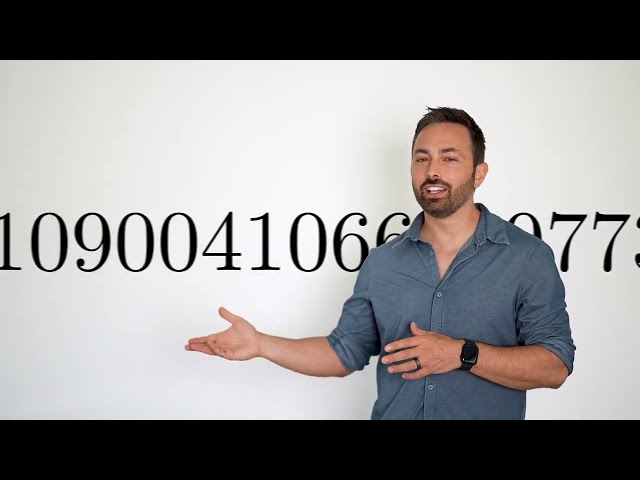
What happens if you just keep squaring?
Keywords
Summary
189 words
Critical Evaluation
Value of the Information & Strength of the Argument
The video provides a high-value introduction to a deep and abstract topic, making it accessible through clear examples and intuitive visualizations. The argumentation is solid, building from simple arithmetic to the construction of p-adic numbers and their applications. The collaboration with mathematician Alex Kontorovich ensures mathematical accuracy, and the use of concrete problems (like Diophantus’s squares) demonstrates the practical utility of p-adics. The explanation of the geometric series convergence in the p-adic context is particularly well-handled, addressing a common point of confusion.
Scientific Rigor, Source Quality, Title Accuracy
The video demonstrates high scientific rigor, with a clear and accurate presentation of mathematical concepts. The sources cited in the description include a standard textbook on p-adic numbers (Koblitz) and other educational videos, which are appropriate for the topic. The title is engaging and accurately reflects the content, as it leads to the discovery of p-adic numbers. The video does not overstate claims and provides a solid foundation for understanding the subject.
169 words
Title / Content Match
The title is intriguing and directly leads to the discovery of p-adic numbers, perfectly matching the video's content.
Quality & Reliability
9/10
High-quality exposition by a renowned science communicator, co-written with a mathematician (Alex Kontorovich), with references to standard literature (Koblitz) and clear explanations of advanced concepts. The content is mathematically sound and well-illustrated.
Key Moments
Markers derived by PSI from the transcript: the creator did not define chapters.
- Introduction: squaring numbers and discovering a pattern.
- Introduction to 10-adic numbers and their arithmetic.
- Finding 1/7 and 1/3 as 10-adic numbers.
- 10-adic representation of -1 and the problem of zero divisors.
- Introduction to p-adic numbers with a prime base.
- Diophantus's problem and the use of modular arithmetic.
- Solving the equation mod 3, 9, 27, and finding the p-adic solution.
- Interpreting the p-adic solution as -1/2 and verifying it.
- Visualizing p-adic numbers as a tree and understanding their geometry.
- The p-adic absolute value and its properties.
- Application to Fermat's Last Theorem and the 3-5 trick.
Cited Sources
- Koblitz, N. (2012). p-adic Numbers, p-adic Analysis, and Zeta-Functions — Reference for p-adic numbers.
- Amazing intro to p-adic numbers here — Additional resource on p-adic numbers.
- Excellent series on p-adic numbers — Additional resource on p-adic numbers.
Concurring Sources
- Koblitz, N. (2012). p-adic Numbers, p-adic Analysis, and Zeta-Functions — Standard reference supporting the mathematical content.
External References
Contribution & Novelties
The video provides a unique and accessible introduction to p-adic numbers, a topic rarely covered in popular science. It bridges the gap between abstract mathematics and intuitive understanding, using clear examples and visualizations. The collaboration with a mathematician ensures depth and accuracy, making it a valuable resource for both students and enthusiasts.
Pour aller plus loin :
- p-adic number — Wikipedia article providing a comprehensive overview.
- Hensel’s lemma — A key technique used in the video to find p-adic solutions.
- Fermat’s Last Theorem — The famous theorem whose proof uses p-adic numbers.
92 words
Radar Profile
The radar profile shows high scores in information quality and quantity, reflecting the video's depth and clarity. The technical level is also high, but the fiabilité is slightly lower due to the inherent complexity of the topic and the need for simplification. Overall, the video excels in delivering accurate and engaging scientific content.
💬 Très positif. Sur les 30 commentaires analysés, la grande majorité exprime une admiration pour la qualité pédagogique et la clarté de l'explication, avec de nombreux témoignages de compréhension enfin acquise sur les nombres p-adiques.