The Fastest Maze-Solving Competition On Earth
Keywords
Summary
167 words
Critical Evaluation
Value of the Information & Strength of the Argument
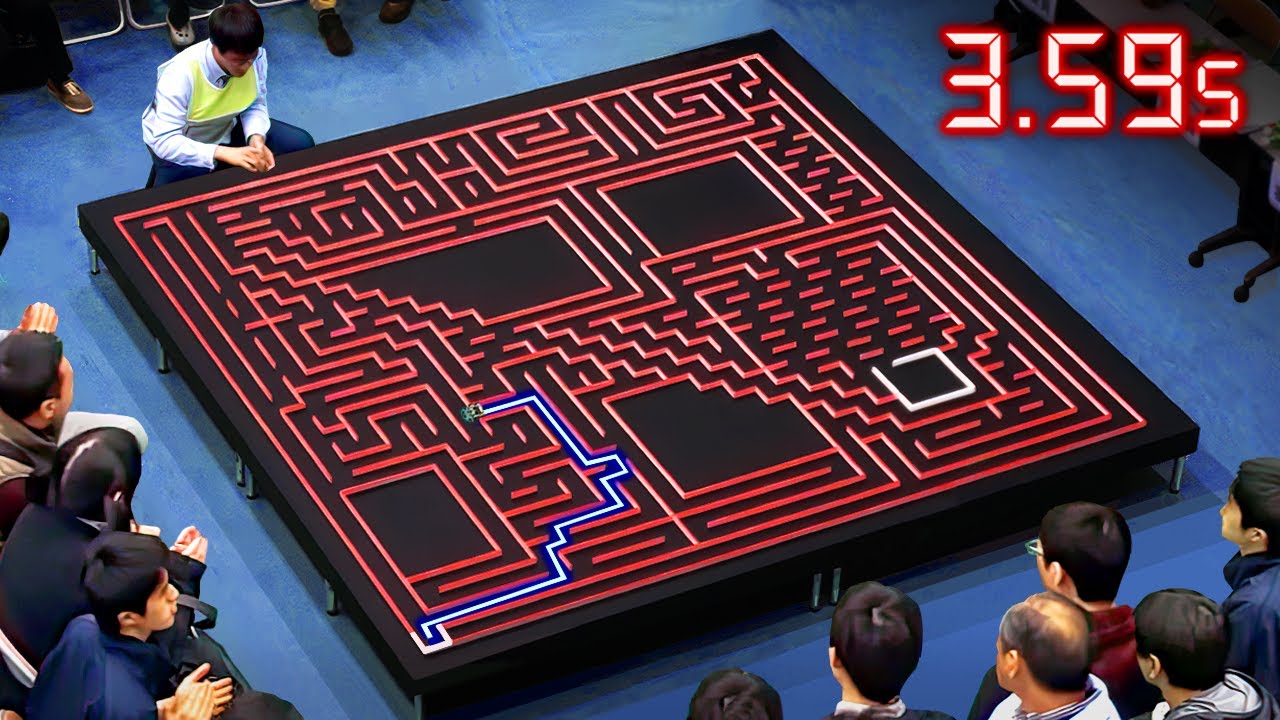
The video provides substantial value by clearly explaining complex engineering and algorithmic concepts in an accessible manner. The argumentation is solid, using a historical narrative to show the progression of ideas and challenges. It effectively demonstrates that the ‘problem’ of Micromouse is not solved, but has evolved into a multi-disciplinary optimization challenge. The use of specific examples, like the 2017 winner ‘Red Comet’ choosing a longer but faster path, powerfully illustrates the core principle that speed is not solely about distance. The explanations of physics (centripetal force, friction) and algorithms (flood fill) are rigorous and well-integrated into the story, making a compelling case for the ingenuity of the competitors.
Scientific Rigor, Source Quality, Title Accuracy
The video demonstrates high scientific rigor by citing a wide range of sources, including historical IEEE Spectrum articles, academic papers, and competition archives, all listed in the description. The historical account of the competition’s origins and the technical explanations are well-supported by these references. The title is perfectly adequate, as the video’s primary focus is on the competition and the engineering that makes it possible. The content is presented with a clear narrative that is both informative and engaging, without sacrificing accuracy. The inclusion of expert interviews and footage from actual competitions further strengthens the video’s credibility.
221 words
Title / Content Match
The title accurately reflects the content, which focuses on the Micromouse competition and the engineering innovations that make these robots the fastest maze-solvers.
Quality & Reliability
9/10
High-quality production with clear explanations of algorithms and physics. The video cites numerous historical and technical sources, including IEEE papers and competition archives. The information is presented accurately and is well-supported by the cited references.
Key Moments
Markers derived by PSI from the transcript: the creator did not define chapters.
- Introduction to the Micromouse competition and the goal of the race.
- History of the competition, starting with Claude Shannon's 'Theseus' mouse and the first IEEE contest.
- Explanation of maze-solving algorithms: wall-following, depth-first search, and breadth-first search.
- Detailed explanation of the flood fill algorithm, the most popular strategy for Micromice.
- Introduction of the concept that the fastest path is not always the shortest, using the example of the 2017 winner 'Red Comet'.
- Discussion of the first major innovation: cutting diagonals, which required new algorithms and chassis designs.
- Explanation of the physics of turning, including centripetal force and friction, and how they limit speed.
- Introduction of the second major innovation: using vacuum fans to increase downforce and traction, allowing for faster cornering.
- Discussion of the future of Micromouse, including potential innovations like computer vision and omnidirectional movement.
Cited Sources
- Onshape — Sponsor of the video, mentioned as a tool for designing Micromouse parts.
- Micromouse Online — A resource for Micromouse enthusiasts, mentioned as a help for the creators.
- UK Micromouse and Robotics Society — A society for Micromouse and robotics, mentioned as a help for the creators.
- Allan, R. (1979). The amazing micromice: See how they won — IEEE Spectrum article about the early Micromouse competition.
- Braunl, T. (1999). Research relevance of mobile robot competitions — IEEE Robotics & Automation Magazine article on the research value of robot competitions.
- Christiansen, D. (1977). Spectral lines: Announcing the Amazing Micro-Mouse Maze Contest — IEEE Spectrum article announcing the first Micromouse contest.
- Christiansen, D. (2014). The Amazing MicroMouse Roars On — IEEE Spectrum article reflecting on the history and continued relevance of Micromouse.
- Claude Shannon Demonstrates Machine Learning — AT&T Tech Channel Archive video of Claude Shannon's 'Theseus' mouse.
- The Fosbury Flop—A Game-Changing Technique — Smithsonian Magazine article about the Fosbury flop, used as an analogy for innovation.
- Gold medal winning heights in the Men's and Women's high jump — Statistica data on high jump records, used to illustrate the plateau before the Fosbury flop.
- IEEE. (2018). Micromouse Competition Rules — Official rules for the Micromouse competition.
- All Japan Micromouse 2017 — Video of the 2017 All Japan Micromouse competition, featuring the winning mouse 'Red Comet'.
- Winning record of the national competition micromouse — Record of finish times in Japanese Micromouse competitions.
- History, Micromouse Online Blog — A blog post detailing the history of Micromouse.
- The first World Micromouse Contest in Tsubuka, Japan — Video of the first World Micromouse Contest in 1985.
- Micromouse Turn List — A reference for the various turns a Micromouse can perform.
- Vacuum Micromouse — Hackaday article about a Micromouse using a vacuum fan.
- Mighty mouse — MIT News Magazine article about a Micromouse.
- Classic Micromouse, Excel 9a. Demonstrate fan suction — Video demonstrating a Micromouse with a fan for suction.
- 1986 - MicroMouse history, competition & how it got started in the USA — Archival video about the early history of Micromouse in the USA.
- Green Ye via YouTube — Video of a Micromouse run, likely showing a specific technique.
Concurring Sources
- IEEE. (2018). Micromouse Competition Rules — The official rules confirm the constraints and objectives described in the video.
- Allan, R. (1979). The amazing micromice: See how they won — This historical article supports the video's account of the early competition and its challenges.
- Braunl, T. (1999). Research relevance of mobile robot competitions — This paper supports the video's claim that Micromouse has ongoing research relevance in robotics.
External References
Contribution & Novelties
The video offers a comprehensive and engaging overview of the Micromouse competition, effectively bridging the gap between historical context and modern engineering challenges. Its main contribution is in clearly explaining the evolution of problem-solving strategies, from simple algorithms to the complex interplay of software and hardware that defines modern robotics. It highlights that the ‘fastest path’ is a multi-variable optimization problem, not just a shortest-path one, and showcases how physical innovations like vacuum fans have pushed the boundaries of what’s possible.
Pour aller plus loin :
- Flood fill algorithm — The core algorithm used by most Micromice, explained in detail.
- Centripetal force — The physics principle behind cornering, crucial for understanding speed limits.
- Fosbury flop — The historical analogy used in the video to illustrate paradigm-shifting innovation.
- Claude Shannon — The mathematician who built ‘Theseus’, the first electronic maze-solving mouse.
140 words
Radar Profile
The radar profile shows a well-rounded video with high scores across all dimensions. The 'quantite_information' and 'qualite_information' are both very high, reflecting the depth and accuracy of the content. The 'niveau_technique' is also high, indicating that the video successfully explains complex concepts. The 'fiabilite_globale' is excellent, supported by a strong list of references.
💬 Très positif. Sur les 30 commentaires analysés, le public exprime une admiration massive pour l'ingéniosité technique et la qualité des animations, avec de nombreux témoignages personnels sur l'inspiration et l'émotion suscitées par la compétition.