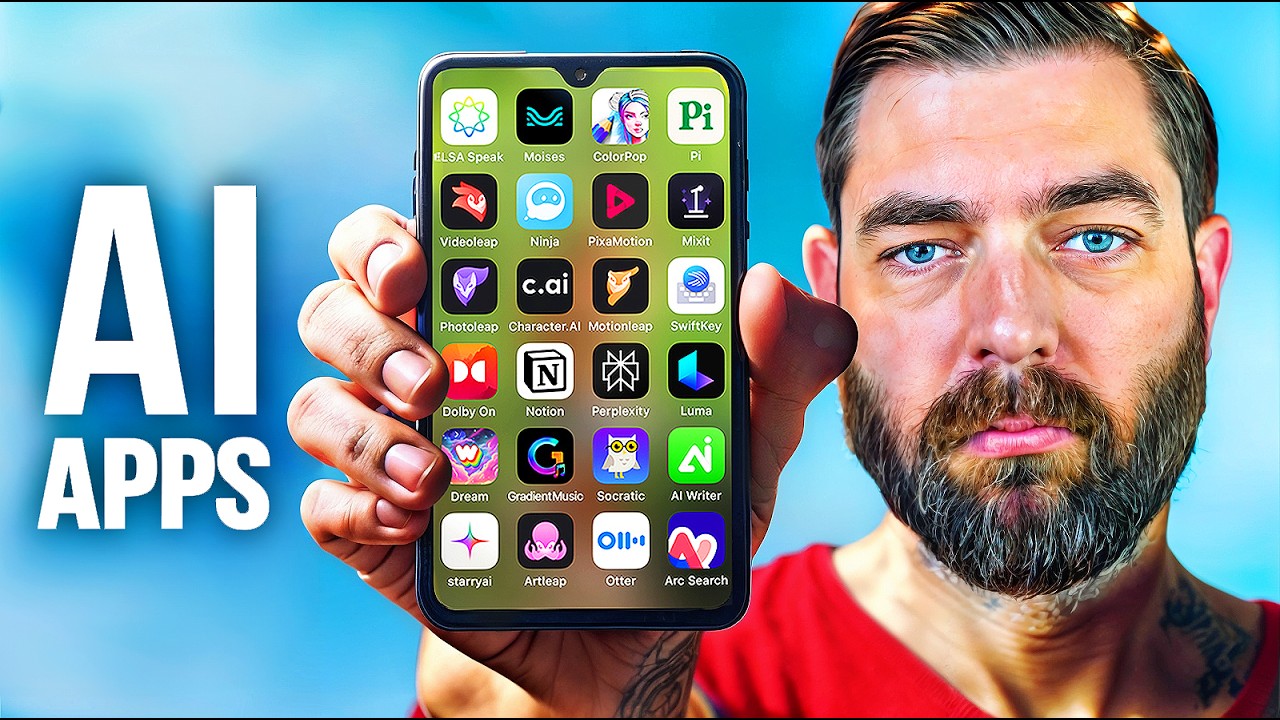
21 Mobile AI Apps You Won't Believe Are Free
Keywords
Summary
164 words
Critical Evaluation
Value of the Information & Strength of the Argument
The video provides substantial value by curating a list of 21 free AI apps, saving viewers time and effort in discovering them. Each app is demonstrated with real-world examples, showing exactly how it works and what it can do. The argumentation is solid, as the creator claims to have tested the apps with his team, and the demonstrations support his claims. However, the analysis is largely subjective, focusing on personal impressions rather than objective metrics or comparisons. The video does not delve into potential limitations, privacy concerns, or the accuracy of AI outputs, which would have strengthened the critical evaluation. Overall, the information is useful and actionable, but the argumentation could be more rigorous.
Scientific Rigor, Source Quality, Title Accuracy
The video demonstrates a reasonable level of scientific rigor for a consumer tech review. The creator provides direct links to each app in the description, which serves as a reliable source for viewers to access the apps. The demonstrations are clear and appear to be genuine, with no obvious editing tricks. However, the video does not cite any external studies or expert opinions to support claims about the apps’ effectiveness. The title accurately reflects the content, and the video stays on topic throughout. The inclusion of a sponsorship segment is transparent, and it does not detract from the overall quality. The creator’s personal experience is the primary source, which is appropriate for this type of content, but it limits the generalizability of the findings.
253 words
Title / Content Match
The title accurately reflects the content: the video presents 21 free AI mobile apps, and the demonstrations confirm their functionality and free tier availability.
Quality & Reliability
7/10
The video provides a practical, hands-on review of 21 free AI mobile apps, with clear demonstrations and personal testing. The information is accurate and up-to-date as of early 2024, but it is based on the creator's subjective experience and does not include independent verification or comparative benchmarks. The sources are primarily app store links, which are reliable for identifying the apps but do not provide in-depth technical analysis.
Chapters
Cited Sources
- ChatGPT on the App Store — Official app store link for ChatGPT, the first app reviewed.
- Pi on the App Store — Official app store link for Pi, the AI chatbot from Inflection AI.
- Perplexity on the App Store — Official app store link for Perplexity, the AI search engine.
- Character.ai on the App Store — Official app store link for Character.ai, the AI character chat app.
- Socratic on the App Store — Official app store link for Socratic, the Google homework helper.
- AI Writer on the App Store — Official app store link for AI Writer, a text generation tool.
- SwiftKey on the App Store — Official app store link for Microsoft SwiftKey keyboard with AI features.
- ELSA Speak on the App Store — Official app store link for ELSA Speak, an English pronunciation app.
- Otter on the App Store — Official app store link for Otter, a meeting transcription app.
- Dream by Wombo on the App Store — Official app store link for Dream, an AI art generator.
- StarryAI on the App Store — Official app store link for StarryAI, an AI art generator.
- Photoleap on the App Store — Official app store link for Photoleap, an AI photo editor.
- VideoLeap on the App Store — Official app store link for VideoLeap, an AI video editor.
- MotionLeap on the App Store — Official app store link for MotionLeap, an app to animate still images.
- PixaMotion on the App Store — Official app store link for PixaMotion, an alternative animation app.
- Colorpop on the App Store — Official app store link for Colorpop, an AI coloring book app.
- Dolby On on the App Store — Official app store link for Dolby On, an audio recording app.
- Gradient Music on the App Store — Official app store link for Gradient Music, an AI music creation app.
- Luma on the App Store — Official app store link for Luma, a 3D capture app.
- Arc Search on the App Store — Official app store link for Arc Search, an AI-powered browser.
- MyMind on the App Store — Official app store link for MyMind, a note-taking app with AI organization.
Concurring Sources
- ChatGPT on the App Store — The app is available for free, confirming the video's claim.
- Perplexity on the App Store — The app is available for free, confirming the video's claim.
- Otter on the App Store — The app is available for free, confirming the video's claim.
External References
Contribution & Novelties
The video provides a curated, up-to-date list of free AI mobile apps, which is valuable for users looking to explore the AI ecosystem on their phones. It highlights both well-known apps like ChatGPT and niche tools like Pi and MotionLeap, offering a broad overview. The demonstrations are practical and show real-world use cases, making the information accessible. However, the video does not introduce new research or original insights; it is a compilation of existing tools. Its novelty lies in the selection and presentation, which can help users discover apps they might not have found otherwise.
Pour aller plus loin :
- Stable Diffusion — The underlying model for many AI art apps mentioned.
- Large language model — The technology behind chatbots like ChatGPT and Pi.
- Latent consistency model — A technique for real-time image generation, as used in StarryAI’s Magic Canvas.
140 words
Radar Profile
The radar profile shows high scores in quantity of information and global reliability, reflecting the video's comprehensive coverage and trustworthy app links. The technical level is moderate, as the content is accessible to a general audience. The quality of information is good, but the subjective nature of the review prevents a perfect score.
💬 Très positif. Sur les 30 commentaires analysés, la grande majorité exprime de la gratitude et de l'enthousiasme pour la sélection d'applications, avec plusieurs téléchargements effectués et des retours positifs sur l'utilité des outils présentés.