GG Sex Genetics Part 3
Keywords
Summary
215 words
Critical Evaluation
Value of the Information & Strength of the Argument
The lecture provides a clear and thorough explanation of sex-linked inheritance, using the classic Drosophila example to illustrate the concept. The argumentation is solid, building from the observed phenotypes to the underlying genetic mechanism. The instructor effectively uses Punnett squares to demonstrate the outcomes of reciprocal crosses, making the logic transparent. The value lies in its pedagogical approach, connecting the historical experiment to the principles of inheritance, and highlighting the key signatures of sex linkage, such as the crisscross pattern and the difference in reciprocal crosses.
Scientific Rigor, Source Quality, Title Accuracy
The scientific rigor is high for an educational lecture, as it accurately presents the principles of sex-linked inheritance and the historical context of Morgan’s work. The content is based on well-established genetic knowledge. However, the lecture does not cite specific sources or references, relying on general knowledge. The title ‘Sex Genetics Part 3’ is appropriate and accurately reflects the content, which is a continuation of a series on sex-related inheritance. The lecture is well-structured and the explanations are precise, though it is not a formal academic presentation.
188 words
Title / Content Match
The title 'Sex Genetics Part 3' accurately reflects the content, which is the third part of a series on sex-related modes of inheritance, focusing on sex linkage.
Quality & Reliability
8/10
The content is a well-structured educational lecture on sex-linked inheritance, based on established genetic principles and the classic experiments of Thomas Hunt Morgan. The explanations are accurate and pedagogically sound, though the video is an informal lecture without formal citations or peer review.
Key Moments
Markers derived by PSI from the transcript: the creator did not define chapters.
- Introduction to the lecture, reviewing previous modes of inheritance (sex-limited, sex-influenced) and sex determination models.
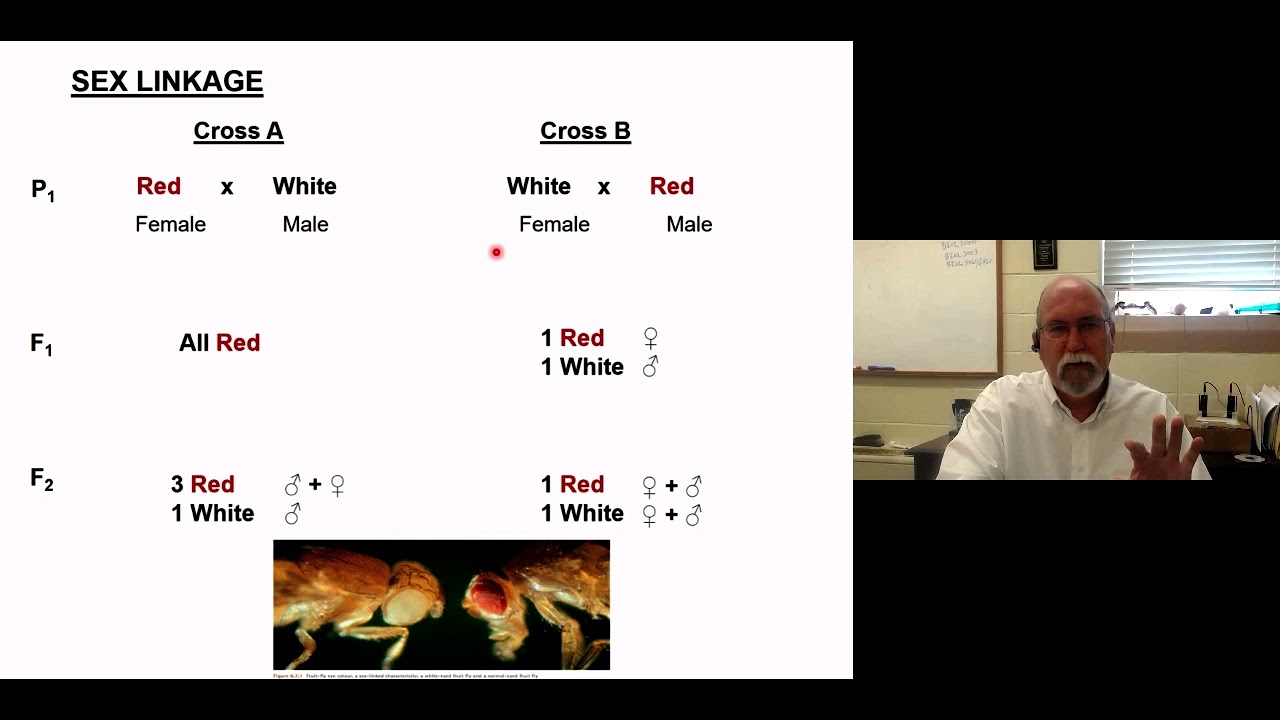
- Definition of sex linkage and its key signature: reciprocal crosses yield different results.
- Historical background: Thomas Hunt Morgan's discovery of a white-eyed male Drosophila mutant.
- Explanation of the first cross (red-eyed female x white-eyed male) and the F2 results showing a 3:1 ratio with only white-eyed males.
- The reciprocal cross (white-eyed female x red-eyed male) producing a 1:1 ratio in F1 with red females and white males, demonstrating crisscross inheritance.
- Genetic explanation: males are hemizygous for X-linked genes, leading to expression of the single allele.
- Punnett square analysis of the first cross, showing the 3:1 ratio and the absence of white-eyed females.
- Punnett square analysis of the reciprocal cross, showing the 1:1 ratio and the crisscross pattern.
- Conclusion and introduction to a problem-solving example, emphasizing the importance of recognizing reciprocal cross differences.
Contribution & Novelties
This lecture provides a clear and accessible explanation of sex-linked inheritance, using the classic Drosophila example to illustrate the concept. It emphasizes the key signatures of sex linkage, such as the difference in reciprocal crosses and the crisscross pattern, which are essential for solving genetics problems. The lecture also highlights the historical context of Morgan’s experiments, making the content engaging and informative.
Pour aller plus loin :
- Sex linkage — Wikipedia article providing an overview of sex-linked inheritance.
- Thomas Hunt Morgan — Biography of the scientist who discovered sex-linked inheritance.
- Drosophila melanogaster — Information on the fruit fly species used in genetic research.
103 words
Radar Profile
The radar profile shows high scores in information quantity, quality, and technical level, indicating a comprehensive and accurate educational content. The reliability is also high, reflecting the established nature of the genetic principles discussed.