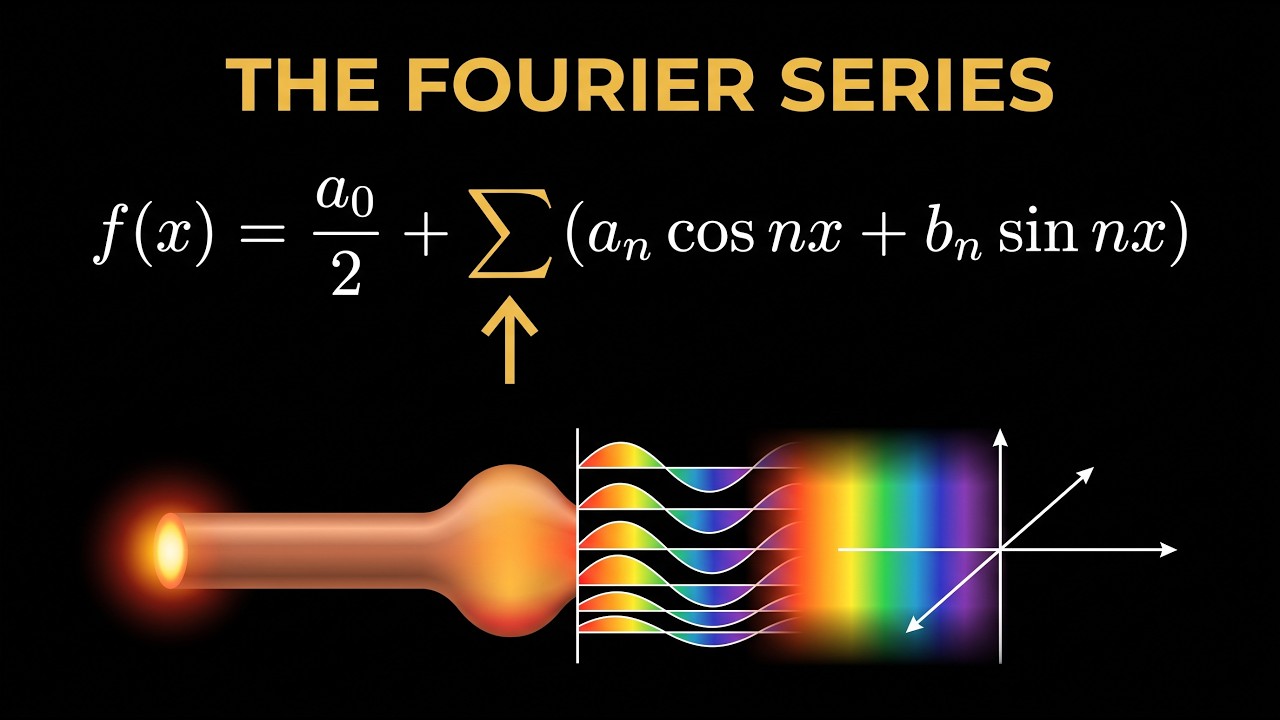
From Heat to Hilbert Space: The Complete Story of Fourier
Keywords
Summary
153 words
Critical Evaluation
Value of the Information & Strength of the Argument
The video excels in building intuition from the physical problem, making abstract concepts accessible. The argumentation is solid, logically progressing from the heat equation to the concept of functions as vectors. The explanation of orthogonality and the coefficient extraction is particularly clear, using geometric intuition. The historical narrative is well-integrated, showing how the mathematics developed in response to real challenges and controversies.
Scientific Rigor, Source Quality, Title Accuracy
The video demonstrates high scientific rigor, correctly attributing the Gibbs phenomenon to Wilbraham and Gibbs, and noting the contributions of Dirichlet, Bôcher, Riesz, Fischer, and von Neumann. The description provides direct links to primary sources (Fourier’s 1822 book, Dirichlet’s 1829 paper, Wilbraham’s 1848 paper, Gibbs’s collected papers, Bôcher’s 1906 book, von Neumann’s 1929 paper) and reputable open courses (MIT OCW). The title accurately reflects the content, which traces the journey from the heat equation to Hilbert spaces.
154 words
Title / Content Match
The title accurately reflects the content, which traces the development from the heat equation to Hilbert spaces.
Quality & Reliability
9/10
The video is historically accurate, correctly attributes discoveries (Wilbraham, Gibbs, Bôcher, Dirichlet, Riesz-Fischer, von Neumann), and provides direct links to primary sources and open courses. The mathematical derivations are sound and clearly explained.
Chapters
Cited Sources
- Joseph Fourier, Theorie analytique de la chaleur (1822) — Original source for Fourier's heat equation and series.
- P. G. Lejeune Dirichlet, Sur la convergence des series trigonometriques (1829) — First rigorous proof of convergence of Fourier series.
- Henry Wilbraham, On a Certain Periodic Function (1848) — First to describe the overshoot phenomenon, later named the Gibbs phenomenon.
- J. Willard Gibbs, Fourier's Series (1898-1899) — Gibbs's notes on the overshoot, which led to the naming of the phenomenon.
- Maxime Bocher, Introduction to the Theory of Fourier's Series (1906) — Proper analysis of the Gibbs phenomenon and attribution to Gibbs.
- John von Neumann, Allgemeine Eigenwerttheorie Hermitescher Funktionaloperatoren (1929/1930) — Foundational paper on the abstract theory of Hilbert spaces.
- MIT OpenCourseWare, Topics in Fourier Analysis — Open course covering Fourier series and the Gibbs phenomenon.
- MIT OpenCourseWare, Basic Hilbert Space Theory — Open course lecture on Hilbert space theory.
- Encyclopedia of Mathematics, Riesz-Fischer theorem — Reference for the Riesz-Fischer theorem on completeness of L2 spaces.
Concurring Sources
- Fourier series - Wikipedia — General reference confirming the mathematical content.
- Hilbert space - Wikipedia — General reference confirming the mathematical content.
Contribution & Novelties
The video’s original contribution lies in its pedagogical approach, building the mathematics of Fourier analysis from the physical intuition of heat diffusion, and clearly connecting it to the abstract concept of Hilbert space. It effectively demystifies the ‘functions as vectors’ idea and explains why sine waves are the natural basis for the heat operator.
Pour aller plus loin :
- Fourier series — Wikipedia article providing a comprehensive overview.
- Hilbert space — Wikipedia article on the mathematical concept.
- Heat equation — Wikipedia article on the partial differential equation.
- Gibbs phenomenon — Wikipedia article on the overshoot effect.
- Riesz–Fischer theorem — Wikipedia article on the completeness of L2 spaces.
107 words
Radar Profile
The radar profile shows very high scores in information quantity, quality, and reliability, with a slightly lower but still strong score in technical level. This indicates a video that is both informative and trustworthy, while remaining accessible to a broad audience.