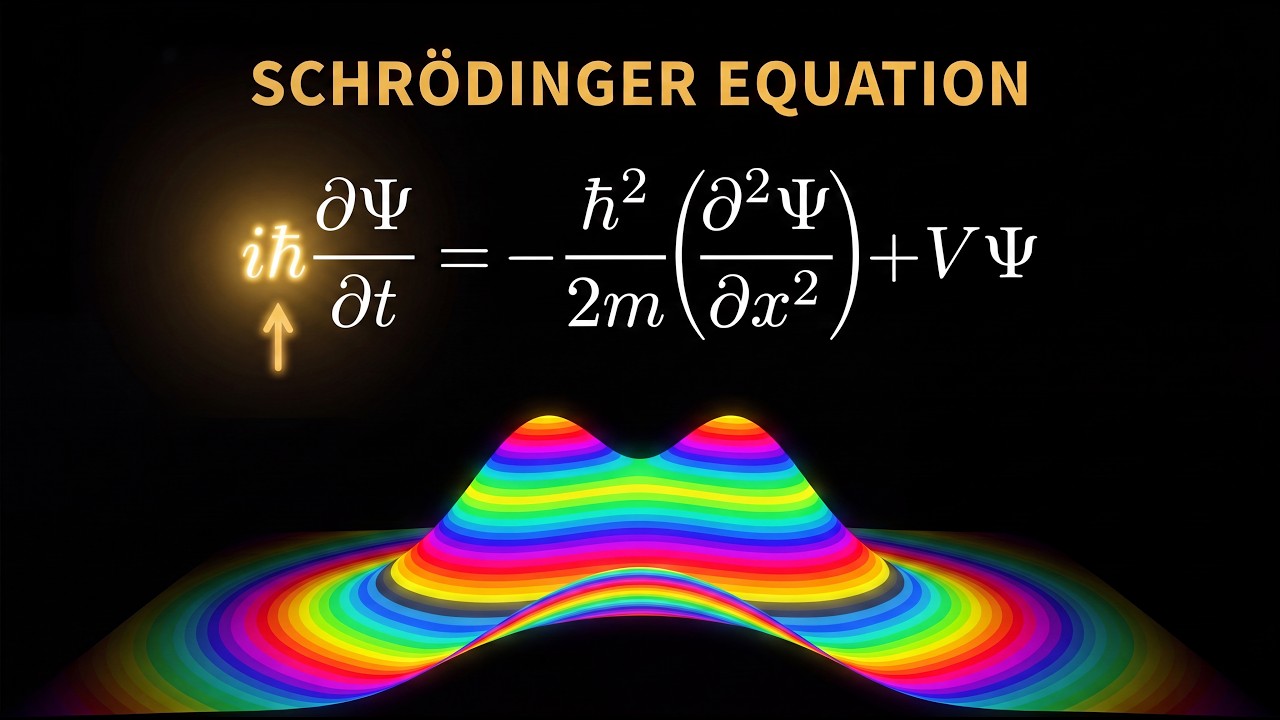
Nobody Explained the Schrödinger Equation Like THIS!
Keywords
Summary
177 words
Critical Evaluation
Value of the Information & Strength of the Argument
The video excels in providing a clear and intuitive explanation of a complex topic. It builds a strong argument by starting with a familiar concept (guitar string harmonics) and systematically extending it to explain the quantization of energy, the shapes of atomic orbitals, and the structure of the periodic table. The historical narrative adds depth and context, making the scientific concepts more relatable. The argumentation is solid, logically progressing from de Broglie’s wave hypothesis to Schrödinger’s equation and its interpretations. The presenter effectively uses analogies and visualizations to convey abstract ideas, and the discussion of quantum tunneling and superposition is both accurate and engaging. The video successfully demonstrates the explanatory power of the Schrödinger equation while honestly acknowledging the unresolved interpretational issues.
Scientific Rigor, Source Quality, Title Accuracy
The video demonstrates a high level of scientific rigor. It accurately presents the historical development of quantum mechanics, correctly attributing key contributions to de Broglie, Schrödinger, and Born. The sources cited in the description are primary literature, including de Broglie’s thesis, Schrödinger’s 1926 papers, Born’s 1926 paper, and Gamow’s 1928 paper on tunneling. These are appropriate and authoritative references. The title is well-matched to the content, as the video indeed provides a unique and accessible explanation of the Schrödinger equation. The content is presented in a way that is both engaging and scientifically sound, with no significant inaccuracies. The video also correctly notes the ongoing debate about the interpretation of quantum mechanics, which is a sign of intellectual honesty.
256 words
Title / Content Match
The title accurately reflects the content: the video provides a clear, accessible explanation of the Schrödinger equation, its meaning, and its implications.
Quality & Reliability
8/10
The video presents a historically and scientifically accurate account of the Schrödinger equation, its origins, and its interpretations, supported by references to primary literature. The pedagogical approach is sound, though some simplifications (e.g., the guitar string analogy) may omit nuances. The presenter clearly distinguishes established physics from open questions.
Key Moments
Markers derived by PSI from the transcript: the creator did not define chapters.
- Introduction: The presenter admits the equation's intimidating reputation and promises a simple explanation.
- Historical context: The crisis of Bohr's model and the introduction of de Broglie's wave hypothesis.
- The guitar string analogy: Explaining standing waves and quantization.
- The Schrödinger equation is presented as 'F=ma for waves'.
- Max Born's probabilistic interpretation of the wave function.
- Three-dimensional standing waves: Explaining the shapes of atomic orbitals (s, p, d, f).
- The periodic table emerges from the filling of these orbital shapes.
- Quantum tunneling: Explaining the sun's energy and the scanning tunneling microscope.
- Superposition and Schrödinger's cat: The unresolved measurement problem.
Cited Sources
- Get a free ebook — Promotional link for a free ebook related to the video's content.
- Previous video — Link to a previous video by the same channel, likely on a related topic.
- Previous video — Link to another previous video by the same channel.
Concurring Sources
- Louis de Broglie, *Recherches sur la théorie des quanta* (1924) — Original thesis proposing the wave nature of electrons.
- Erwin Schrödinger, *Quantisierung als Eigenwertproblem*, *Annalen der Physik* (1926) — Original paper presenting the Schrödinger equation.
- Max Born, *Zur Quantenmechanik der Stoßvorgänge*, *Zeitschrift für Physik* (1926) — Original paper introducing the probabilistic interpretation.
- George Gamow, “The Quantum Theory of Nuclear Disintegration,” *Nature* (1928) — Original paper explaining alpha decay via quantum tunneling.
Contribution & Novelties
The video’s original contribution lies in its pedagogical approach, using the guitar string analogy to provide an intuitive and memorable explanation of the Schrödinger equation and its consequences. It effectively bridges the gap between mathematical formalism and physical intuition, making the subject accessible to a broad audience. The historical narrative, including the anecdote about Schrödinger’s personal life, adds a human dimension that is often missing from standard treatments.
Pour aller plus loin :
- Quantum mechanics — A comprehensive overview of the field.
- Schrödinger equation — Detailed mathematical and historical background.
- Wave function — Explains the concept of the wave function and its interpretations.
- Quantum tunnelling — Further details on the phenomenon of tunneling.
- Schrödinger’s cat — The thought experiment and its implications.
122 words
Radar Profile
The radar profile shows high scores in information quantity and quality, reflecting the video's comprehensive and accurate content. The technical level is moderate, indicating it is accessible to a general audience while still covering advanced concepts. The overall reliability is high, supported by the use of primary sources and a rigorous presentation.
💬 Très positif. Sur les 30 commentaires analysés, les spectateurs expriment une admiration unanime pour la clarté et la pédagogie de la vidéo, soulignant qu'elle a permis une compréhension nouvelle et intuitive de l'équation de Schrödinger, même pour des scientifiques expérimentés.