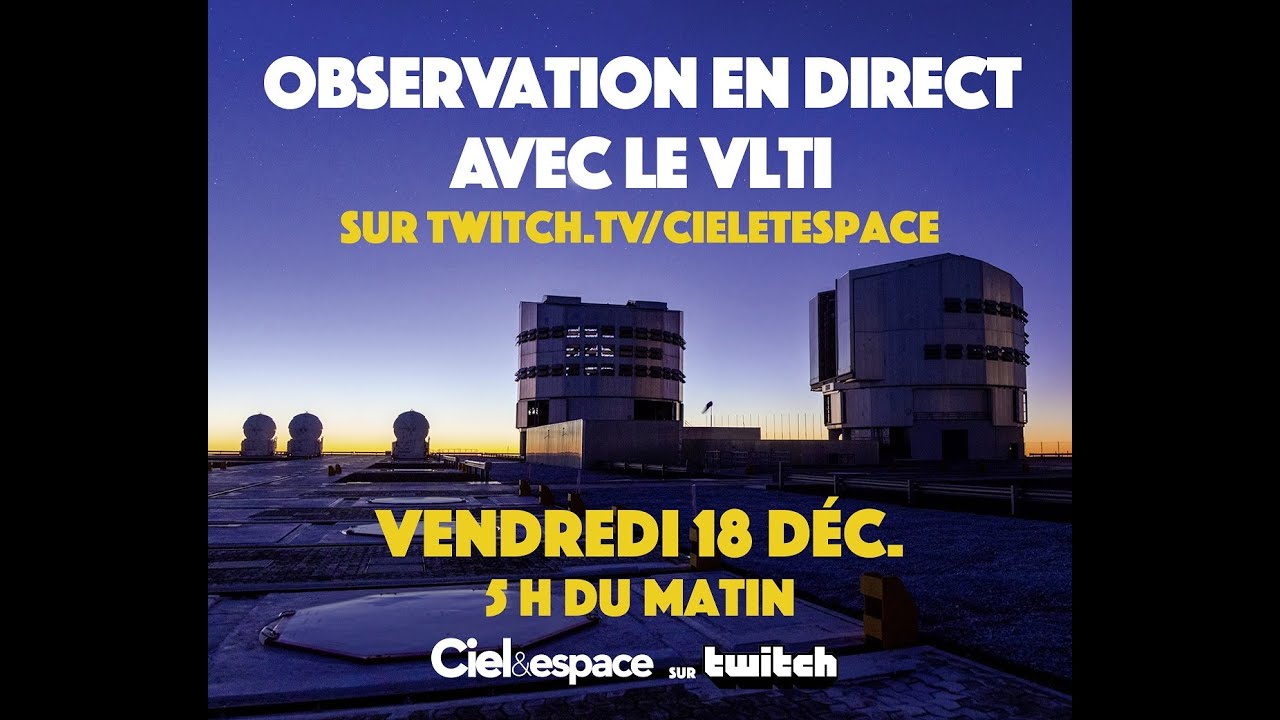
Une observation de Bételgeuse en direct avec le VLTI
Keywords
Summary
179 words
Critical Evaluation
Value of the Information & Strength of the Argument
The video provides unique, real-time insight into the practical aspects of astronomical interferometry, a complex technique rarely shown in such detail. The astrophysicists explain the scientific goals (studying Betelgeuse’s diameter and surface features) and the technical challenges (aligning telescopes, compensating for path differences, calibrating the instrument). Their argumentation is solid, based on direct experience and real data, making the content highly valuable for understanding how modern astronomy is conducted.
Scientific Rigor, Source Quality, Title Accuracy
The scientific rigor is high: the information comes from professional researchers actively using the instrument. They reference historical milestones (Michelson’s 1920 observation) and current projects (e.g., extending the delay lines). The title accurately reflects the content, which is a live observation session. The video does not cite external sources, but the expertise of the speakers and the live data provide strong credibility.
146 words
Title / Content Match
The title accurately describes the content: a live observation of Betelgeuse using the VLTI, with real-time footage and expert commentary.
Quality & Reliability
8/10
The video is a live observation session with professional astrophysicists from the Lagrange Laboratory, showing real-time data and detailed technical explanations. The information is reliable and grounded in direct practice, though not peer-reviewed.
Key Moments
Markers derived by PSI from the transcript: the creator did not define chapters.
- Introduction: context of the observation and the team from Lagrange Laboratory.
- Explanation of the VLTI and MATISSE instrument, including the two cameras (3 and 10 microns).
- Historical background: Michelson's 1920 measurement of Betelgeuse's diameter.
- Technical details on interferometry: combining beams, delay lines, and fringe contrast.
- Live pointing of telescopes and acquisition of Betelgeuse's light.
- Real-time data display: fringes appear on screen, indicating successful observation.
- Discussion of the scientific goals: comparing observations from 2018, 2019, and 2020.
- Challenges of restarting the instrument after the pandemic shutdown.
- Future plans: extending delay lines to allow longer baselines.
Cited Sources
- MATISSE instrument page (ESO) — The instrument used for the observation, mentioned in the video.
- VLTI page (ESO) — The interferometer facility used, mentioned in the video.
Concurring Sources
- ESO press release on MATISSE — Describes the MATISSE instrument and its capabilities, consistent with the video.
Contribution & Novelties
The video offers a rare, behind-the-scenes look at a live interferometric observation, providing educational value by demystifying the process. It highlights the operational challenges and the scientific context of studying Betelgeuse.
Pour aller plus loin :
- Interferometry (Wikipedia) — Overview of the technique.
- Very Large Telescope (Wikipedia) — Details on the facility.
- Betelgeuse (Wikipedia) — Information on the star.
59 words
Radar Profile
The radar profile shows high scores in information quantity, quality, and technical level, with a slightly lower but still strong reliability score. This indicates a content-rich, technically detailed, and trustworthy video, though not a formal scientific publication.
💬 Sur les 0 commentaires analysés, aucune tendance n'est disponible.