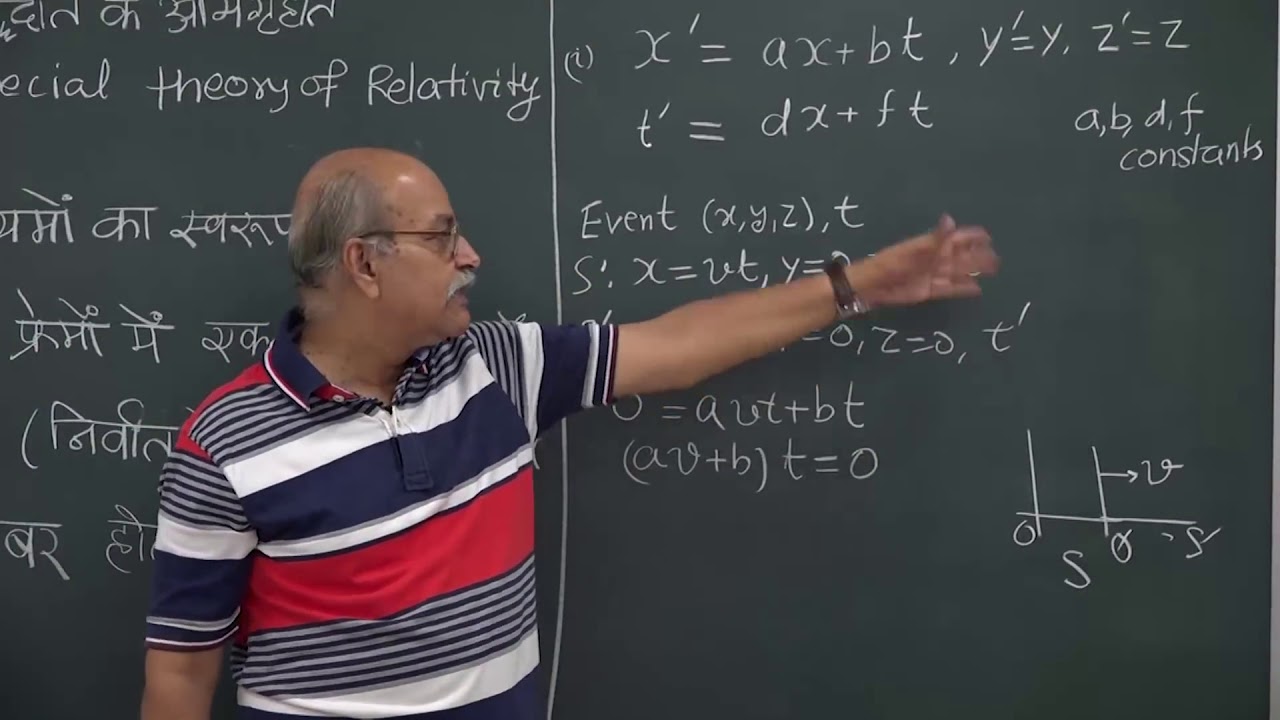
W2-03 Lorentz Transformation
Keywords
Summary
176 words
Critical Evaluation
Value of the Information & Strength of the Argument
The lecture provides a clear, step-by-step derivation of the Lorentz transformation, which is the core of special relativity. The argumentation is logical and builds on the two postulates, using thought experiments with light pulses to derive the equations. The value lies in its pedagogical approach, making the derivation accessible to students. However, the presentation is informal and lacks rigorous mathematical notation, which might be a drawback for advanced learners. The reasoning is sound, but the lack of formal proofs and references to standard literature reduces its scholarly depth.
Scientific Rigor, Source Quality, Title Accuracy
The lecture is a self-contained derivation and does not cite external sources. The title accurately reflects the content. The scientific rigor is acceptable for an introductory lecture, but the lack of references and the informal style may not meet the standards of a formal academic presentation. The derivation follows standard textbook methods, but the absence of citations means the viewer cannot easily verify the content against authoritative sources.
171 words
Title / Content Match
The title accurately reflects the content, which is a lecture on the Lorentz transformation.
Quality & Reliability
7/10
The derivation is mathematically sound and follows standard textbook methodology, but the presentation is informal and lacks rigorous referencing to external sources.
Key Moments
Markers derived by PSI from the transcript: the creator did not define chapters.
- Introduction to the need for a new transformation
- Setting up the frames S and S' and assumptions
- Writing general linear transformation equations
- Using the event at the origin of S' to find relation between coefficients
- First light event on the x-axis and deriving equation 1
- Second light event on the negative x-axis and deriving equation 2
- Third light event on the y-axis and deriving equation 3
- Solving the equations to find the Lorentz factor
- Final form of the Lorentz transformation equations
- Conclusion and summary
Contribution & Novelties
The lecture provides a clear and systematic derivation of the Lorentz transformation, which is a fundamental concept in special relativity. It is particularly useful for students who want to understand the mathematical basis of the transformation without relying on memorization. The step-by-step approach, using light events to derive the equations, is a common pedagogical technique but is presented here in a straightforward manner.
Pour aller plus loin :
- Lorentz transformation - Wikipedia — Provides a comprehensive overview and historical context.
- Special relativity - Wikipedia — Covers the postulates and consequences of special relativity.
- Galilean transformation - Wikipedia — Explains the classical transformation that Lorentz transformation replaces.
106 words
Radar Profile
The radar profile shows high scores in information quantity, technical level, and reliability, indicating a solid educational content. The quality of information is also good, but the lack of external references slightly lowers the overall reliability score.