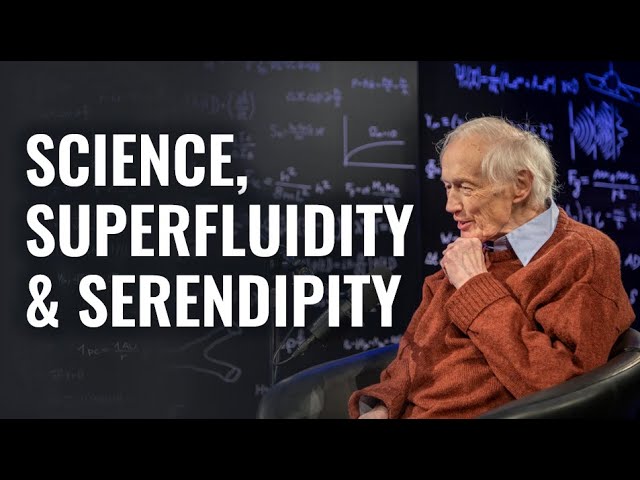
Sir Anthony Leggett on science, superfluidity, and serendipity
Keywords
Summary
130 words
Critical Evaluation
Value of the Information & Strength of the Argument
The value of the information is high, coming from a leading expert in the field. Leggett provides clear explanations of complex concepts like Cooper pairs and the distinction between conventional and high-temperature superconductors. His arguments are well-structured, using analogies to make abstract ideas accessible. However, the discussion is largely qualitative and lacks detailed technical depth, which may limit its value for specialists. The argumentation is solid, but it is based on personal experience and established knowledge rather than presenting new evidence or data.
Scientific Rigor, Source Quality, Title Accuracy
The scientific rigor is high due to Leggett’s authority and the institutional backing of the Perimeter Institute. However, the video does not cite specific sources or references, relying instead on the speaker’s expertise. The title accurately reflects the content, which is a reflective interview rather than a formal lecture. The description provides links to the podcast and institute, but these are not direct citations to scientific literature. Overall, the content is reliable but not formally sourced.
174 words
Title / Content Match
The title accurately reflects the content, which is a reflective interview covering Leggett's scientific work and personal experiences.
Quality & Reliability
8/10
High reliability due to the speaker's Nobel Prize credentials and the institutional setting, but the content is largely anecdotal and lacks formal citations.
Key Moments
Markers derived by PSI from the transcript: the creator did not define chapters.
- Leggett discusses his return to Perimeter Institute and changes in the area.
- Explanation of the importance of low temperatures in physics.
- Analogy of military parade and children in forest to explain macroscopic quantum effects.
- Description of the farmer's market demonstration with superconductors.
- Discussion on the importance of superconductivity in power grids and future applications.
- Challenges in achieving room-temperature superconductivity and current research.
- Explanation of Cooper pairs and the mechanism of conventional superconductivity.
- Comparison between superconductivity and superfluidity in helium.
Cited Sources
- Conversations at the Perimeter Podcast — Main podcast page for the series.
- Episode page for this interview — Direct link to the audio version of this episode.
- Perimeter Institute LinkedIn — Institutional social media page.
Concurring Sources
- Superfluidity - Wikipedia — General reference on superfluidity, consistent with Leggett's explanations.
- Cooper pair - Wikipedia — Reference on Cooper pairs, matching the mechanism described.
Contribution & Novelties
The video offers a unique perspective from a Nobel laureate on the conceptual foundations of superfluidity and superconductivity, emphasizing the importance of analogies in explaining complex quantum phenomena. It provides insights into the challenges of achieving room-temperature superconductivity and the potential societal benefits. The discussion of serendipity in science adds a human element often missing in technical presentations.
Pour aller plus loin :
- Superfluidity - Wikipedia — Overview of superfluidity and its key phenomena.
- Cooper pair - Wikipedia — Explanation of the electron pairing mechanism in superconductivity.
- High-temperature superconductivity - Wikipedia — Discussion of cuprate superconductors and current research challenges.
100 words
Radar Profile
The radar profile shows high scores in quality and reliability, reflecting the expert source and clear explanations. The quantity of information is moderate, as the interview is more conversational than dense. The technical level is moderate, accessible to a general audience but not highly specialized.
💬 Sur les 0 commentaires analysés, aucune tendance n'est disponible.