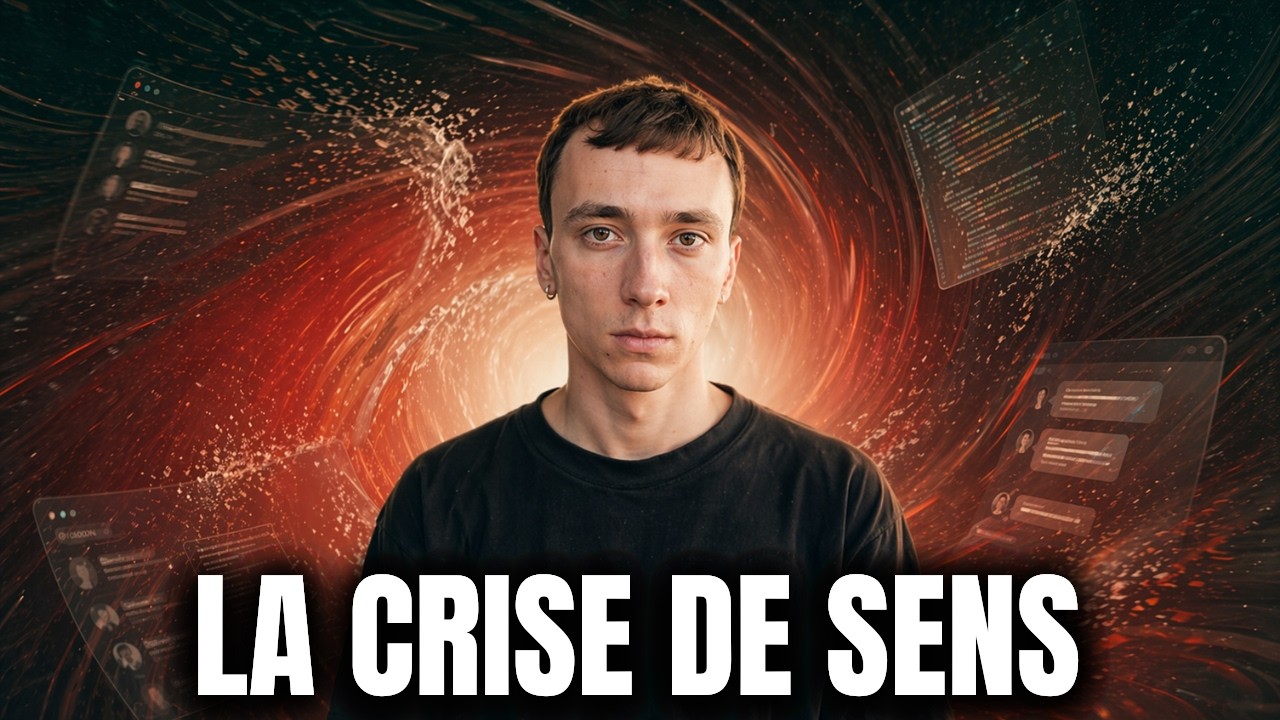
Le paradoxe de l'IA : plus tu progresses, plus tu te perds
Keywords
Summary
160 words
Critical Evaluation
Value of the Information & Strength of the Argument
The video offers a valuable personal perspective on the psychological and existential challenges of AI adoption, a topic often overlooked in technical discussions. The vortex model and strange attractor metaphor provide intuitive frameworks for self-reflection. However, the argumentation is largely anecdotal and lacks empirical support. The speaker’s authority is based on personal experience and his own teaching, not on scientific research. The speculative sections on AGI rely on popular narratives rather than rigorous analysis, and the reasoning sometimes jumps from personal observation to broad societal claims without sufficient evidence.
Scientific Rigor, Source Quality, Title Accuracy
The video cites only two sources: Olivier Chambon’s book ‘L’éveil psychédélique’ and Dario Amodei’s essay ‘Machines of Loving Grace’. These are referenced in passing and not critically examined. The description contains only a promotional link to the speaker’s bootcamp, not to any scientific references. The title accurately captures the video’s theme, but the content is more of a personal essay than a rigorous scientific analysis. The speaker’s claims about AGI timelines and societal impacts are presented without citations to research or expert consensus, reducing the overall scientific rigor.
192 words
Title / Content Match
The title accurately reflects the video's core theme: the paradox of AI's productivity gains leading to personal disorientation and existential crisis.
Quality & Reliability
5/10
The video is a personal essay blending subjective experience, spiritual concepts, and speculative AI forecasts. It lacks empirical data, peer-reviewed references, and balanced expert perspectives, relying heavily on anecdotal evidence and personal authority.
Chapters
- L'IA rend tout le monde productif. Puis elle les détruit.
- Pourquoi l'IA épuise : le modèle du vortex
- Présence expansive vs structure égotique
- La voix dans notre tête et l'IA
- L'IA nous amène dans le fond du vortex
- L'intentionnalité : la seule chose qui nous reste
- Comment remonter : méditation, mouvement, respiration
- La souveraineté cognitive
- L'attracteur étrange de Lorenz
- Se connecter à l'attracteur étrange de sa vie
- Mon erreur : Fluid Company
- "C'est pas parce que tu peux le faire que tu dois le faire"
- Le filtre du samouraï et la do not do list
- L'IA ne crée pas ta mission, elle lève les obstacles
- C'est quoi l'AGI ?
- Quand est-ce que ça arrive ?
- Le scénario de Dario Amodei (Machines of Loving Grace)
- Le contre-scénario : alignement et risques
- La transition chaotique : 20-30% de chômage
- La fenêtre de 5-10 ans pour construire le futur
- Construire de la résilience de manière fractale
Cited Sources
- Bootcamp IA - Prisme One — Promotional link to the speaker's AI bootcamp, mentioned in the video description.
Concurring Sources
- Machines of Loving Grace — Cited in the video as the source for the optimistic post-AGI scenario.
Dissenting Sources
- AI alignment research — The video presents alignment as an unsolved problem, but the field of AI alignment research offers ongoing efforts and potential solutions, contrasting with the video's fatalistic tone.
Contribution & Novelties
The video contributes a personal and philosophical perspective on the psychological impact of AI, proposing the ‘vortex’ model and ‘strange attractor’ as tools for self-alignment. It highlights the importance of cognitive sovereignty and intentionality in an AI-driven world.
Pour aller plus loin :
- Artificial general intelligence — Overview of AGI concepts and debates.
- Lorenz system — Mathematical basis of the strange attractor metaphor.
- Dario Amodei’s essay ‘Machines of Loving Grace’ — Original source for the optimistic AGI scenario.
78 words
Radar Profile
The radar profile shows moderate scores in information quantity and technical level, but lower scores in quality and reliability, reflecting the video's subjective and speculative nature. The balance suggests a personal essay with some conceptual depth but lacking rigorous scientific backing.