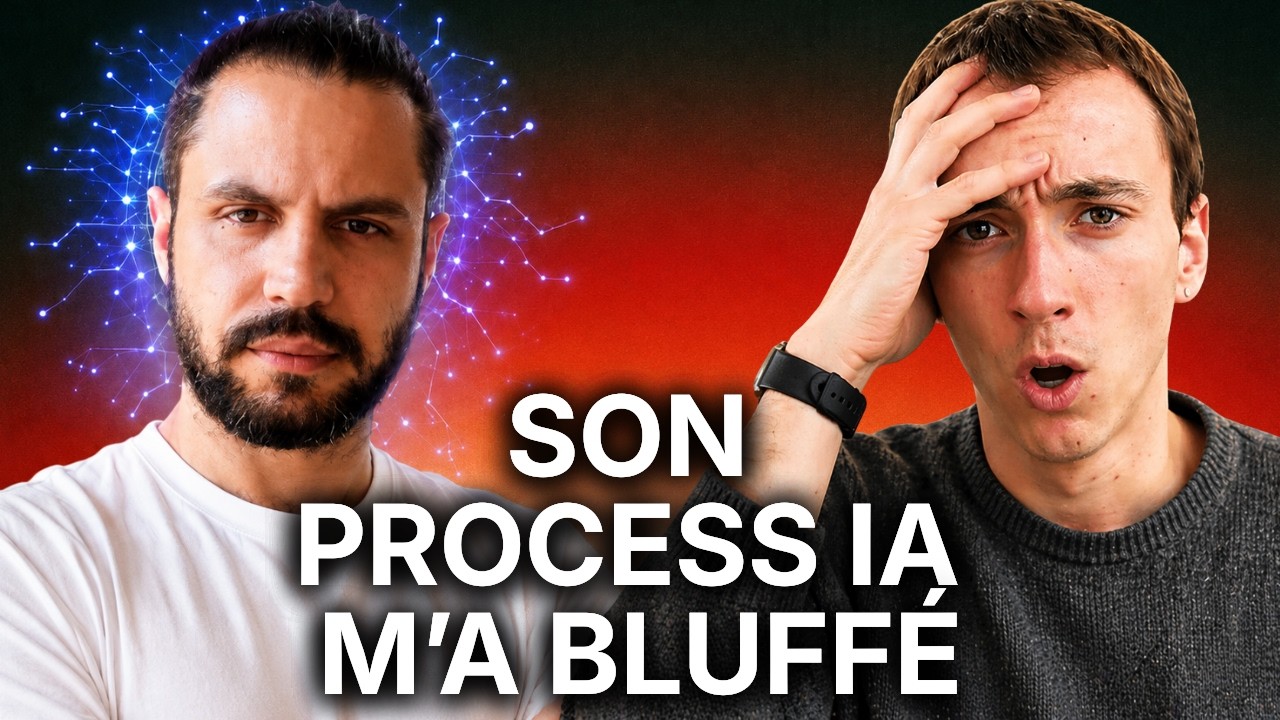
Ce dev gère 4 agents IA comme une équipe d'ingénieurs - co-fondateur d'Argil.AI (YC)
Keywords
Summary
190 words
Critical Evaluation
Value of the Information & Strength of the Argument
The video provides valuable insights into practical AI agent management, with concrete examples and a clear methodology. Brivael’s argumentation is coherent, drawing from his experience as an engineering manager and startup founder. He effectively contrasts sophisticated orchestration tools with simpler, more effective approaches, and supports his points with real-world cases, such as the GPU shader project. The discussion on taste and agency offers a thoughtful perspective on human-AI collaboration, though it remains largely philosophical and subjective.
Scientific Rigor, Source Quality, Title Accuracy
The video references several sources, including a DeepMind paper (not specified) and the work of Luc Ferry, but these are mentioned without detailed citations. The description provides links to Argil.ai and a bootcamp, which are relevant but not directly supporting the technical claims. The title accurately reflects the content, focusing on managing AI agents in a development context. The discussion includes speculative elements, such as predictions about the AI industry, which are presented as opinions rather than evidence-based forecasts.
170 words
Title / Content Match
The title accurately reflects the content, focusing on managing multiple AI agents in a development workflow, as demonstrated by the co-founder of Argil.AI.
Quality & Reliability
7/10
The video features a practitioner with substantial experience in AI-driven development and startup management, providing concrete examples and references to industry practices. However, many claims are anecdotal and lack verifiable data or citations, and the discussion includes speculative philosophical views.
Chapters
- Intro : qui est Brivael (Argil, YC, 5x retweeté par Elon)
- Son workflow : 3-4 agents Claude Code en parallèle
- Le process RFC vocal : comment il pilote ses agents
- L'exemple fou : 3 mois de dev en 4 heures (shaders GPU)
- Vibe coding vs comprendre ce qu'on fait
- Ses conseils pour les non-techs qui veulent construire
- Taste et Agency : ce qui reste à l'humain
- "On a craqué la cognition, pas la créativité"
- Humain + IA = le meilleur résultat (vidéo Zuckerberg)
- Laurent Alexandre : 1% des médecins restent meilleurs que l'IA
- Conscience, ADN et psychédéliques
- Neuralink et l'hybridation biologie-silicium
- Peter Thiel et pourquoi on n'innove plus
- Son process de création de posts X avec Claude
- "Le prochain Star Wars sera fait par un gamin dans sa chambre"
- Pourquoi les modèles IA sont une commodité
- "95% des boîtes IA vont disparaître dans 3 ans"
- Figma, OpenAI et les vrais produits
- La mission d'Argil : du storytelling pour tous
- Son livre en préparation et conclusion
Cited Sources
- Argil.ai — Official website of the company co-founded by Brivael, mentioned as the context for his work.
- Prisme One Bootcamp — Promotional link for a bootcamp related to AI and personal knowledge management, mentioned in the video description.
Concurring Sources
- Anthropic's Claude Code documentation — Official documentation for Claude Code, the tool used by the speaker for AI agents.
Dissenting Sources
- DeepMind paper on AI creativity — The speaker mentions a DeepMind paper that challenges the idea of AI creativity, but no specific citation is provided, making it difficult to verify.
Contribution & Novelties
The video offers a unique perspective on managing multiple AI agents as a team, emphasizing the importance of a clean codebase and structured workflows. It introduces the ‘vocal RFC’ method as an efficient way to delegate complex tasks to AI agents. The discussion on taste and agency provides a nuanced view on human-AI collaboration, suggesting that AI can handle cognition but not creativity. This contributes to the ongoing debate on the limits of AI.
Pour aller plus loin :
- Request for Comments (RFC) — The RFC format is a standard for technical documentation, relevant to the workflow described.
- Claude Code — Anthropic’s coding agent, central to the discussed workflow.
- Vibe coding — A term describing AI-assisted coding without deep understanding, contrasted with the speaker’s approach.
- Singularity — The concept of technological singularity, which the speaker discusses and revises.
138 words
Radar Profile
The radar profile shows high scores in information quantity and technical level, reflecting the detailed and practical content. The lower score in reliability indicates that many claims are anecdotal and lack external verification.