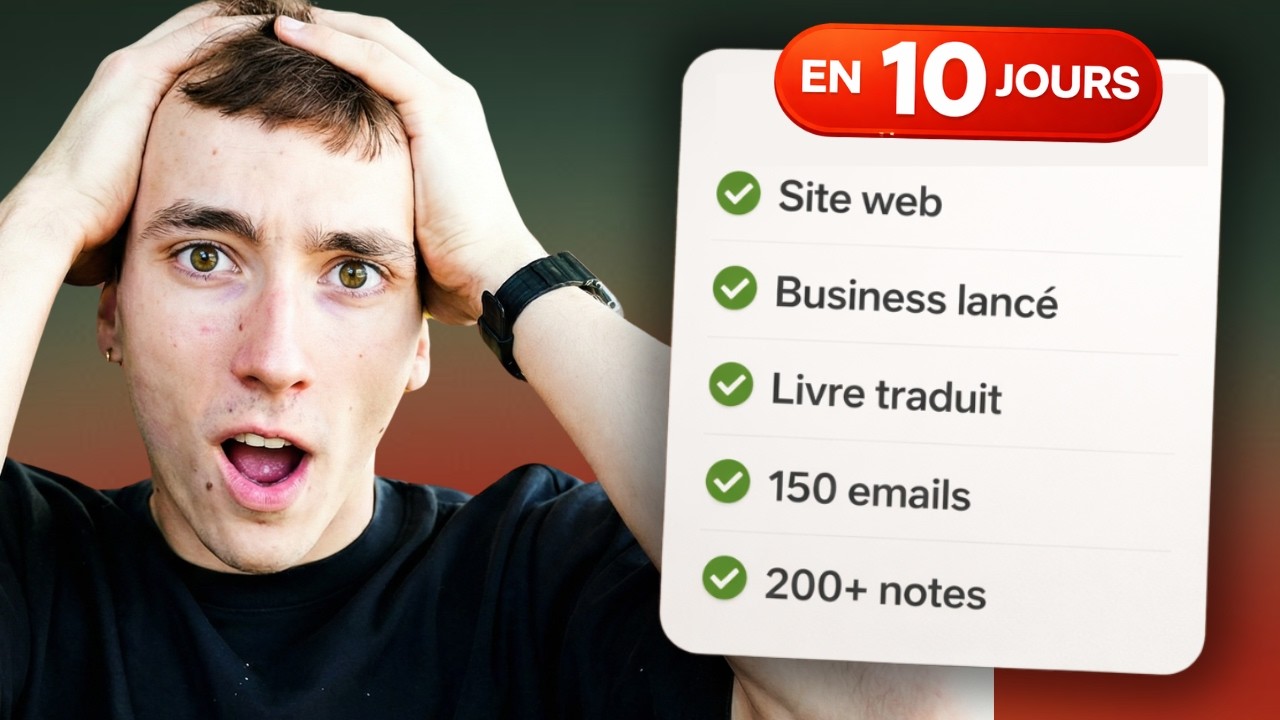
Obsidian + Claude Code : ce que ce débutant a fait en 10 jours est bluffant
Keywords
Summary
127 words
Critical Evaluation
Value of the Information & Strength of the Argument
The video provides high practical value by showing real, reproducible workflows. The demonstrations are concrete and the results are impressive, especially for a non-technical user. The argumentation is solid, emphasizing that the value lies in the method and process design, not just the AI execution. The distinction between simple AI usage and a fully integrated system is well-illustrated. However, the video is largely anecdotal and lacks critical analysis of potential limitations or failure cases. The promotion of the bootcamp introduces a bias, as the demonstrated system is likely part of the paid curriculum.
Scientific Rigor, Source Quality, Title Accuracy
The video is a practical demonstration rather than a scientific study. It cites no external sources, and the only link provided is to the creator’s bootcamp. The title accurately reflects the content, and the video’s claims are plausible but not independently verified. The lack of sources and the promotional nature of the video reduce its scientific rigor. The creator’s expertise is evident, but the video would benefit from referencing external documentation or studies on AI workflows and knowledge management.
187 words
Title / Content Match
The title accurately reflects the content: a beginner's journey with Obsidian and Claude Code, showing impressive results in 10 days.
Quality & Reliability
7/10
The video is a practical demonstration of an AI-powered workflow, with real screen recordings and concrete results. The claims are plausible and align with current AI capabilities, but they are anecdotal and lack independent verification. The creator promotes a paid bootcamp, which introduces a potential conflict of interest.
Chapters
- Intro : présentation de JCK et de son profil (non-tech)
- Le déclic de JCK
- Ses deux frustrations
- La peur du terminal : comment elle disparaît en une journée
- Le changement de mindset
- La comparaison avec la découverte de l'entrepreneuriat en 2012
- Le gap entre power user IA classique et le système intégré
- Les limites de ChatGPT : mémoire parcellaire, biais, références hors sujet
- Les résultats en vrac : livre traduit en 1h, 2 ebooks créés, 150 newsletters repackagées
- DEMO 1 : Process de déconstruction de podcast (fiche process, commande /podcast)
- L'importance de la méthode humaine dans les commandes IA (first principles vs résumé)
- Pourquoi utiliser le terminal ? (puissance brute, Cloud Code, file system local)
- Demo live : déconstruction d'un podcast Naval Ravikant en temps réel
- Explication : c'est quoi une note permanente ? (concept atomique, Zettelkasten)
- Avant/après : la création de notes permanentes avec et sans IA (de "la flemme" à 30-100 notes/semaine)
- La place de l'humain : pourquoi les notes permanentes restent utiles à l'ère de l'IA
- DEMO 2 : Création de notes permanentes à partir d'un livre (style d'écriture, connexions, essais associés)
- Dataview : plugin qu'il n'arrivait pas à utiliser, maintenant setup par l'IA
- DEMO 3 : Écriture d'articles avec notes permanentes associées au plan
- Context engineering pour la pensée : briques conceptuelles partagées avec l'IA
- Les notes "Origin JCK" : réutiliser ses propres concepts comme des Legos
- L'importance de continuer à lire (maillage mental, ping-pong intellectuel humain/IA)
- Transition vers la partie Business
- DEMO 4 : Business "Stoïcien Moderne" — l'idée testée un samedi après-midi
- Étude de marché en 3-4 min, analyse du Daily Stoic, roadmap, plan de lancement 30 jours
- Ressources injectées : livres, citations, articles, notes personnelles sur le stoïcisme
- Landing page, lead magnet 7 jours, emails quotidiens, identité visuelle — tout en une après-midi
- Le learning : barrière mentale cassée, business testable en 2h
- La valeur est dans la méthode/le process, plus dans l'exécution
- DEMO 5 : Offre B2B Perspective (Prism) — étude de marché, positionnement, deck client
- Deck de présentation généré en 6-7 min avant le podcast
- Unit Economics : valider la rentabilité d'un business en une commande
- Guide CEO Amplifié, séquence email, funnel complet prêt
- L'importance du contexte qui évolue et du file system local (Obsidian vs Notion)
- Le système amplifie tes forces et réduit tes faiblesses
- Présentation du Bootcamp Perspectives IA
Cited Sources
- Prisme One Bootcamp IA — The video promotes this bootcamp as a way to build a similar AI-powered second brain system.
Concurring Sources
- Zettelkasten method — The video's approach to permanent notes aligns with the Zettelkasten method, which is a well-established knowledge management technique.
- Prompt engineering — The video's emphasis on process design and context engineering is a practical application of prompt engineering principles.
Dissenting Sources
- AI limitations in knowledge work — While the video shows impressive results, it does not address potential limitations such as AI hallucination, data privacy, or the need for human oversight, which are common concerns in AI applications.
Contribution & Novelties
The video’s main contribution is demonstrating a practical, integrated workflow combining Obsidian and Claude Code for knowledge management and business creation. It shows how a non-technical user can leverage AI to overcome common frictions in note-taking and project execution. The emphasis on process design and context engineering is a valuable insight. However, the approach is not entirely novel, as similar workflows are discussed in the AI community.
Pour aller plus loin :
- Zettelkasten method — The note-taking method underlying the permanent notes concept.
- Context engineering — The practice of designing prompts and context to improve AI outputs.
- Claude Code documentation — Official documentation for the tool used in the video.
110 words
Radar Profile
The radar profile shows high scores in information quantity and quality, indicating a content-rich video with practical demonstrations. The technical level is moderate, making it accessible to a broad audience. The reliability score is slightly lower, reflecting the anecdotal nature and promotional bias.