Keywords
Summary
186 words
Critical Evaluation
Value of the Information & Strength of the Argument
The video provides a clear, methodical approach to solving standard radioactivity problems, which is valuable for students learning to apply theoretical formulas. The argumentation is logical and follows a consistent pattern: identify given data, select the appropriate formula, substitute values, and solve. The instructor explains each step, including unit conversions and the rationale behind using certain equations. However, the presentation is purely verbal with no visual aids, which may reduce engagement and make it harder to follow complex calculations. The content is accurate but does not offer any novel insights or alternative methods, limiting its value to a straightforward tutorial.
Scientific Rigor, Source Quality, Title Accuracy
The scientific rigor is adequate for an introductory tutorial: the formulas used are standard and correctly applied, and the numerical results are consistent with known values (e.g., radon half-life, radium half-life). However, the video does not cite any external sources, which is typical for a problem-solving session but limits its depth. The title accurately describes the content, as it is indeed a session on numericals for the radioactivity chapter. The lack of visual aids and occasional verbosity could be seen as a minor weakness in presentation, but the core physics is sound.
207 words
Title / Content Match
The title accurately reflects the content: a lecture solving numerical problems on radioactivity.
Quality & Reliability
6/10
The video provides a step-by-step tutorial on solving numerical problems related to radioactivity, using standard formulas and constants. The derivations are correct, but the presentation is verbose and lacks visual aids, which may hinder clarity. The content is accurate but not novel, and no external sources are cited.
Key Moments
Markers derived by PSI from the transcript: the creator did not define chapters.
- Introduction: recapping formulas for radioactivity, half-life, and decay constant.
- Problem 1: Time for radon to reduce to 1% of initial amount, given half-life 3.8 days.
- Problem 2: Time for 3/4 of atoms to disintegrate, given half-life 20 days.
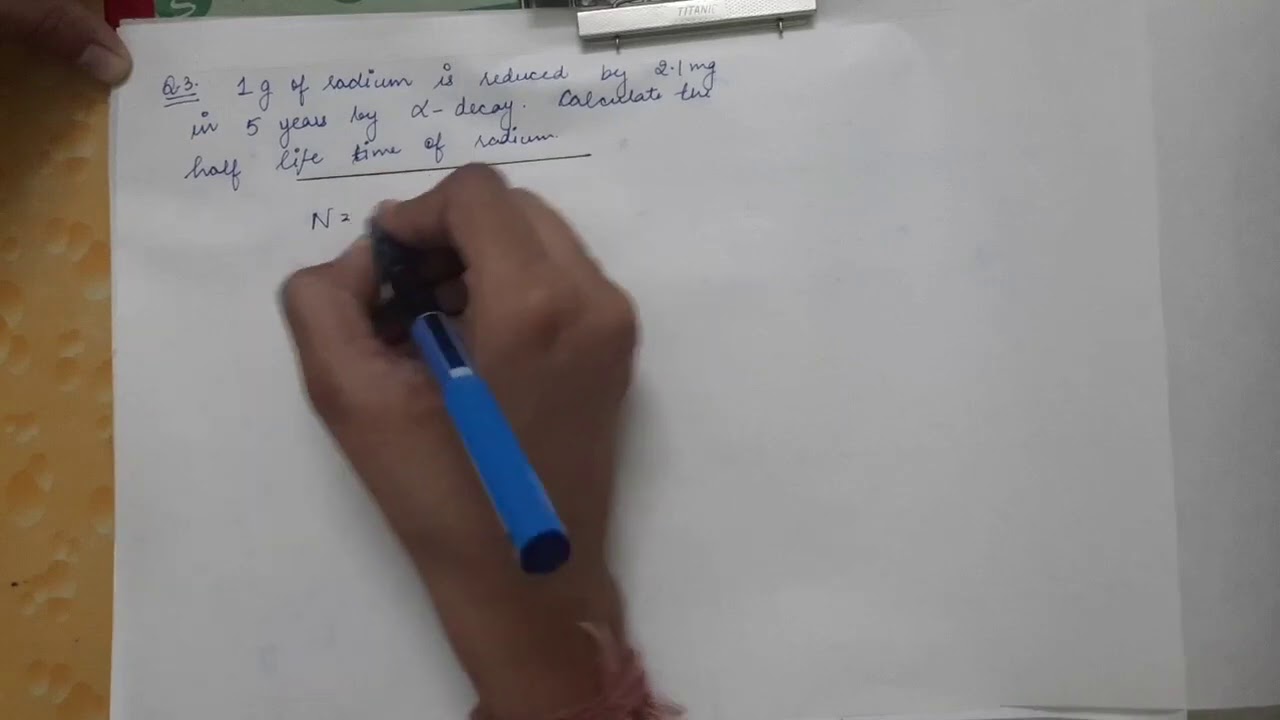
- Problem 3: Half-life of radium from mass reduction of 2.1 mg over 5 years.
- Problem 4: Weight of 1 curie of lead-214, using activity and Avogadro's number.
- Problem 5: Amount of polonium-210 needed for 5 millicurie alpha source.
Contribution & Novelties
The video offers a practical walkthrough of solving radioactivity numericals, reinforcing standard formulas and their application. It is useful for students seeking to practice problem-solving, but it does not introduce new concepts or methods beyond textbook material.
Pour aller plus loin :
- Radioactive decay — Overview of decay processes and the exponential decay law.
- Half-life — Definition and examples of half-life in various contexts.
- Curie (unit) — Explanation of the unit of radioactivity and its conversions.
76 words
Radar Profile
The radar profile shows a balanced performance across all dimensions, with slightly higher scores in quality and reliability, reflecting the accurate but unoriginal content. The low quantity of information and technical level are consistent with a basic tutorial, while the overall note of 3 stars indicates a satisfactory but not exceptional educational resource.