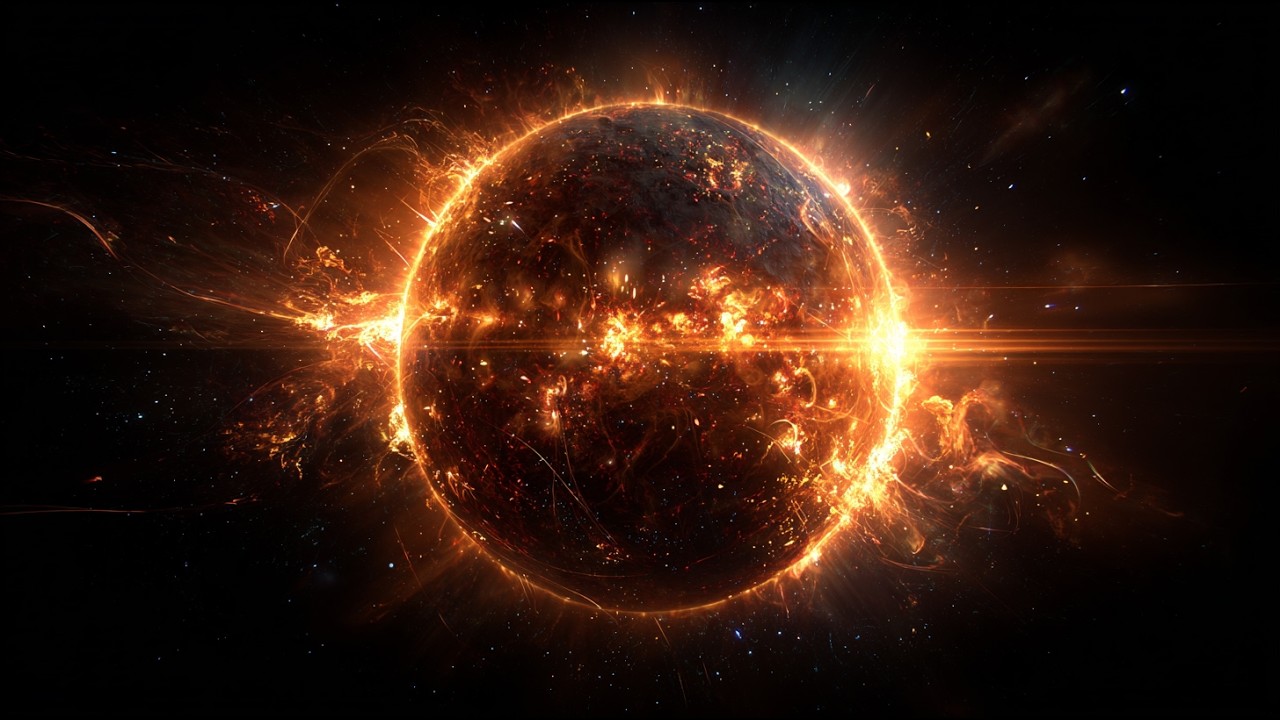
Le soleil comme vous ne l'avez jamais vu
Keywords
Summary
128 words
Critical Evaluation
Value of the Information & Strength of the Argument
The video’s value lies in its exceptional visual content, showcasing real, high-resolution images of the Sun from NASA’s SDO and ESA’s Solar Orbiter. It effectively communicates complex solar physics concepts in an accessible yet accurate manner. The argumentation is solid, based on established scientific knowledge, and the explanations are clear and well-structured. The use of comparisons with Earth helps convey the immense scales involved. The narrative is engaging and poetic, enhancing the viewer’s appreciation without compromising scientific rigor.
Scientific Rigor, Source Quality, Title Accuracy
The video demonstrates strong scientific rigor, referencing reputable sources such as NASA and ESA. The description provides links to official resources, including SDO’s image gallery and Solar Orbiter’s physics page. The title accurately reflects the content, as the video indeed presents the Sun in a unique and visually stunning way. The content is well-researched and aligns with current scientific understanding. The video’s structure with chapters helps organize the information logically. The creator also notes that the Sun’s internal structure is studied indirectly through helioseismology, showing attention to methodological accuracy.
182 words
Title / Content Match
The title accurately reflects the content: the video presents the Sun through real, high-resolution images from space telescopes, offering a unique visual perspective.
Quality & Reliability
9/10
High-quality popular science content based on real observational data from NASA and ESA missions, with clear explanations of complex phenomena. The video is well-structured, uses accurate scientific terminology, and cites reputable sources. Minor simplifications are appropriate for the format.
Chapters
- Toutes les lumières du soleil
- La couronne du roi
- L’étoile est une bombe magnétique
- La rotation de l’astre
- éruptions solaires
- éjections de masses coronales
- Filaments et pluie de plasma sur le soleil
- Le vent solaire et les trous coronaux
- La chromosphère
- Spicules et nano-éruptions
- La photosphère, surface et taches solaires
- Granulation
- Cycles solaires
- à l’intérieur, cœur et fusion
- Ressortir de l’étoile
- Mercure aux premières loges
- Des tornades solaires et des images
Cited Sources
- NASA - Understanding the Magnetic Sun — Referenced in the video description as a source for understanding the Sun's magnetic field.
- SDO Gallery - Ultra HD — Source of high-resolution images of the Sun used in the video.
- ESA - Solar Orbiter turning pictures into physics — Referenced for Solar Orbiter mission imagery and scientific insights.
- NASA SVS - Best of SDO — Source of compiled images from the Solar Dynamics Observatory.
- NASA SVS - Solar Orbiter's First Views — Referenced for Solar Orbiter's first images.
- ESA Solar Orbiter Flickr Album — Additional images from Solar Orbiter used in the video.
Concurring Sources
- NASA - Understanding the Magnetic Sun — Supports the video's explanations of solar magnetism.
- ESA - Solar Orbiter turning pictures into physics — Aligns with the video's use of Solar Orbiter data.
Contribution & Novelties
The video’s original contribution is its compilation of the most recent and spectacular real images of the Sun, providing a visually immersive experience that goes beyond typical educational content. It effectively bridges the gap between raw scientific data and public understanding, making complex phenomena accessible. The poetic narration adds an emotional dimension that enhances engagement.
Pour aller plus loin :
- Helioseismology — The study of solar oscillations to infer internal structure, as mentioned in the video.
- Solar cycle — The 11-year cycle of solar activity, a key concept discussed.
- Coronal mass ejection — Detailed explanation of CMEs, which are prominently featured.
- Solar Dynamics Observatory — The NASA mission providing many of the images.
- Solar Orbiter — ESA mission contributing new views of the Sun.
124 words
Radar Profile
The radar profile shows high scores across all dimensions, indicating a well-rounded and reliable video. The strong performance in information quantity and quality, combined with high technical level and reliability, reflects its excellence as an educational resource.
💬 Très positif. Sur les 30 commentaires analysés, tous expriment une admiration et une gratitude extrêmes pour la qualité visuelle et narrative du documentaire, le qualifiant de 'meilleur documentaire sur le soleil' et saluant le travail de vulgarisation.