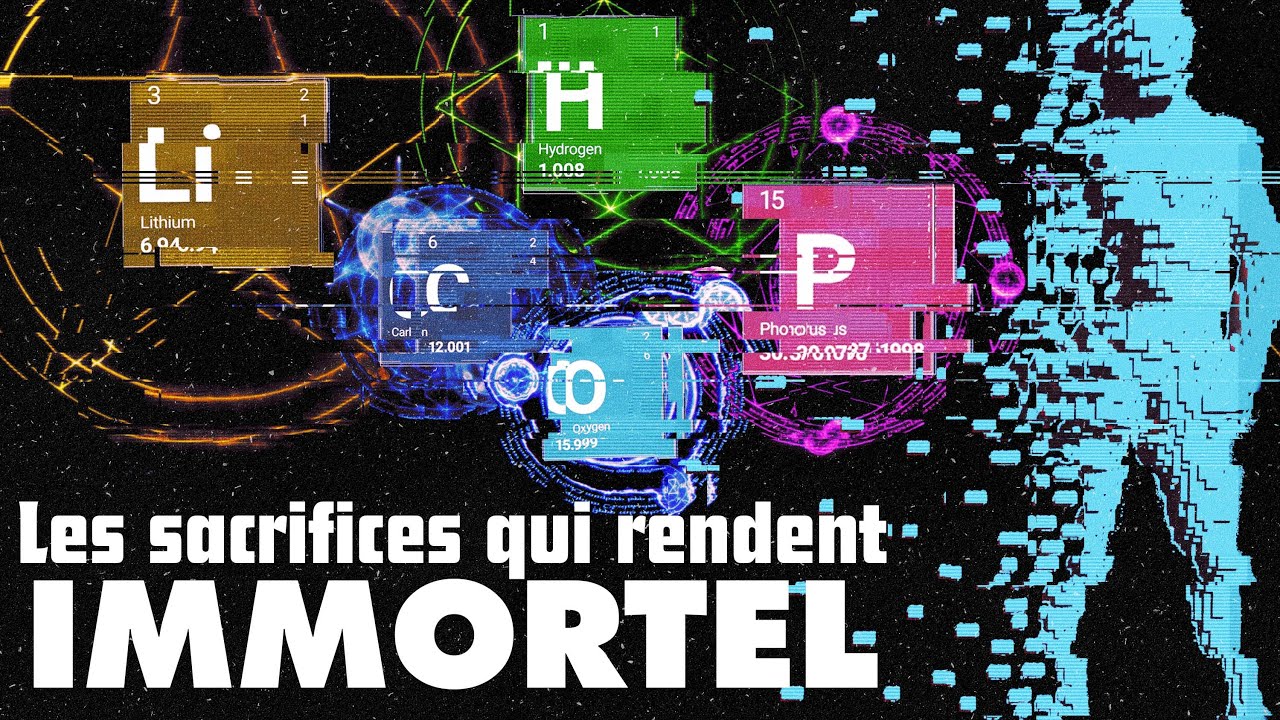
L'immortalité qui se cache en nous - l'origine des vos éléments
Keywords
Summary
191 words
Critical Evaluation
Value of the Information & Strength of the Argument
The video provides a compelling and scientifically accurate narrative that connects astrophysics to human existence. It effectively explains complex concepts like stellar nucleosynthesis and neutron star mergers using clear analogies and visual aids. The argumentation is solid, building from the historical observation of a supernova to the detailed processes that create elements, and finally to the molecular basis of life. The poetic framing enhances engagement without compromising scientific integrity.
Scientific Rigor, Source Quality, Title Accuracy
The video demonstrates strong scientific rigor, referencing well-established sources such as Hubert Reeves’ ‘Poussières d’étoiles’ and Daniel Briot’s ‘Ce que disent les étoiles’, as well as reputable websites like Wikipedia, CNRS, and Observatoire de Paris. The sources are credible and appropriately cited in the description. The title accurately reflects the content, which is a poetic yet scientifically grounded exploration of the origin of elements and their connection to life. The video does not overstate claims and appropriately notes uncertainties, such as the exact origin of certain atoms.
171 words
Title / Content Match
The title is poetic and intriguing, and the content thoroughly explores the origin of elements and their connection to human existence, fully matching the promise.
Quality & Reliability
8/10
The video presents a scientifically accurate overview of stellar nucleosynthesis and the origin of elements, supported by references to established works and sources. The information is well-structured and aligns with current astrophysical understanding, though it simplifies complex processes for a general audience.
Key Moments
Markers derived by PSI from the transcript: the creator did not define chapters.
- Introduction: historical supernova of 1054 and the idea that stars are not eternal.
- Explanation of how stars forge elements through nuclear fusion and supernovae.
- Discussion of rare elements like gold and the role of neutron star collisions.
- Transition to molecular level: atoms combining in interstellar space to form molecules.
- The importance of carbon and the complexity of life's molecules, including DNA.
- Reflection on the immortality of atoms and the journey of a water molecule.
- Conclusion: we are made of stardust, and the universe is contemplating itself.
Cited Sources
- Nucléosynthèse stellaire - Wikiwand — Reference for stellar nucleosynthesis processes.
- Composition of the human body - Wikipedia — Source for elemental composition of the human body.
- Le tableau de Mendeleïev : 150 ans d'histoire - CNRS — Context on the periodic table and its history.
- Sommes-nous bien poussières d'étoiles ? - SciencePost — Article supporting the stardust concept.
- Tableau périodique détaillé : l'origine de chaque atome du corps - SciencePost — Detailed periodic table with origins of elements.
- CHNOPS - Wikiwand — Reference for the main elements in living organisms.
- Liste d'espèces chimiques détectées dans le milieu interstellaire - Wikiwand — List of molecules found in interstellar space.
- Les molécules dans le milieu interstellaire - Observatoire de Paris — Educational resource on interstellar molecules.
- Origine des éléments - GeoWiki — Geological perspective on element origins.
- Taux d'éléments dans le corps humain - Lenntech — Data on element concentrations in the human body.
- L'origine des éléments chimiques - La Recherche — Article on the origin of chemical elements.
- Simulateur de vie stellaire - Star in a Box — Interactive simulation of stellar evolution.
- Tableau périodique avec origines - SciencePost — Visual periodic table showing element origins.
- Liste des molécules interstellaires - Observatoire de Paris — Catalogue of interstellar molecules.
Concurring Sources
- Nucleosynthesis - Wikipedia — Confirms the processes described in the video.
- Stellar nucleosynthesis - Wikipedia — Supports the explanation of element formation in stars.
External References
Contribution & Novelties
The video offers a poetic and accessible synthesis of the origin of elements, connecting astrophysics to human existence. It stands out for its narrative style that makes complex scientific concepts emotionally resonant. The explanation of neutron star collisions as the source of heavy elements is particularly well-illustrated.
Pour aller plus loin :
- Nucleosynthesis - Wikipedia — Overview of the processes that create new atomic nuclei.
- Stellar evolution - Wikipedia — Detailed lifecycle of stars, from formation to death.
- Neutron star merger - Wikipedia — Explanation of the collision events that produce heavy elements.
- Abiogenesis - Wikipedia — The study of how life arises from non-living matter, relevant to the video’s discussion of molecular complexity.
114 words
Radar Profile
The radar profile shows high scores in information quality and technical level, with slightly lower scores in quantity and reliability. This indicates a well-crafted, scientifically accurate video that excels in depth and clarity, though it could benefit from more extensive coverage of certain topics and additional source citations.
💬 Très positif. Sur les 30 commentaires analysés, l'enthousiasme est unanime : les spectateurs louent la qualité poétique et pédagogique de la vidéo, la décrivant comme 'magnifique', 'passionnante' et 'vertigineuse', avec une appréciation particulière pour la manière dont elle rend la science émouvante.