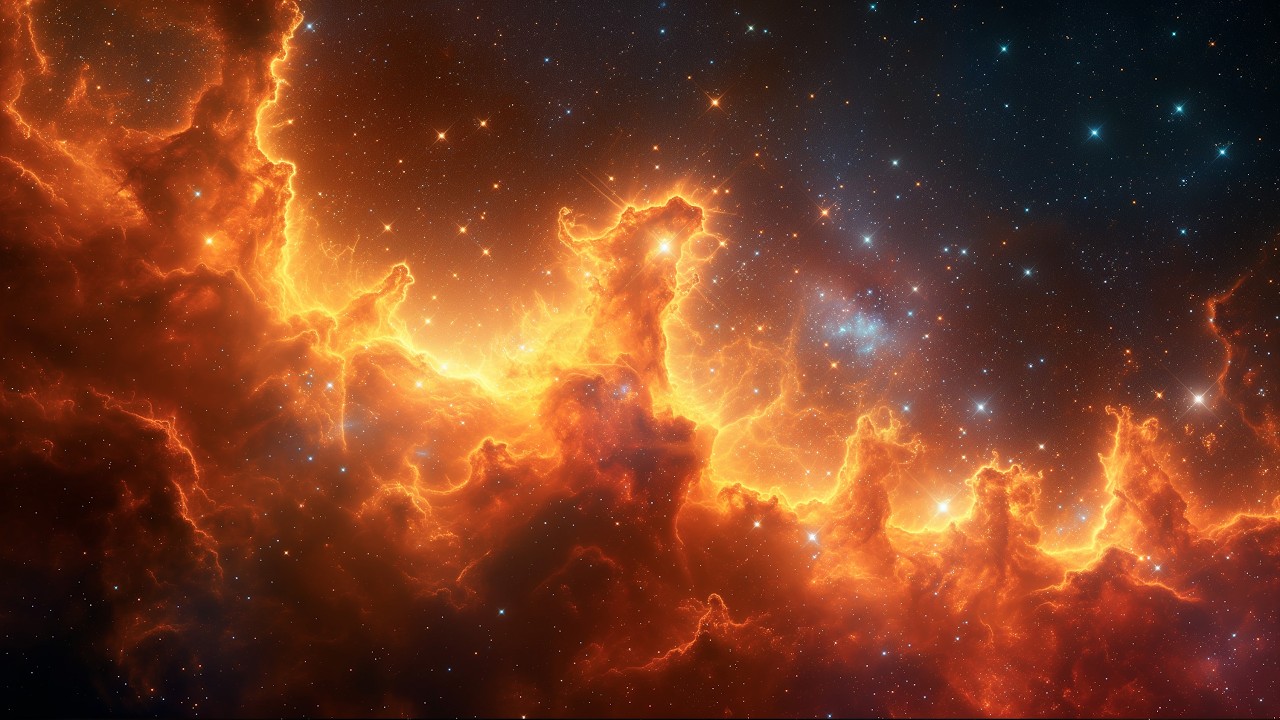
Où et comment les étoiles se forment ?
Keywords
Summary
158 words
Critical Evaluation
Value of the Information & Strength of the Argument
The video provides valuable information about star formation, using vivid imagery and analogies to convey scale and density. The argumentation is coherent, following a logical progression from the description of nebulae to the processes of star birth and death. It effectively communicates complex concepts like gravitational collapse and stellar feedback in an accessible manner. The poetic style enhances engagement without compromising scientific accuracy.
Scientific Rigor, Source Quality, Title Accuracy
The video cites popular science books (e.g., ‘Ce que disent les étoiles’ by Daniel Briot, ‘Poussières d’étoiles’ by Hubert Reeves) and Wikipedia articles on nebulae, molecular clouds, and star formation. These are reliable for general information but not primary scientific sources. The title accurately reflects the content. The description includes links to the cited sources, which are appropriate for a general audience. The video does not include any advertising sequences.
148 words
Title / Content Match
The title accurately reflects the content, which explains where and how stars form, using specific examples like the Pillars of Creation and the Carina Nebula.
Quality & Reliability
8/10
The video presents accurate astronomical concepts (star formation in nebulae, stellar nurseries, the Pillars of Creation, Eta Carinae) with poetic narration. It cites popular science books and Wikipedia articles, but lacks direct peer-reviewed sources. The scientific content is reliable and up-to-date for a general audience.
Key Moments
Markers derived by PSI from the transcript: the creator did not define chapters.
- Introduction to the video's theme: the birthplaces of stars.
- Description of the Pillars of Creation in the Eagle Nebula.
- Explanation of the scale and density of nebulae.
- Comparison of various nebulae, including the Trifid and Tarantula.
- Discussion of Eta Carinae and its potential hypernova.
- How massive stars sculpt and trigger new star formation.
- The lifecycle of nebulae and their eventual dispersal.
- Connection to our Sun's origin and the vast number of stars in the universe.
Cited Sources
- Nébuleuse - Wikiwand — Reference for the definition and characteristics of nebulae.
- Nuage moléculaire - Wikiwand — Reference for molecular clouds as stellar nurseries.
- Naissance des étoiles - Wikiwand — Reference for the process of star formation.
- Balade Mentale - Episode précédent — Link to the previous episode in the series.
- Balade Mentale - Playlist — Link to the full series playlist.
Concurring Sources
- Nébuleuse - Wikiwand — Consistent with the video's description of nebulae as star-forming regions.
- Nuage moléculaire - Wikiwand — Supports the video's explanation of molecular clouds as stellar nurseries.
- Naissance des étoiles - Wikiwand — Aligns with the video's account of star formation processes.
External References
Contribution & Novelties
The video offers a poetic and visually stunning overview of star formation, making complex astrophysical concepts accessible to a general audience. It synthesizes information from multiple sources and presents it in an engaging narrative. The use of specific examples like the Pillars of Creation and Eta Carinae helps ground the concepts.
Pour aller plus loin :
- Star formation - Wikipedia — Comprehensive overview of the physical processes.
- Pillars of Creation - Wikipedia — Details on this iconic structure.
- Eta Carinae - Wikipedia — Information on this massive star system.
- Nebula - Wikipedia — General information on nebulae.
97 words
Radar Profile
The radar profile shows high scores in information quantity, quality, and reliability, with a slightly lower technical level. This indicates a well-researched and accurate video that is accessible to a general audience, balancing depth with clarity.
💬 Très positif. Sur les 30 commentaires analysés, tous expriment une admiration pour la beauté et la qualité scientifique de la vidéo, soulignant son caractère poétique et captivant.