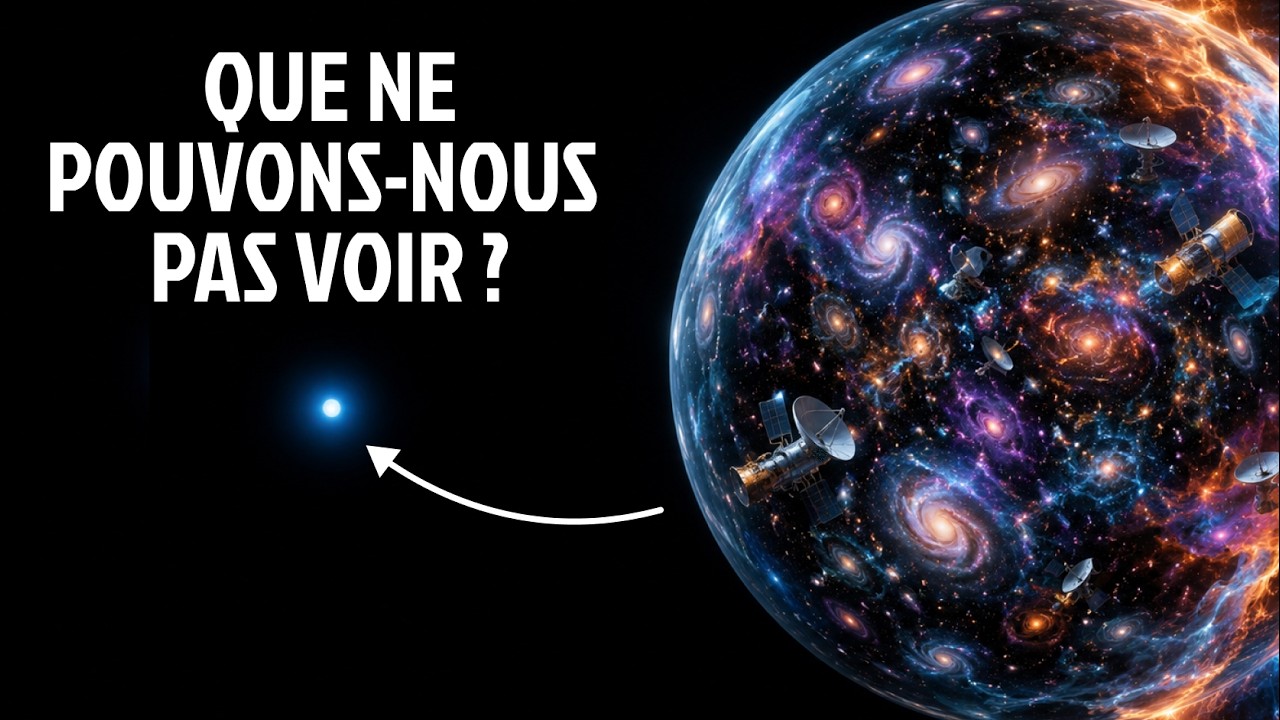
Qu'y a-t-il au-delà de l'univers Observable?
Keywords
Summary
184 words
Critical Evaluation
Value of the Information & Strength of the Argument
The video provides substantial value by clearly explaining a complex cosmological concept (the observable universe and its limits) using intuitive analogies (e.g., balancing a pencil, inflating a balloon) and concrete numbers (e.g., 93 billion light-years, 2 trillion galaxies). The argumentation is solid: it builds logically from the flatness problem to the inflationary solution, and then to the consequence that most of the universe is hidden. It correctly distinguishes between established measurements (Planck) and theoretical inferences (size of the universe beyond observable). The video also addresses common misconceptions, such as the idea that the observable universe is the entire universe, and explains the difference between the particle horizon and the event horizon. The reasoning is consistent with mainstream cosmology, and the video does not overstate speculative claims, clearly labeling them as such.
Scientific Rigor, Source Quality, Title Accuracy
The video demonstrates high scientific rigor. It references specific measurements from the Planck satellite and cites key studies: Vardanyan, Trotta, and Silk (2011) for the lower bound on the universe’s size, and Conselice et al. (2016) for the galaxy count. It also mentions Penrose’s work on entropy. The sources are credible and directly relevant. The title accurately reflects the content, which is a detailed exploration of the observable universe’s boundaries and the physics that hides the rest. The video does not overstate certainty; it clearly distinguishes between what is measured and what is inferred. The description also provides chapter markers, which aid navigation. Overall, the sources are well-integrated and the title is appropriate.
259 words
Title / Content Match
The title accurately reflects the content, which explores the limits of the observable universe and the physical reasons (inflation) why the rest is inaccessible.
Quality & Reliability
8/10
The video presents a rigorous, well-structured explanation of cosmological concepts, grounded in established physics (inflation, CMB, Planck data). It cites specific measurements and studies (e.g., Planck, Vardanyan et al. 2011, Conselice et al. 2016) and distinguishes between established science and theoretical extrapolations. The tone is educational, with clear explanations of complex ideas. Minor caveats: some numbers (e.g., 10^24 stars) are presented as estimates without full context, and the 'beyond observable' section is inherently speculative, though clearly framed as such.
Chapters
Cited Sources
- Planck 2018 results. VI. Cosmological parameters — The Planck satellite's final data on cosmological parameters, including Omega, which the video cites for the flatness measurement.
- Applications of Bayesian model averaging to the curvature and size of the Universe — Vardanyan, Trotta, and Silk (2011) analysis that the video cites for the lower bound on the universe's size (251 times the observable radius).
- The Evolution of Galaxy Number Density at z < 8 and Its Implications — Conselice et al. (2016) study estimating 2 trillion galaxies in the observable universe, cited in the video.
- The Emperor's New Mind — Penrose's book, mentioned in the video for the entropy fine-tuning argument.
Concurring Sources
- Planck 2018 results. VI. Cosmological parameters — Confirms the flatness measurement (Omega = 1 ± 0.005) cited in the video.
- The Evolution of Galaxy Number Density at z < 8 and Its Implications — Supports the estimate of 2 trillion galaxies in the observable universe.
Contribution & Novelties
The video’s original contribution lies in its clear synthesis of the flatness problem, cosmic inflation, and the resulting causal horizons, making the abstract concept of ‘beyond the observable universe’ tangible. It effectively explains why the observable universe is not the entire universe, using the same physics (inflation) to solve one problem while creating another. The video also clarifies the distinction between different horizons (particle, event, Hubble), which is often conflated.
Pour aller plus loin :
- Cosmic inflation — Overview of the inflationary theory, its motivations, and evidence.
- Observable universe — Detailed explanation of the observable universe’s size and limits.
- Cosmic microwave background — The oldest light, its discovery, and its role in cosmology.
- Event horizon — General concept of horizons, including cosmological event horizon.
124 words
Radar Profile
The radar profile shows high scores in information quantity and quality, with a slightly lower technical level, indicating a well-balanced educational content. The reliability score is high, reflecting the use of established science and credible sources.