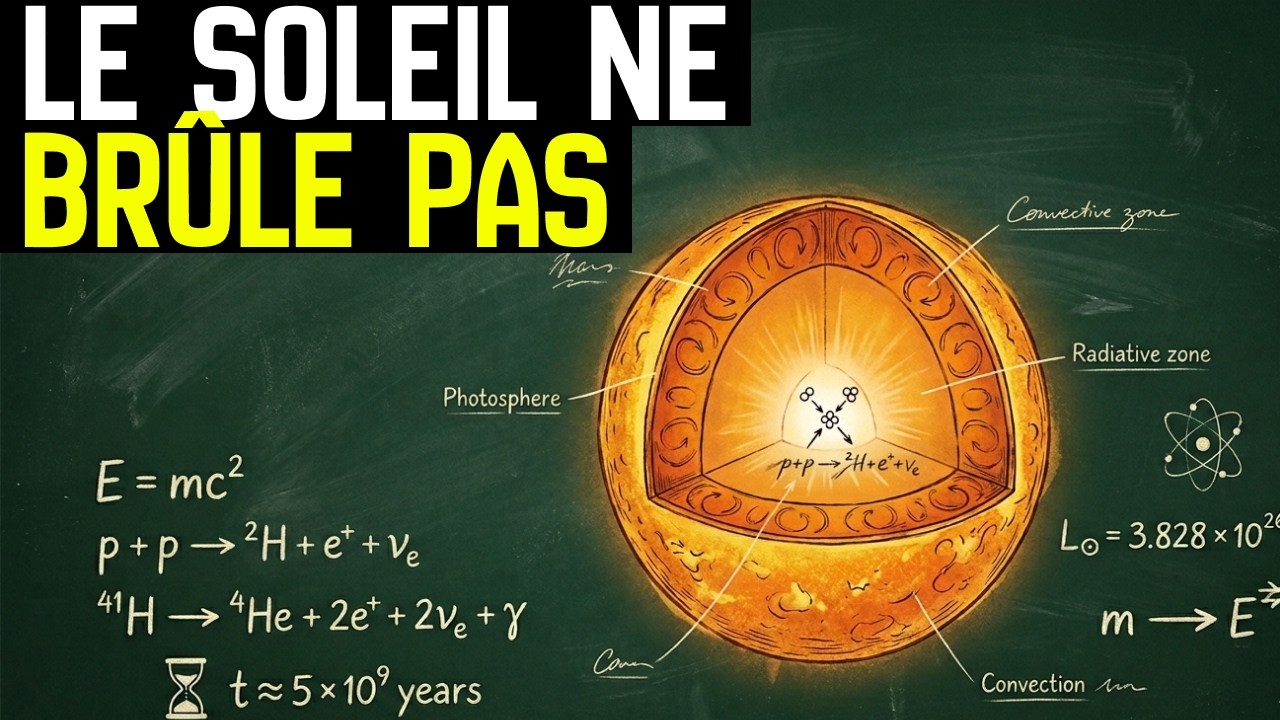
Le Soleil n'a JAMAIS brûlé | Le paradoxe de 5 milliards d'années
Keywords
Summary
166 words
Critical Evaluation
Value of the Information & Strength of the Argument
The video provides substantial scientific value by accurately explaining complex astrophysical concepts in an accessible manner. It effectively uses historical anecdotes and analogies to build a compelling narrative. The argumentation is solid, logically progressing from the problem of the Sun’s energy source to the quantum mechanical solution and its experimental confirmation. The inclusion of the solar neutrino problem and its resolution adds depth and credibility. The video’s strength lies in its ability to convey the wonder of science without sacrificing accuracy.
Scientific Rigor, Source Quality, Title Accuracy
The video demonstrates strong scientific rigor by referencing primary sources and key experiments. It cites Feynman’s lectures, Eddington’s 1920 address, Bethe’s 1939 paper, and the Homestake and SNO experiments. The description provides a link to the Feynman Lectures, which is a reliable source. The title accurately reflects the content, though it uses a sensationalist framing. The video’s narrative is well-researched and aligns with established scientific consensus.
162 words
Title / Content Match
The title is provocative and attention-grabbing, accurately reflecting the core message that the Sun does not undergo combustion but rather nuclear fusion. It aligns well with the content.
Quality & Reliability
8/10
The video presents a scientifically accurate account of stellar fusion, referencing key historical figures (Helmholtz, Eddington, Bethe, Davis) and experiments (Homestake, SNO, JET, ITER). It correctly explains quantum tunneling, the proton-proton chain, and the solar neutrino problem. The narrative is engaging and uses analogies effectively, though it occasionally simplifies complex concepts for a general audience.
Chapters
- Le soleil n'a jamais brûlé
- Le calcul qui a brisé la physique
- L'alchimie littérale des étoiles
- La barrière de Coulomb
- L'effet tunnel quantique
- La masse qui disparaît — E = mc²
- 100 000 ans pour sortir du soleil
- Qui a découvert ça ?
- Le détecteur de neutrinos
- La solution (SNO, 2001)
- Tu es des débris d'étoiles mortes
- ITER : on essaie de copier le soleil
- Chaque étoile est un soleil
- Tu es de la lumière solaire avec un nom
- Il fait autre chose — depuis 5 milliards d'ans
Cited Sources
- The Feynman Lectures on Physics, Vol. I, Ch. 3 — Referenced as the source for Feynman's explanation of stellar fusion and the concept of stars as crucibles.
Concurring Sources
- The Feynman Lectures on Physics, Vol. I, Ch. 3 — Supports the explanation of stellar fusion and the role of quantum mechanics.
Contribution & Novelties
The video’s original contribution lies in its engaging narrative that connects the physics of the Sun to everyday human experience, emphasizing the poetic and philosophical implications of stellar fusion. It effectively synthesizes historical discoveries and modern experiments into a coherent story.
Pour aller plus loin :
- Proton–proton chain — Detailed description of the fusion process in Sun-like stars.
- Solar neutrino problem — Historical overview of the discrepancy and its resolution via neutrino oscillation.
- Sudbury Neutrino Observatory — Information about the experiment that confirmed neutrino oscillation.
- ITER — Official site of the international fusion reactor project.
- Parker Solar Probe — NASA’s mission to study the Sun’s outer atmosphere.
107 words
Radar Profile
The radar profile shows high scores in quantity of information and technical level, indicating a content-rich video with substantial scientific depth. The quality and reliability scores are also strong, reflecting accurate and well-sourced information. The overall balance suggests a highly informative and trustworthy presentation.