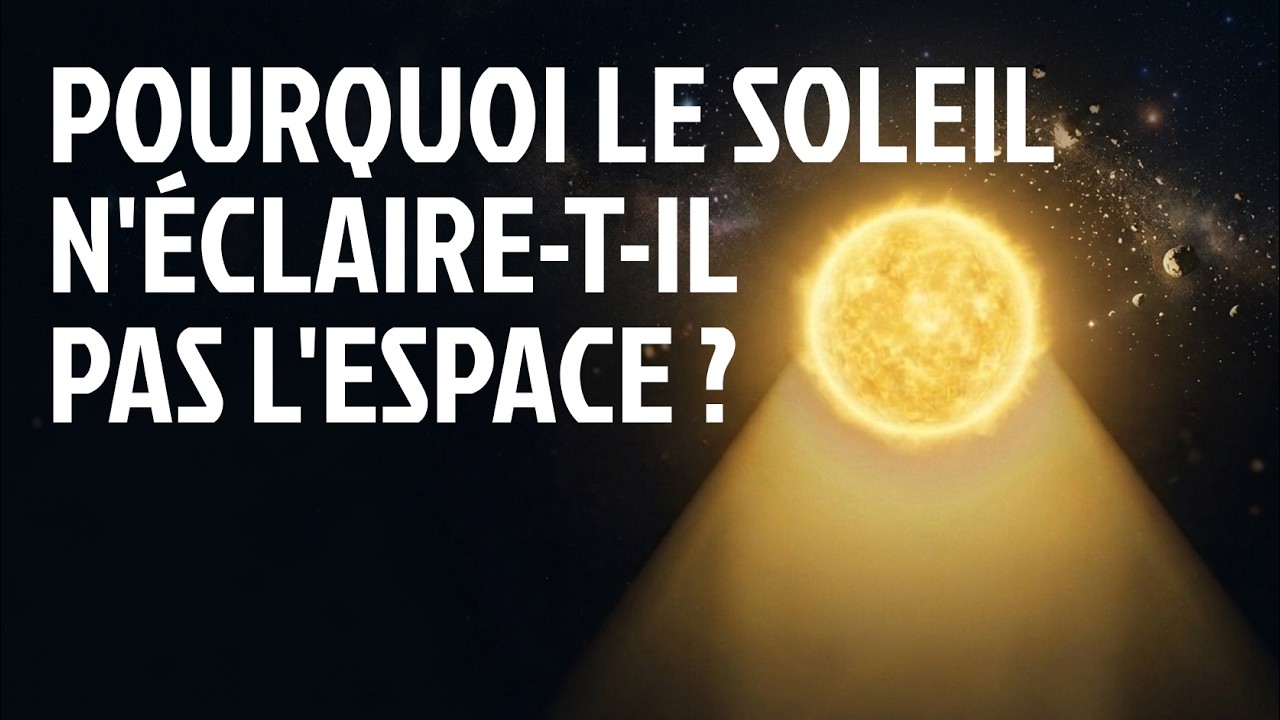
Pourquoi le Soleil éclaire-t-il les planètes, mais l'espace autour reste-t-il sombre ?
Keywords
Summary
158 words
Critical Evaluation
Value of the Information & Strength of the Argument
The video provides a clear and engaging explanation of a classic cosmological puzzle. It builds the argument logically, starting with basic observations and progressively introducing more complex concepts. The use of analogies (e.g., scaling the solar system) helps make abstract ideas accessible. The argumentation is solid, correctly identifying the key factors that resolve Olbers’ paradox: the finite age of the universe and the expansion of space. The video also correctly explains the role of atmospheric scattering in the color of the sky and the darkness of space, and it clarifies common misconceptions about why stars don’t appear in photographs of planets.
Scientific Rigor, Source Quality, Title Accuracy
The video demonstrates strong scientific rigor. It accurately describes Rayleigh scattering, the scale of the universe, and the resolution of Olbers’ paradox. It references specific missions and observations (Hubble Deep Field, JWST, Gaia) and mentions the cosmic microwave background. The title is somewhat misleading as it focuses on the darkness of space, but the content is directly relevant to the broader question of why the night sky is dark. The video does not cite specific sources in the description, but the information presented is consistent with established scientific knowledge.
205 words
Title / Content Match
The title is slightly misleading as it focuses on the darkness of space, but the video primarily addresses Olbers' paradox and the reasons for the night sky's darkness, which is closely related.
Quality & Reliability
8/10
The video provides a scientifically accurate and well-structured explanation of Olbers' paradox, incorporating established physics (Rayleigh scattering, cosmic expansion, cosmic microwave background) and referencing key missions (Hubble, JWST, Gaia). The content is up-to-date and aligns with current cosmological understanding, though it simplifies some concepts for a general audience.
Chapters
- Introduction
- Pourquoi le ciel nocturne paraît-il sombre ?
- Le paradoxe d'Olbers
- L'âge de l'univers : quand le temps devient l'ennemi de la lumière
- L'expansion de l'univers
- La lumière que nous ne pouvons pas voir
- La matière noire, la limite ultime de nos instruments
- Conclusion : ce que révèle l'obscurité du ciel
Contribution & Novelties
The video offers a comprehensive and accessible synthesis of the reasons for the darkness of the night sky, integrating multiple lines of evidence. It goes beyond a simple explanation of Olbers’ paradox by also covering atmospheric scattering, the expansion of the universe, and the cosmic microwave background. The use of vivid analogies and historical context adds depth. For those interested in exploring further, the following concepts and resources are relevant:
Pour aller plus loin :
- Olbers’ paradox — The classic paradox and its resolution.
- Cosmic microwave background — The remnant radiation from the Big Bang, a key piece of evidence.
- Hubble Deep Field — The iconic image that revealed thousands of galaxies in a tiny patch of sky.
- James Webb Space Telescope — The latest space observatory pushing the limits of observation.
132 words
Radar Profile
The radar profile shows high scores in information quantity, quality, and reliability, with a moderate technical level. This indicates a well-researched and accurate video that is accessible to a general audience, though it does not delve into highly technical details.