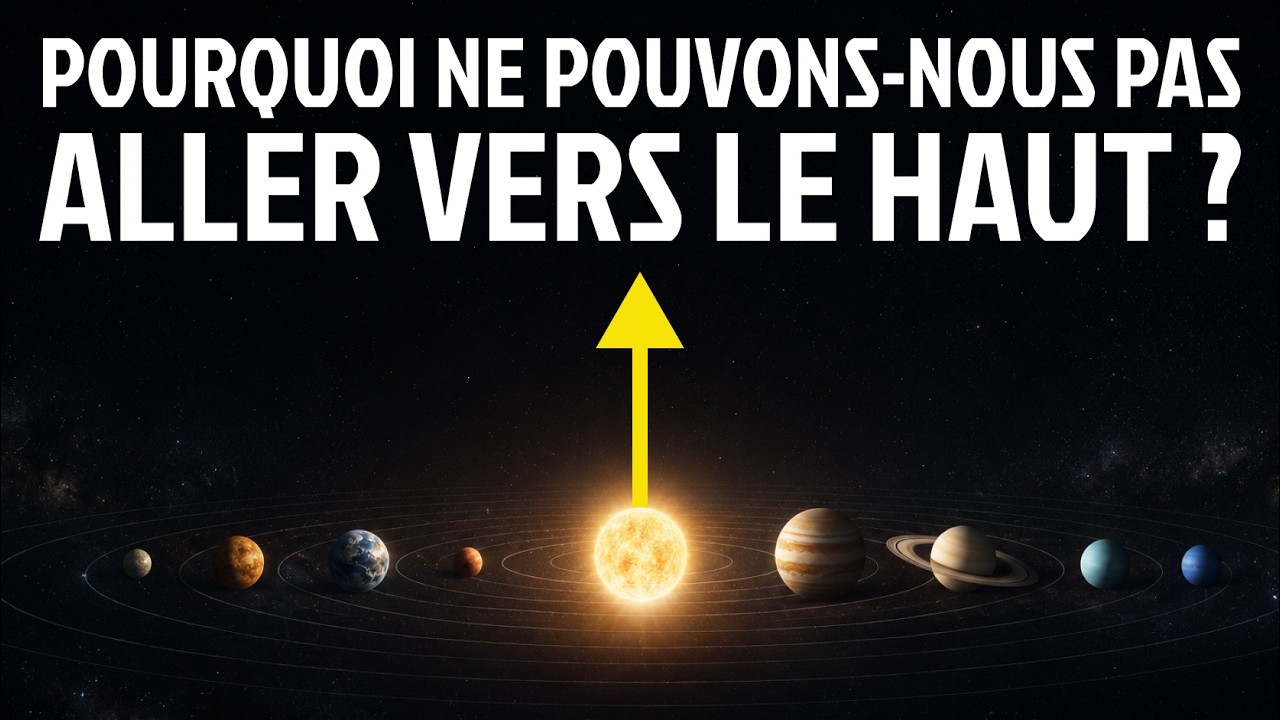
Pourquoi Est-il Impossible d'Aller « Vers le Haut » dans le Système Solaire
Keywords
Summary
197 words
Critical Evaluation
Value of the Information & Strength of the Argument
The video provides substantial value by explaining complex astrodynamics concepts in an accessible yet accurate manner. It effectively uses analogies (e.g., the prison, the cicatrice) to illustrate the constraints of orbital mechanics. The argumentation is solid, building logically from the problem (delta-v) to the solutions (Oberth maneuver, solar sails). It cites real missions and scientific findings, which strengthens its credibility. The discussion of the heliosphere’s shape and the IBEX ribbon adds depth, showing current scientific uncertainties. The video also highlights the practical implications of understanding the solar poles for space weather prediction, making the topic relevant.
Scientific Rigor, Source Quality, Title Accuracy
The video demonstrates high scientific rigor, referencing actual missions (Ulysses, Solar Orbiter, Parker Solar Probe, IBEX, IMAP) and scientific principles (Tsiolkovsky equation, Oberth effect). The information is consistent with current knowledge in astrodynamics and heliophysics. The title accurately reflects the content, which focuses on the difficulty of vertical escape from the ecliptic. The video does not overstate claims and acknowledges uncertainties, such as the exact shape of the heliosphere. The use of specific data (e.g., speeds, distances, mission dates) adds to its reliability. No major discrepancies were found.
199 words
Title / Content Match
The title accurately reflects the core topic: the difficulty and near-impossibility of traveling perpendicular to the ecliptic plane in the solar system.
Quality & Reliability
8/10
The video provides a scientifically accurate and well-structured explanation of orbital mechanics, citing real missions (Ulysses, Solar Orbiter, Parker Solar Probe, IBEX, IMAP) and scientific concepts (Oberth maneuver, delta-v, heliosphere). The information is up-to-date as of 2026 and aligns with established knowledge. Minor simplifications are present but do not compromise accuracy.
Chapters
- L'illusion d'avoir déjà tout conquis
- La prison invisible
- La frontière ultime est encore au-dessus de nous
- Les deux témoins du sommet
- La bulle à la forme inconnue
- Le plongeon dans le feu
- La photographie qui manque à l'histoire
- Tomber dans le Soleil coûte plus cher que d'en partir
- Les trois portes de sortie
- Qu'est-ce que "le haut", au juste ?
- Pourquoi personne ne l'a encore fait
- Le dernier mot
Cited Sources
- Ulysses mission (NASA/ESA) — Mentioned as the first mission to observe the solar poles, using a Jupiter gravity assist.
- Solar Orbiter (ESA) — Current mission providing first direct images of the solar poles, using Venus flybys.
- Parker Solar Probe (NASA) — Record-breaking probe that survived close approaches to the Sun, demonstrating heat shield technology.
- IBEX (NASA) — Mapped the heliosphere boundary using energetic neutral atoms, discovering the IBEX ribbon.
- IMAP (NASA) — Launched in 2025 to map the heliosphere with higher sensitivity.
Concurring Sources
- NASA Solar System Exploration — General information on missions and solar system structure, consistent with the video's claims.
- ESA Science & Technology — Details on Solar Orbiter's trajectory and objectives, supporting the video's description.
Contribution & Novelties
The video synthesizes recent developments in solar and heliospheric exploration, presenting the challenge of vertical escape as a key frontier. It connects the energy problem to the Oberth maneuver and solar sails, offering a forward-looking perspective. The discussion of the heliosphere’s uncertain shape and the IBEX ribbon adds novelty, as these are recent findings. The video also emphasizes the importance of solar poles for space weather, which is often underappreciated.
Pour aller plus loin :
- Oberth effect — The principle behind the maneuver described, crucial for understanding the energy gain at perihelion.
- Tsiolkovsky rocket equation — The fundamental equation explaining the exponential fuel requirements.
- Solar sail — The technology proposed as a fuel-free alternative for changing orbital inclination.
- Heliosphere — The bubble-like region shaped by the solar wind, whose form is still debated.
133 words
Radar Profile
The radar profile shows high scores in information quantity and quality, with a slightly lower but still strong technical level and reliability. This indicates a well-balanced, informative, and credible video, with a slight emphasis on providing substantial content rather than extreme technical depth.
💬 Sur les 0 commentaires analysés, aucune tendance n'est disponible.