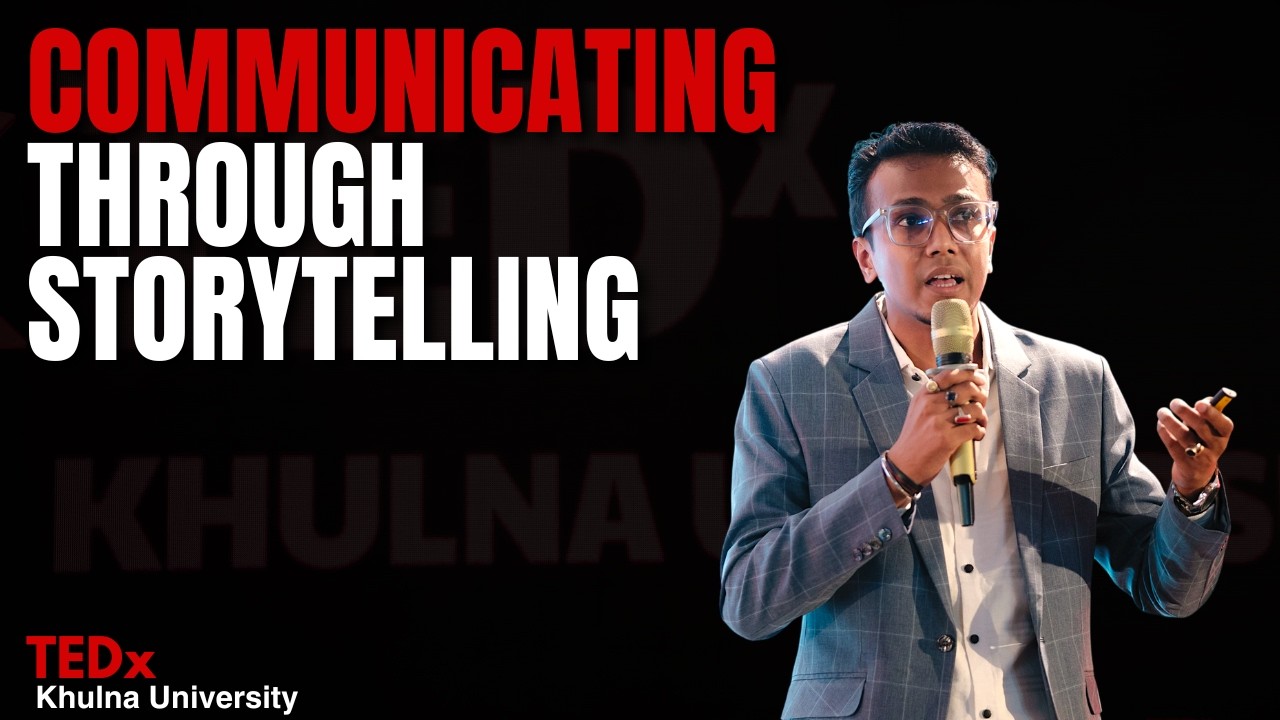
Communicating through Storytelling | Uzzal Saha | TEDxKhulna University
Keywords
Summary
152 words
Critical Evaluation
Value of the Information & Strength of the Argument
The talk’s value lies in its inspirational and motivational aspects, drawing on the speaker’s personal experiences to illustrate the potential of storytelling for social impact. However, the argumentation is largely anecdotal and lacks empirical evidence or structured analysis. The speaker makes broad claims about the effectiveness of storytelling without providing concrete data or case studies, which weakens the overall persuasiveness. The advice given, such as finding a purpose and staying consistent, is generic and not backed by specific methodologies or research.
Scientific Rigor, Source Quality, Title Accuracy
The talk demonstrates low scientific rigor, as it contains no citations, references, or data to support its claims. The only source mentioned is the TEDx platform itself, which is not a scientific source. The title accurately reflects the content, which is a personal narrative on storytelling. The speaker’s credibility is based on his professional role and personal achievements, but these are not independently verifiable within the talk. Overall, the content is more of an opinion piece than a scientifically grounded presentation.
177 words
Title / Content Match
The title accurately reflects the content, which focuses on the power of storytelling in communication, though the talk also includes personal anecdotes and career advice.
Quality & Reliability
5/10
The talk is a personal narrative and opinion piece with no empirical data, citations, or verifiable sources. It relies on anecdotal evidence and general assertions, limiting its scientific reliability.
Key Moments
Markers derived by PSI from the transcript: the creator did not define chapters.
- Introduction: Speaker asks about the audience's life at age 16, introducing the story of a 16-year-old mother from the Bede community.
- Discussion on marginalized communities in Bangladesh, including the Bede and indigenous groups, and their lack of identity and rights.
- Explanation of strategic communication and the importance of connecting emotionally with the audience.
- Advice for aspiring storytellers: finding purpose, building confidence, and self-learning.
- Personal journey: from TEDx volunteer to co-founding an organization working with over 2,000 women, using storytelling for social change.
- Call to action: encouraging the audience to use storytelling for better governance and to smile, work for others, and love people.
Cited Sources
- TEDx Program — Mentioned as the platform for the talk and for further information about TEDx events.
Concurring Sources
- TEDx Talks — The talk is part of the TEDx series, which often features personal stories and ideas worth spreading.
Contribution & Novelties
The talk offers a personal perspective on storytelling as a tool for social change, particularly in the context of Bangladesh. It highlights the importance of giving voice to marginalized communities and provides anecdotal evidence of how storytelling can be used in advocacy. However, it does not introduce new concepts or research, and the advice is largely generic.
Pour aller plus loin :
- Narrative transportation theory — Explores how stories can immerse audiences and influence attitudes, relevant to the talk’s emphasis on emotional connection.
- Digital storytelling — A method of using digital media to tell stories, which aligns with the speaker’s use of photos and videos.
- Social impact storytelling — Discusses how narratives can drive social change, echoing the talk’s call to action.
122 words
Radar Profile
The radar profile shows low scores across all dimensions, indicating a talk that is light on information, technical depth, and reliability. It is primarily an inspirational narrative rather than an informative or evidence-based presentation.