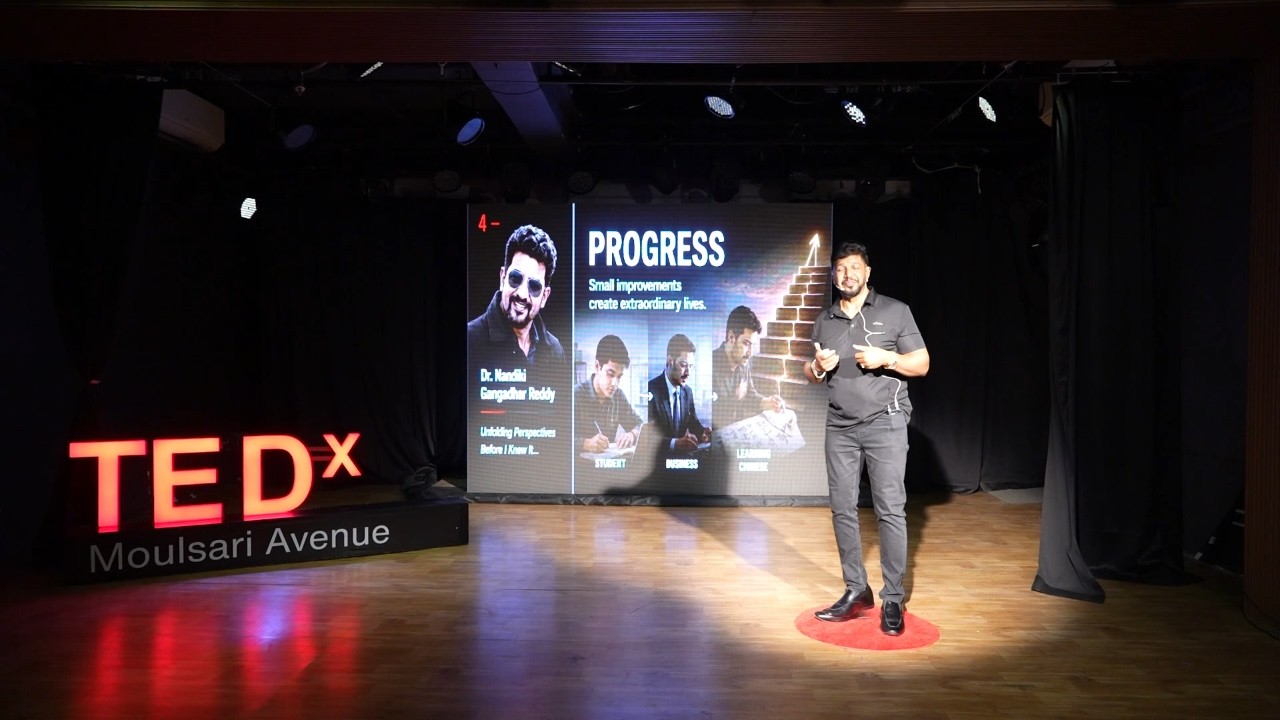
The meaning we find later | Dr. Nandiki Gangadhar Reddy | TEDxMoulsari Avenue
Keywords
Summary
160 words
Critical Evaluation
Value of the Information & Strength of the Argument
The talk’s value lies in its relatable personal anecdotes that illustrate abstract concepts like ikigai and kaizen. The speaker’s story of leaving a stable job to pursue a purpose-driven career is compelling and provides a concrete example of retrospective meaning-making. However, the argumentation is largely anecdotal and lacks rigorous evidence or critical analysis. The speaker presents the Japanese concepts as universally applicable without addressing cultural nuances or potential criticisms. The connection to the Bhagavad Gita is interesting but underdeveloped, and the claim that these principles are universal is asserted rather than argued. Overall, the talk offers inspirational value but limited analytical depth.
Scientific Rigor, Source Quality, Title Accuracy
The talk does not cite any scientific sources or studies, relying solely on personal experience and general references to Japanese philosophy. The only external source mentioned is the TEDx program itself, with a link to ted.com/tedx. The title ‘The meaning we find later’ accurately reflects the central theme of understanding life’s events in retrospect, though the connection is not explicitly stated until the end. The speaker’s credibility is established through his professional background, but the lack of citations weakens the scientific rigor. The talk is more of a motivational speech than a scholarly presentation.
211 words
Title / Content Match
The title accurately reflects the talk's theme of retrospective meaning-making, though the connection is implicit.
Quality & Reliability
5/10
Personal narrative with anecdotal evidence; no scientific sources cited; Japanese concepts presented simplistically; lacks empirical support.
Key Moments
Markers derived by PSI from the transcript: the creator did not define chapters.
- Introduction: Speaker asks audience about major life decisions and introduces the theme of meaning unfolding later.
- Speaker introduces Japanese concepts: ikigai, kaizen, and wabi-sabi as frameworks for understanding life.
- Story of the 1999 Odisha cyclone and the decision to leave a government job to pursue sustainable housing.
- Explanation of kaizen through personal academic success and the habit of daily review instilled by his mother.
- Learning Chinese using kaizen during commode time, leading to a technical partnership.
- Discussion of wabi-sabi as acceptance, illustrated by business challenges and COVID-19 decisions.
- Encounter with a Japanese monk and the connection of Japanese concepts to Indian philosophy, particularly the Bhagavad Gita.
- Conclusion: Universal message of dharma, karma, and peace, with a closing sloka.
Cited Sources
- TEDx Program — Mentioned as the organizing body for the talk.
Concurring Sources
- Ikigai: The Japanese Secret to a Long and Happy Life — Popular book that discusses ikigai as a framework for purpose and well-being.
Dissenting Sources
- Critique of Ikigai as a Buzzword — Some scholars argue that ikigai is often oversimplified in Western media, losing its cultural specificity.
Contribution & Novelties
The talk offers a personal narrative that connects Japanese life principles (ikigai, kaizen, wabi-sabi) to Indian philosophical concepts, suggesting a universal human wisdom. While not scientifically novel, it provides a relatable framework for personal development.
Pour aller plus loin :
- Ikigai — Overview of the Japanese concept of purpose.
- Kaizen — Explanation of continuous improvement philosophy.
- Wabi-sabi — Aesthetic and worldview centered on imperfection and acceptance.
- Bhagavad Gita — Hindu scripture referenced in the talk for its teachings on dharma and karma.
82 words
Radar Profile
The radar profile shows low scores in technical level and reliability, reflecting the anecdotal nature of the talk. Information quantity and quality are moderate, indicating a personal story with limited depth. The overall profile suggests a motivational talk rather than a rigorous scientific presentation.
💬 Sur les 0 commentaires analysés, aucune tendance n'est disponible.