The Cost of What We Don't See
Keywords
Summary
164 words
Critical Evaluation
Value of the Information & Strength of the Argument
The talk provides a compelling narrative that links safety to financial performance, using relatable analogies (e.g., chai stalls, car insurance) to make the argument accessible. The speaker’s personal experience lends credibility, but the argumentation relies heavily on anecdotal evidence and emotional appeals rather than rigorous data. The 1:6 cost ratio is presented as a simple mathematical truth without a clear derivation or source, which weakens the scientific rigor. The use of Heinrich’s triangle is appropriate but not deeply explored. The argument that safety is a strategic investment is well-structured, but the lack of specific, verifiable examples of ROI beyond general claims limits its persuasiveness.
Scientific Rigor, Source Quality, Title Accuracy
The talk references several sources: Heinrich’s triangle, OSHA, the National Disaster Management Authority (NDMA), and the National Green Tribunal. However, these are mentioned in passing without specific citations or data points. The Visakhapatnam and Bhopal incidents are well-known, but the figures cited (e.g., 13 deaths, 50 crore liability) are not sourced. The title is appropriate but does not fully capture the specific focus on the chemical industry and the PRICE framework. Overall, the scientific rigor is moderate; the talk is more of an expert opinion than a data-driven analysis.
208 words
Title / Content Match
The title accurately reflects the core message about hidden costs of safety neglect, though it is somewhat generic.
Quality & Reliability
6/10
The talk relies on anecdotal evidence and personal experience, with some references to established concepts (Heinrich's triangle) and regulatory bodies (OSHA, NDMA). However, specific statistics are not precisely cited, and the 1:6 cost ratio is presented without a clear source.
Key Moments
Markers derived by PSI from the transcript: the creator did not define chapters.
- Introduction of Rajan's story and the concept of hidden decisions leading to accidents.
- Introduction of the PRICE framework and the 'P' for 'Pay' - invisible costs.
- Discussion of Heinrich's triangle and the ratio of incidents to near misses.
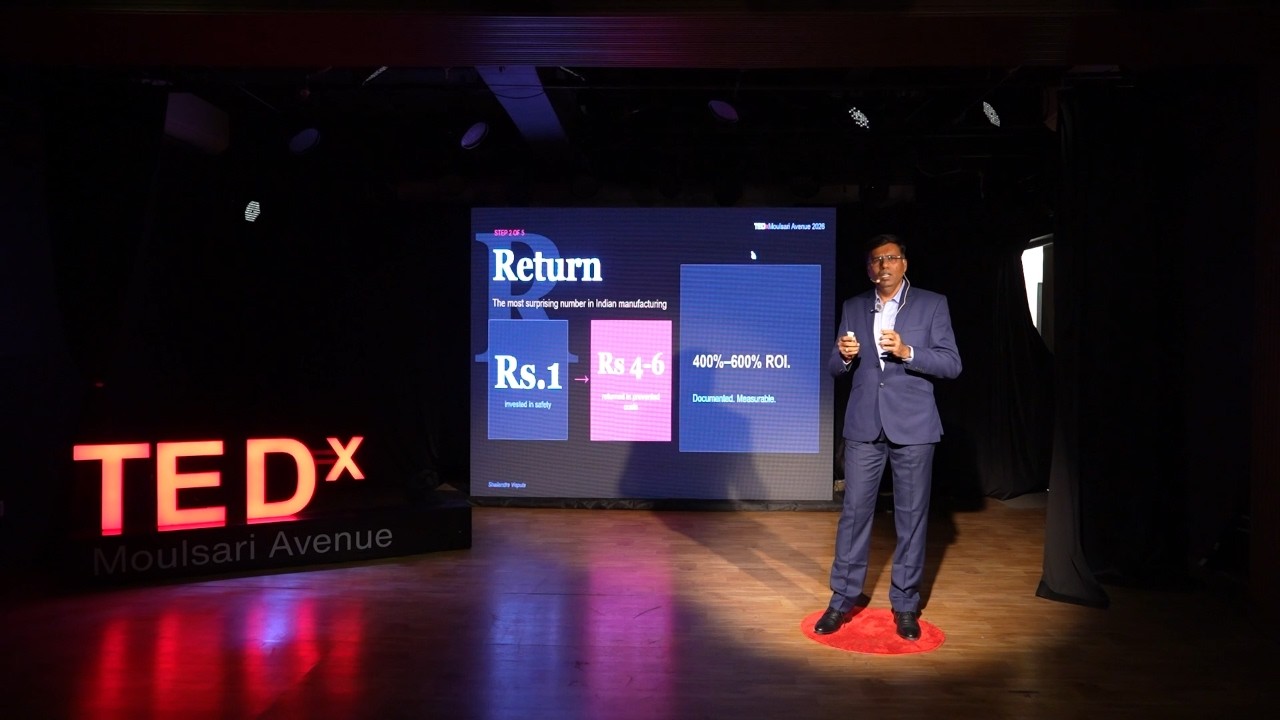
- The 'R' for 'Return' - safety as an investment with high ROI, using the chai stall analogy.
- The 'I' for 'Invest' - car insurance analogy and the Visakhapatnam gas leak example.
- The 'C' for 'Culture' - the Bhopal disaster and the importance of safety culture.
- The 'E' for 'Earn' - India's chemical industry growth and the link between safety and profitability.
Cited Sources
- TEDx Program — Mentioned in the video description as the organizing body for the TEDx event.
Concurring Sources
- Heinrich's triangle — The talk references this concept to explain the relationship between near misses and major accidents.
- OSHA — The talk cites OSHA as a source for the return on investment in safety.
Contribution & Novelties
The talk offers a practical framework (PRICE) for understanding safety as a strategic investment, which is a useful perspective for leaders. It synthesizes known concepts like Heinrich’s triangle and the business case for safety into a memorable narrative. The emphasis on culture as a collection of small decisions is a valuable insight.
Pour aller plus loin :
- Heinrich’s triangle — Provides background on the ratio of incidents to accidents.
- Bhopal disaster — Details the catastrophic industrial accident referenced in the talk.
- Occupational Safety and Health Administration (OSHA) — Official source for workplace safety regulations and data.
- National Disaster Management Authority (NDMA) — Indian agency responsible for disaster management, mentioned in the talk.
112 words
Radar Profile
The radar profile shows moderate scores across all dimensions, with a slight emphasis on information quantity and quality. This reflects a talk that is informative but not deeply technical or highly rigorous, balancing anecdotal evidence with established concepts.