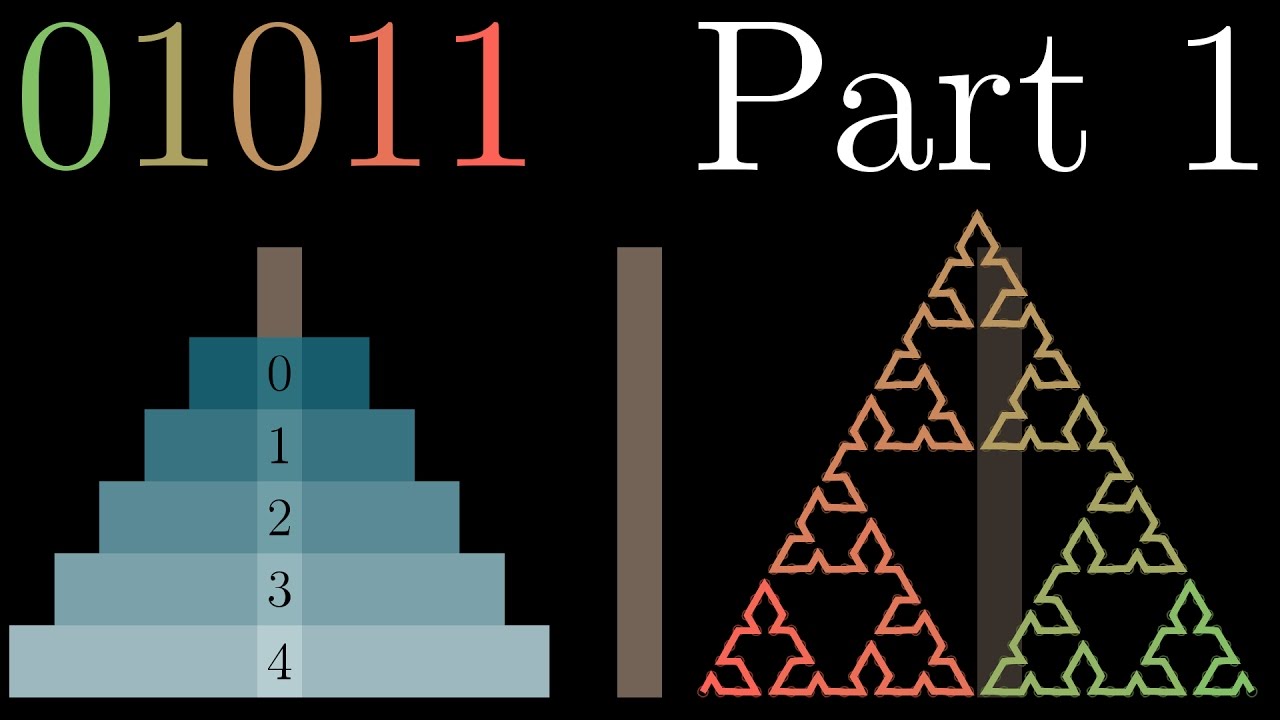
Binary, Hanoi and Sierpinski, part 1
Keywords
Summary
110 words
Critical Evaluation
Value of the Information & Strength of the Argument
The video provides a valuable insight into the deep connection between binary arithmetic and the Tower of Hanoi, illustrating the power of recursive thinking. The argumentation is solid, building from basic concepts to the elegant correspondence between bit flips and disk moves. The use of visual animations effectively reinforces the logical steps, making the reasoning easy to follow. The presenter also addresses potential questions, such as why the method always yields legal moves and why it is optimal, strengthening the overall argument.
Scientific Rigor, Source Quality, Title Accuracy
The scientific rigor is high, as the mathematical content is accurate and well-explained. The video does not cite external sources, but it is based on well-known mathematical facts. The title accurately reflects the content, focusing on the binary solution to the Tower of Hanoi. The description includes a link to Desmos careers, which is a sponsor, but this does not affect the scientific content. The video is a clear and reliable educational resource.
170 words
Title / Content Match
The title accurately reflects the content, as the video indeed explores the relationship between binary counting and the Tower of Hanoi, setting up for the Sierpinski triangle in part 2.
Quality & Reliability
9/10
The video presents a well-established mathematical connection between binary counting and the Tower of Hanoi puzzle, with clear explanations and visualizations. The content is accurate and aligns with known mathematical facts. The presentation is rigorous, though it does not delve into formal proofs, but the reasoning is sound and the educational quality is high.
Key Moments
Markers derived by PSI from the transcript: the creator did not define chapters.
- Introduction to the Tower of Hanoi puzzle and the surprising connection to binary counting.
- Explanation of the rules of the Tower of Hanoi and the goal of the puzzle.
- Introduction to binary counting, emphasizing the rhythmic pattern of flipping bits.
- Demonstration of how binary counting can be used to solve the Tower of Hanoi, with visual examples.
- Discussion of the recursive nature of both binary counting and the Tower of Hanoi solution.
- Explanation of why the binary method is optimal and always yields legal moves.
- Connection between the self-similar patterns in binary counting and the Tower of Hanoi.
- Teaser for part 2, linking the concepts to the Sierpinski triangle.
Cited Sources
- Desmos Careers — Sponsor mention in the video description, not directly related to the content.
Concurring Sources
- Tower of Hanoi — Confirms the rules and recursive solution of the puzzle.
- Binary number — Provides background on binary counting.
Contribution & Novelties
The video offers a fresh perspective on the Tower of Hanoi by linking it to binary counting, highlighting the self-similar structure common to both. This connection is not widely known and provides a deeper understanding of recursion and binary arithmetic. The visual presentation makes the abstract concept tangible.
Pour aller plus loin :
- Tower of Hanoi — Provides background on the puzzle and its recursive solution.
- Binary number system — Explains the binary system and its properties.
- Recursion (computer science) — Discusses recursion, a key concept in the video.
- Sierpinski triangle — The fractal mentioned as the topic of part 2.
101 words
Radar Profile
The radar profile shows high scores in information quality and reliability, with slightly lower scores in quantity and technical depth. This reflects a well-explained but concise introduction to the topic, suitable for a broad audience.
💬 Très positif. Sur les 30 commentaires analysés, les spectateurs expriment un grand enthousiasme pour la clarté et l'élégance de l'explication, certains mentionnant des révélations personnelles sur les liens entre mathématiques et informatique.