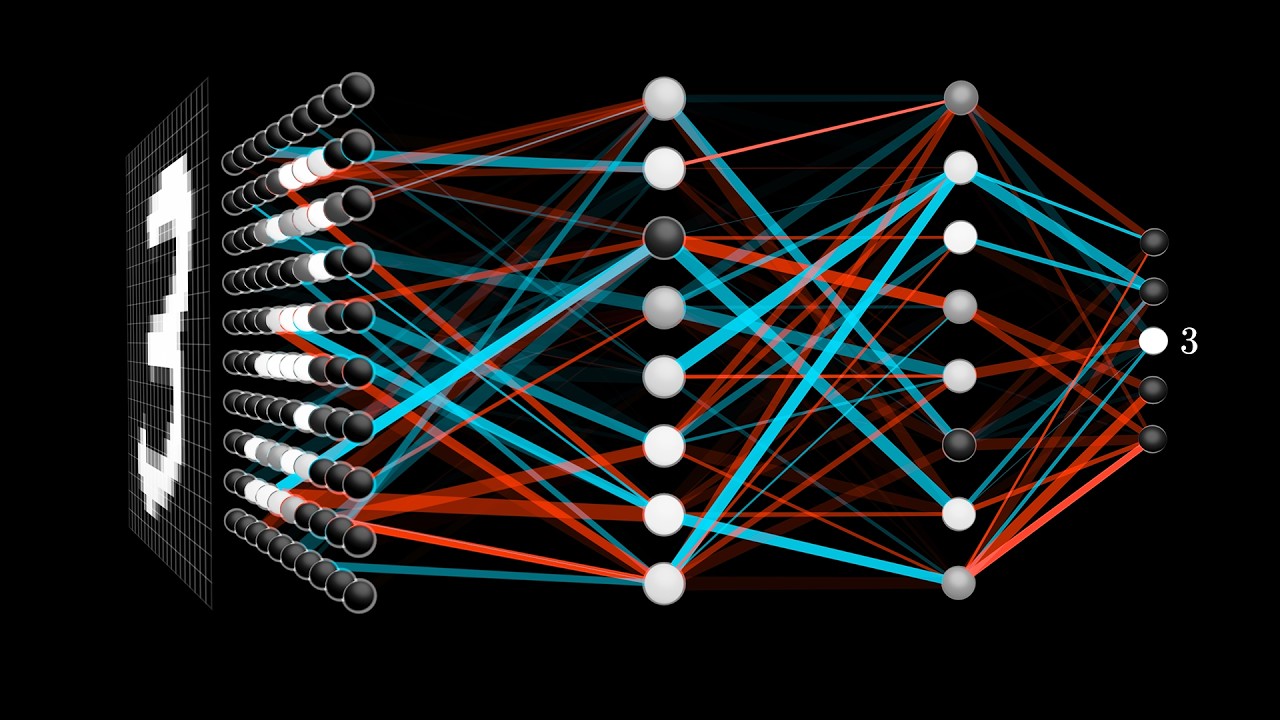
But what is a neural network? | Deep learning chapter 1
Keywords
Summary
143 words
Critical Evaluation
Value of the Information & Strength of the Argument
The video provides high value by demystifying a complex topic through clear, intuitive explanations and visualizations. It builds the concept of a neural network from the ground up, starting with individual neurons and progressing to the full network architecture. The argumentation is solid, as it logically motivates the structure of layers and the use of weights and biases. The use of the handwritten digit example effectively illustrates the concepts, and the mathematical notation is introduced in a way that is accessible yet accurate. The video also encourages further learning by pointing to additional resources.
Scientific Rigor, Source Quality, Title Accuracy
The video demonstrates strong scientific rigor by accurately presenting the mathematical foundations of neural networks and acknowledging simplifications. It cites reputable sources, including Michael Nielsen’s free online book, Chris Olah’s blog, and the Deep Learning textbook by Goodfellow et al. The title accurately reflects the content, and the video’s structure is well-organized. The creator also provides a correction for a minor notation error, showing attention to detail. Overall, the sources are credible and the content is reliable.
186 words
Title / Content Match
The title accurately reflects the content, which provides a foundational explanation of neural networks.
Quality & Reliability
9/10
High-quality educational content with clear explanations, accurate mathematical foundations, and references to reputable resources. The video is well-structured and the information is presented with appropriate caveats about simplifications.
Chapters
Cited Sources
- Neural Networks and Deep Learning (book) — Recommended for further learning, available for free.
- Neural Networks and Deep Learning (GitHub) — Code and data for the same example introduced in the video.
- Chris Olah's blog — Recommended for deeper insights into neural networks.
- Distill publication — Recommended for beautiful and clear explanations of machine learning concepts.
- Deep Learning (book) — Advanced text by Goodfellow, Bengio, and Courville.
- Manim (animation library) — Open-source Python library used for animations.
- 3Blue1Brown website — Official website with additional resources.
- 3Blue1Brown neural networks topics — Interactive form of this series.
- Welch Labs video 1 — Recommended series on machine learning.
- Welch Labs video 2 — Recommended series on machine learning.
Concurring Sources
- Michael Nielsen's Neural Networks and Deep Learning — Provides a similar introduction to neural networks with the same example.
- Deep Learning by Goodfellow et al. — Authoritative textbook that covers the mathematical foundations in depth.
External References
Contribution & Novelties
This video provides a clear and intuitive introduction to neural networks, emphasizing the mathematical structure and the role of layers in feature detection. It stands out for its visual explanations and accessible approach, making complex concepts understandable. The video also sets the stage for understanding the learning process in subsequent videos.
Pour aller plus loin :
- Neural Networks and Deep Learning — Free online book by Michael Nielsen, covering the same example with code.
- Deep Learning — Comprehensive textbook by Goodfellow, Bengio, and Courville.
- Distill — Publication with interactive and visual explanations of machine learning concepts.
- Chris Olah’s blog — In-depth articles on neural network internals.
- Manim — The animation library used to create the video’s visuals.
117 words
Radar Profile
The radar profile shows high scores in information quality, technical level, and reliability, with slightly lower but still strong scores in information quantity. This indicates a well-balanced, authoritative educational resource that is both informative and technically sound.
💬 Très positif. Sur les 30 commentaires analysés, les spectateurs expriment une admiration unanime pour la clarté des explications et la qualité pédagogique, saluant souvent la vidéo comme une référence incontournable pour comprendre les réseaux de neurones.