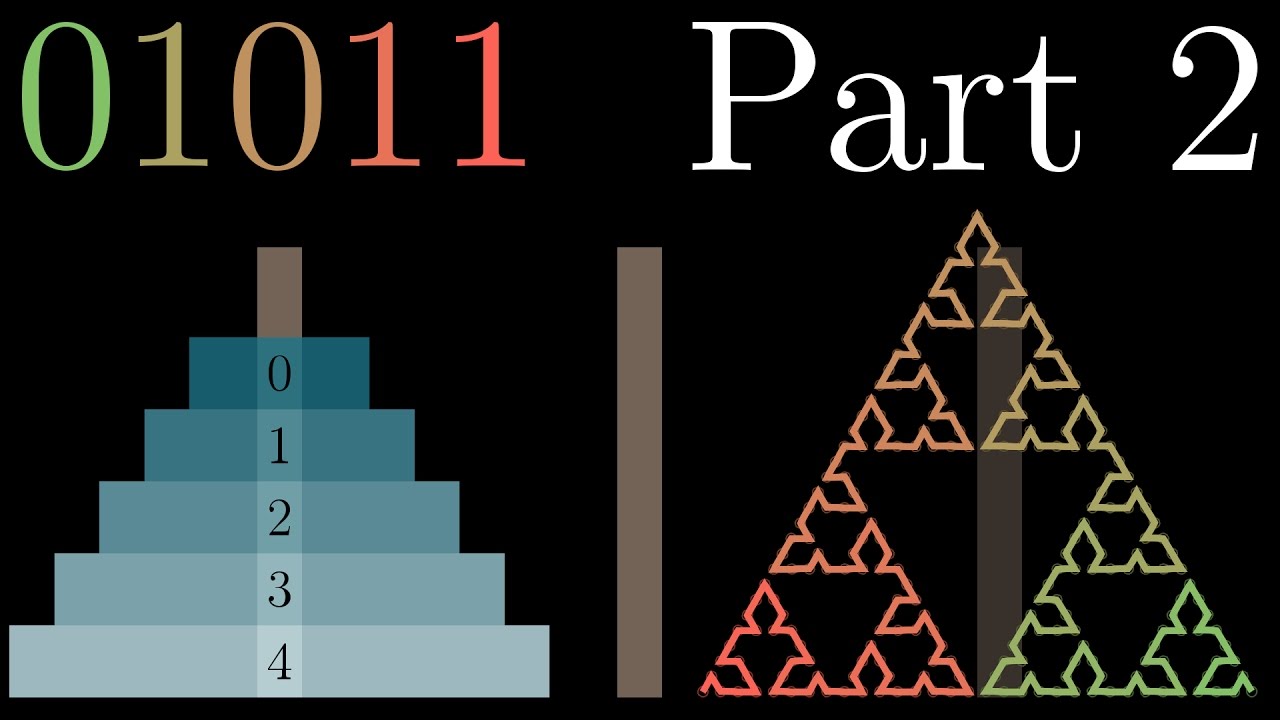
Binary, Hanoi, and Sierpinski, part 2
Keywords
Summary
146 words
Critical Evaluation
Value of the Information & Strength of the Argument
The video provides a high-value explanation of a non-trivial mathematical connection. The argumentation is solid, building step-by-step from the binary solution to the Towers of Hanoi to the ternary solution of a constrained version, and finally to the Sierpinski triangle. The use of animations and clear visualizations greatly enhances the understanding of the recursive and self-similar patterns. The video does not just state the connection but explains why it works, by highlighting the parallel structures between counting and the puzzle. The logical flow is compelling and the reasoning is rigorous.
Scientific Rigor, Source Quality, Title Accuracy
The video is scientifically rigorous, presenting a well-known mathematical relationship with clear explanations. The sources are not explicitly cited within the video, but the content is consistent with established mathematical knowledge. The title accurately reflects the content, which is a continuation of the previous video on binary counting and the Towers of Hanoi. The video does not rely on external sources but rather on the internal logic of the mathematical argument. The quality of the explanation is high, and the video is well-structured.
188 words
Title / Content Match
The title accurately reflects the content, which builds on the binary solution to the Towers of Hanoi and extends it to ternary counting and the Sierpinski triangle.
Quality & Reliability
9/10
The video presents a rigorous mathematical argument, clearly explaining the connection between ternary counting, the Towers of Hanoi, and the Sierpinski triangle. The reasoning is logical and well-illustrated, with no apparent errors. The content is consistent with established mathematical knowledge.
Key Moments
Markers derived by PSI from the transcript: the creator did not define chapters.
- Introduction: recap of the binary solution to Towers of Hanoi and introduction to the constrained version.
- Explanation of ternary counting and its relation to the constrained Towers of Hanoi.
- Visualization of the constrained solution as a path through a graph.
- Connection between the graph and the Sierpinski triangle.
- Discussion of the self-similar nature of the problem and the fractal structure.
- Conclusion and teaser for the next video.
Cited Sources
- Desmos Careers — Mentioned as a sponsor and for job opportunities.
Concurring Sources
- Towers of Hanoi — The video's explanation of the recursive solution aligns with the standard algorithm.
- Sierpinski triangle — The video's visualization of the Sierpinski triangle as a graph is consistent with its known properties.
Contribution & Novelties
The video provides an original and insightful presentation of the connection between ternary counting, the Towers of Hanoi, and the Sierpinski triangle. It offers a clear visual and intuitive explanation of why these seemingly unrelated concepts are deeply linked. The use of animations to illustrate the recursive and self-similar patterns is particularly effective.
Pour aller plus loin :
- Towers of Hanoi — Provides background on the classic puzzle and its recursive solution.
- Sierpinski triangle — Explains the fractal and its properties.
- Ternary numeral system — Details the base-3 counting system used in the video.
94 words
Radar Profile
The radar chart shows high scores in quality of information and reliability, with slightly lower scores in quantity and technical level. This indicates a focused, well-explained video that may not cover a broad range of topics but excels in depth and clarity.
💬 Très positif. Sur les 30 commentaires analysés, l'enthousiasme est unanime, les spectateurs saluent la beauté des connexions mathématiques et la qualité des animations, certains exprimant une admiration quasi émotionnelle.