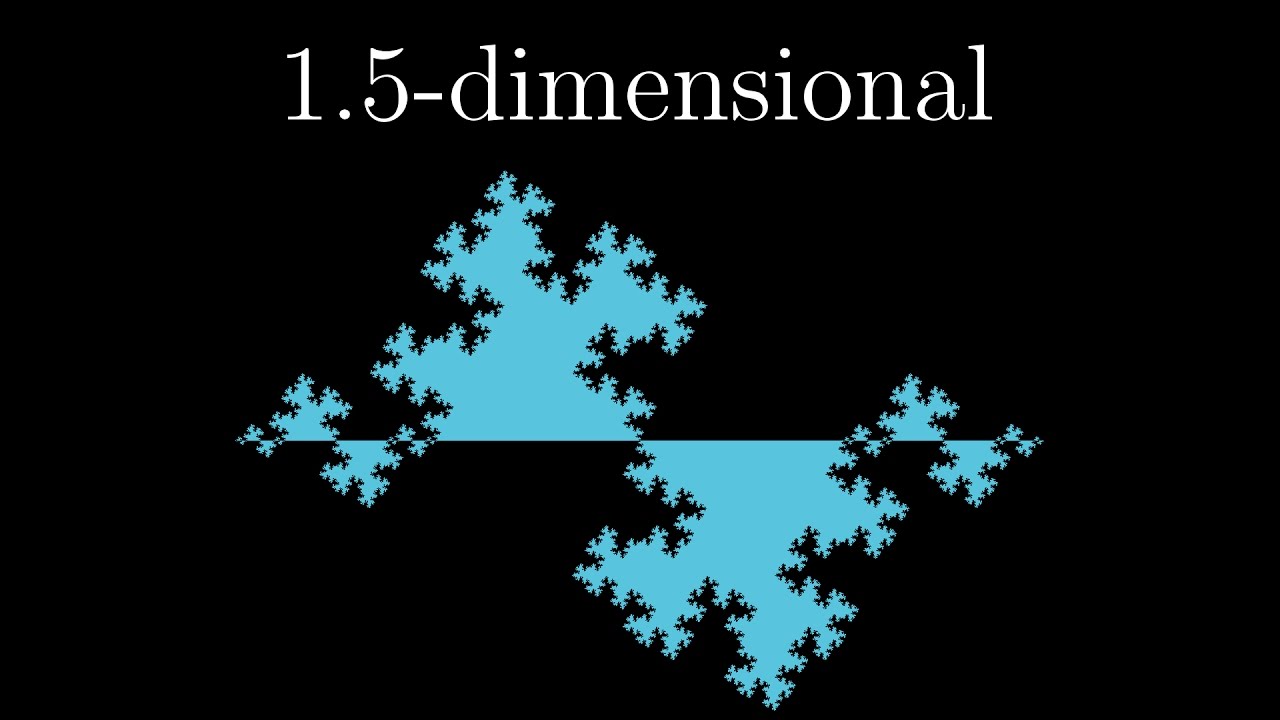
Fractals are typically not self-similar
Keywords
Summary
112 words
Critical Evaluation
Value of the Information & Strength of the Argument
The video provides a clear and compelling argument for redefining fractals beyond self-similarity. It builds from simple self-similar examples to a general method (box-counting) that applies to natural shapes. The argumentation is solid, using logical progression and visual demonstrations to support each step. The value lies in correcting a widespread misconception and offering a practical tool for measuring roughness in nature.
70 words
Title / Content Match
The title accurately reflects the video's main thesis: fractals are not necessarily self-similar, and the video explains the broader concept of fractal dimension.
Quality & Reliability
9/10
High-quality mathematical exposition with rigorous definitions and clear visualizations, backed by references to Mandelbrot's work and standard mathematical concepts.
Key Moments
Markers derived by PSI from the transcript: the creator did not define chapters.
- Introduction to fractals and common misconception about self-similarity.
- Definition of fractal dimension using self-similar examples.
- Calculation of dimension for Sierpinski triangle and Koch curve.
- Introduction of box-counting method for non-self-similar shapes.
- Application to coastline of Britain and empirical measurement.
- Discussion of scale-dependence and definition of fractals.
- Examples of natural fractals and their dimensions.
- Conclusion and emphasis on the broader concept of fractals.
Cited Sources
- 3Blue1Brown Home Page — Official channel page with additional resources.
- Fractals Thanks — List of supporters for the video.
- Riemann Zeta Function by Vince Rubinetti — Background music used in the video.
- 3Blue1Brown Playlist — Recommended playlist for further viewing.
- Reddit Community — Community discussion forum.
Concurring Sources
- Mandelbrot's book 'The Fractal Geometry of Nature' — Referenced in the video description as the full reference for fractal definitions.
External References
Contribution & Novelties
The video provides a clear and accessible explanation of fractal dimension, correcting the common misconception that fractals are always self-similar. It introduces the box-counting method as a practical tool for measuring roughness in natural shapes, bridging pure mathematics and applied science.
Pour aller plus loin :
- Hausdorff dimension — A more general definition of fractal dimension.
- Coastline paradox — The phenomenon that coastline length depends on measurement scale.
- Mandelbrot set — A famous fractal with integer dimension boundary.
78 words
Radar Profile
The radar profile shows high scores in information quantity, quality, and reliability, with a slightly lower technical level, indicating a well-balanced educational video that is both rigorous and accessible.
💬 Très positif. Sur les 30 commentaires analysés, les spectateurs expriment une admiration enthousiaste pour la clarté et la beauté des explications, avec de nombreux commentaires humoristiques et des anecdotes personnelles sur l'impact du contenu.