All possible pythagorean triples, visualized
Keywords
Summary
214 words
Critical Evaluation
Value of the Information & Strength of the Argument
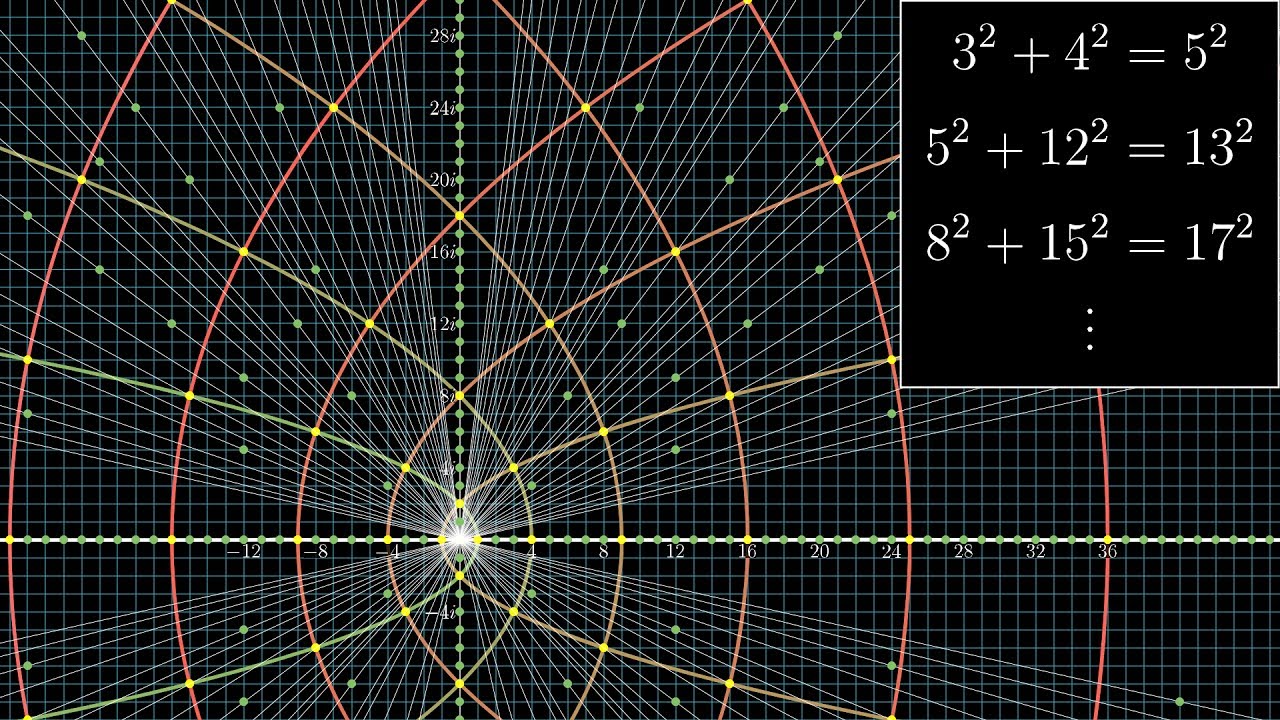
The video provides a high-value, elegant explanation of a classic number theory problem. The argumentation is rigorous and well-structured: it introduces the complex number approach, demonstrates its effectiveness with examples, addresses its limitations (missing multiples), and then proves completeness using a geometric argument on the unit circle. The logical flow is clear, and the visualizations significantly aid understanding. The proof that all rational slopes are covered is particularly convincing, establishing that the method indeed generates all Pythagorean triples.
Scientific Rigor, Source Quality, Title Accuracy
The video is scientifically rigorous, with a correct mathematical derivation and proof. It does not cite external sources, but it is based on well-established mathematical concepts. The title accurately reflects the content, and the video delivers on its promise to visualize all Pythagorean triples. The description includes links to the channel’s website, Patreon, and social media, but no specific academic references. The video’s internal logic and clarity compensate for the lack of external citations.
167 words
Title / Content Match
The title accurately reflects the content: the video visualizes and explains how to generate all Pythagorean triples using complex numbers.
Quality & Reliability
9/10
The video presents a rigorous mathematical derivation, correctly linking complex numbers to Pythagorean triples, and includes a proof of completeness. The reasoning is clear and well-illustrated, with no apparent errors.
Key Moments
Markers derived by PSI from the transcript: the creator did not define chapters.
- Introduction to Pythagorean triples and Fermat's Last Theorem
- Reformulation as lattice points at integer distance
- Introduction of complex numbers and squaring to generate triples
- Visualization of the square transformation on the grid
- Discussion of missing triples and scaling factors
- Shift to rational points on the unit circle
- Proof of completeness using slopes and geometry
- Conclusion and mention of related topics
Cited Sources
- 3Blue1Brown Website — Home page of the channel, providing additional resources and videos.
- 3Blue1Brown Recommended Playlist — Playlist of recommended videos for new viewers.
- Special Thanks to Supporters — List of supporters who helped fund the video.
- Music by Vincent Rubinetti — Album containing the background music used in the video.
Concurring Sources
- Pythagorean triple — General reference on Pythagorean triples, including generating formulas.
External References
Contribution & Novelties
The video offers a fresh and insightful perspective on generating Pythagorean triples by leveraging complex numbers and geometric visualization. It not only provides a formula but also proves its completeness, which is often not addressed in standard treatments. The visual mapping of the grid under the square function is particularly illuminating, making the abstract concept tangible.
Pour aller plus loin :
- Gaussian integer — These are complex numbers with integer real and imaginary parts, central to the method.
- Rational point — Points on the unit circle with rational coordinates, key to the completeness proof.
- Fermat’s Last Theorem — The theorem mentioned in the introduction, stating no positive integers satisfy a^n + b^n = c^n for n > 2.
118 words
Radar Profile
The radar profile shows high scores across all dimensions, indicating a well-balanced and excellent video. The quantity and quality of information are strong, the technical level is appropriate for an interested audience, and the reliability is high due to the rigorous mathematical proof.
💬 Très positif. Sur les 30 commentaires analysés, les spectateurs expriment une admiration massive pour la clarté et la beauté de l'explication, certains mentionnant même que c'est la meilleure ressource d'apprentissage des mathématiques sur Internet.