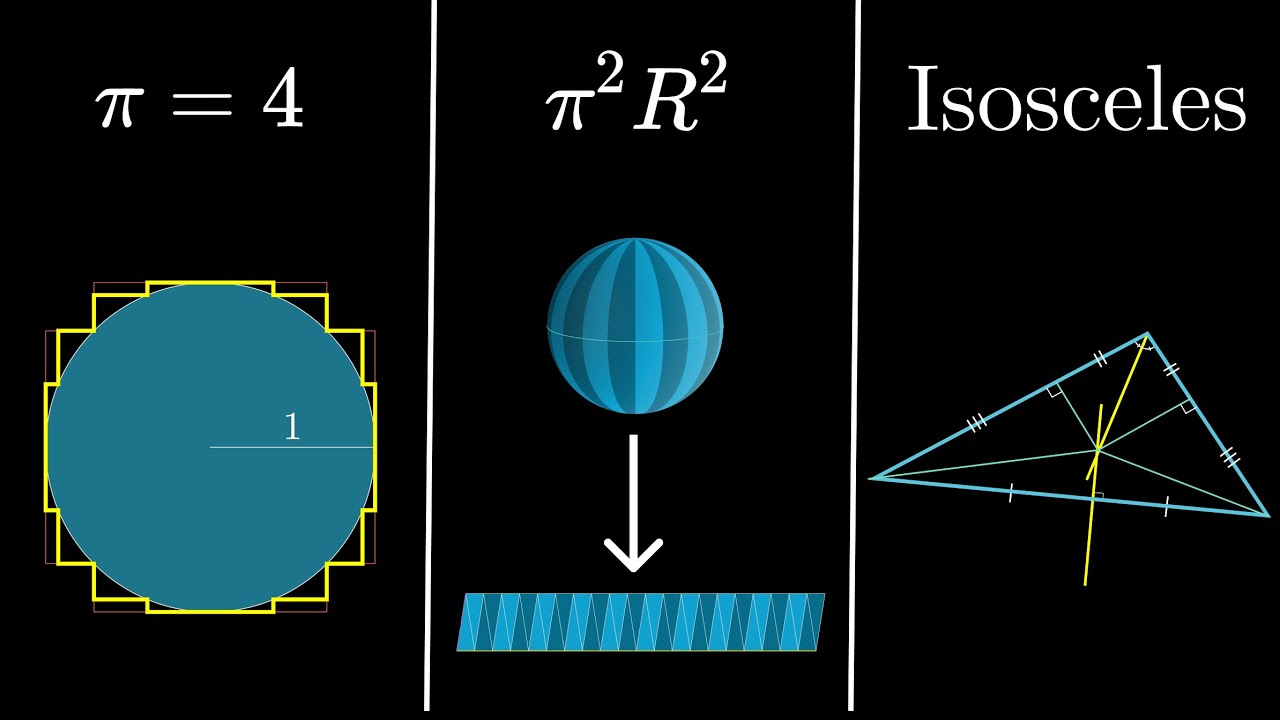
How to lie using visual proofs
Keywords
Summary
184 words
Critical Evaluation
Value of the Information & Strength of the Argument
The video provides significant educational value by dissecting common mathematical misconceptions and demonstrating the importance of rigor. The argumentation is solid: each false proof is carefully deconstructed, and the explanations are clear and logical. The use of animations helps visualize the concepts, and the progression from simpler to more subtle errors is effective. The video also connects the examples to broader mathematical principles, such as the continuity of length and the local flatness of curved surfaces, enhancing its depth.
88 words
Title / Content Match
The title accurately reflects the content: the video presents three visual proofs that are false and explains the subtle errors in each.
Quality & Reliability
9/10
The video is produced by a renowned mathematics educator known for rigorous and clear explanations. The content is logically sound, and the false proofs are correctly debunked with precise mathematical reasoning. The presentation is well-structured and the arguments are convincing.
Chapters
Cited Sources
- 3Blue1Brown FAQ — Mentioned in the description as a resource for the animation library used.
- Manim GitHub repository — The custom Python library used for animations.
- Manim Community GitHub repository — Community version of the animation library.
- 3Blue1Brown videos repository — Code for specific videos.
- Video on false pi=4 proof — Referenced as a related video on the false pi=4 proof.
Concurring Sources
- 3Blue1Brown FAQ — Provides background on the animation tools used, supporting the video's production quality.
External References
Contribution & Novelties
The video offers a fresh perspective on common mathematical fallacies, emphasizing the importance of rigor and critical thinking. It provides clear visual demonstrations of why these proofs fail, which is valuable for learners. The discussion of the continuity of length and the local flatness of curved surfaces adds depth.
Pour aller plus loin :
- Gaussian curvature — Explains the concept of curvature that prevents flattening a sphere without distortion.
- Limit of a function — Relevant to the discussion of limits and the continuity of length.
- Riemann integral — Connects to the discussion of approximating areas with rectangles and the need for rigorous error bounds.
104 words
Radar Profile
The radar profile shows high scores across all dimensions, with particularly strong performance in information quality and reliability, reflecting the video's educational value and rigorous content. The technical level is also high, indicating a sophisticated audience.
💬 Très positif. Sur les 30 commentaires analysés, les spectateurs expriment une admiration unanime pour la clarté des explications et la valeur pédagogique de la vidéo, certains partageant des anecdotes personnelles sur l'impact de la chaîne.