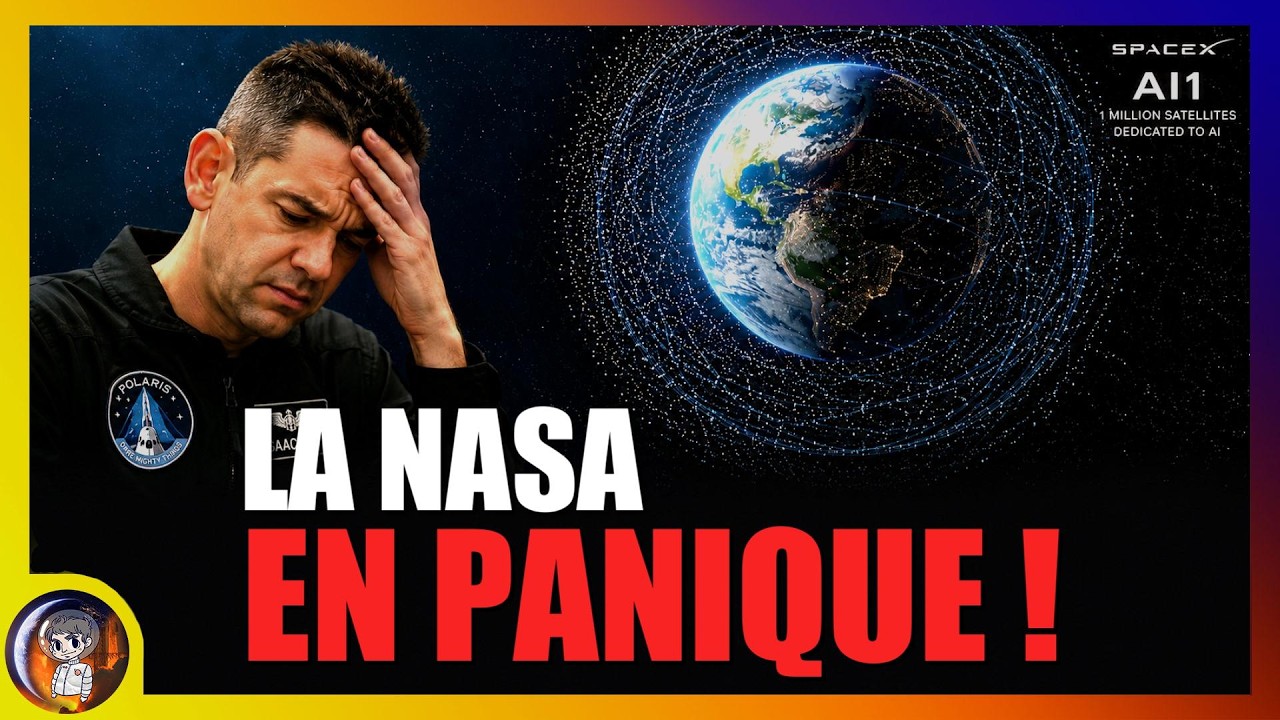
Le PLAN LUNAIRE prend L’EAU ! Pourquoi la NASA TREMBLE ? - Le Journal de la Starbase #371 - Le JDE
Keywords
Summary
179 words
Critical Evaluation
Value of the Information & Strength of the Argument
The video provides valuable insights into SpaceX’s AI1 satellite, offering technical details on its power, thermal management, and potential impact on global computing capacity. The argumentation is coherent, explaining the rationale behind orbital data centers and the engineering challenges. However, the host often relies on official statements and projections without critical scrutiny, and the discussion of the Artemis program highlights inconsistencies but does not deeply analyze the implications.
Scientific Rigor, Source Quality, Title Accuracy
The video cites sources primarily from SpaceX announcements and NASA press conferences, with links to various space news channels and official sites. The information is presented with reasonable accuracy, but there is a lack of independent verification. The title is somewhat clickbait, but the content does address the challenges facing the lunar program. The adéquation between title and content is acceptable, though the title exaggerates the ‘panic’ aspect.
151 words
Title / Content Match
The title is somewhat sensationalist ('NASA TREMBLE') but the content does cover the challenges facing the Artemis program and SpaceX's latest developments, so it is broadly aligned.
Quality & Reliability
7/10
The video provides a detailed technical overview of SpaceX's AI1 satellite and Artemis 3 updates, with clear explanations and references to recent events. However, it relies heavily on official announcements and lacks independent verification or critical analysis of the claims.
Chapters
- INTRO
- AI1 : le NOUVEAU SATELLITE IA de SPACEX
- L’IA en ORBITE ?
- ANATOMIE du SATELLITE
- AI1 SIMPLE NEURONE du CERVEAU ORBITAL ?
- BASTROP monte en PUISSANCE ! 08 :59 TERAFAB
- STARSHIP, condition SINE QUA NON ?
- La NASA en PANIQUE ?
- PRÉPARATIFS 13e VOL STARSHIP – Site de Massey’s
- Maintenances PAD B
- Prototype du 14e VOL
Cited Sources
- Journal de l'Espace official site — Main website of the channel, providing additional articles and resources.
- Listing of subscriber questions and answers — PDF document with a summary of questions and answers from subscribers.
- Creative Commons License — License for the music used in the video.
- eToro offer link — Sponsored link for an investment platform, mentioned in the video.
- Matt Lowne Films YouTube channel — One of the credited sources for images and animations.
- RGV Aerial Photography YouTube channel — Credited for aerial footage of Starbase.
- Ryan Hansen Space YouTube channel — Credited for space-related content.
- Spaceflight Now YouTube channel — Credited for space news coverage.
- Starship Gazer YouTube channel — Credited for Starship tracking and imagery.
- What About It YouTube channel — Credited for space industry analysis.
Concurring Sources
- SpaceX official announcements — The video's claims about AI1 and Starship align with SpaceX's public statements.
- NASA Artemis blog — NASA's official blog provides updates on Artemis missions, consistent with the video's coverage.
Dissenting Sources
- Critics of satellite constellations — Some experts and commenters raise concerns about space debris and environmental impact, which the video does not deeply address.
Contribution & Novelties
The video provides a detailed and accessible explanation of SpaceX’s AI1 satellite concept, including its design, power, and thermal management, which is a relatively new topic in space news. It also offers a critical look at the Artemis 3 mission architecture, highlighting the use of a standard Starship instead of the HLS, which is a nuance not widely covered. The host connects these developments to broader trends in space industrialization and the role of Starship.
Pour aller plus loin :
- SpaceX official website — For official updates on Starship and satellite programs.
- NASA Artemis program — Official NASA page for Artemis missions.
- Kessler Syndrome — Relevant to concerns about satellite constellations and space debris.
- Orbital data centers concept — Background on the idea of computing in space.
- Starship HLS — Details on the lunar lander variant.
136 words
Radar Profile
The radar profile shows high scores in information quantity and technical level, reflecting the video's detailed technical content. However, the quality of information and reliability are slightly lower, indicating a reliance on official sources without independent verification. The overall balance suggests a well-informed but not deeply critical analysis.
💬 The comments are predominantly positive, with many viewers expressing appreciation for the detailed explanations and the host's presentation. Some critical voices raise concerns about the environmental and safety implications of large satellite constellations, but the overall tone is supportive and engaged.