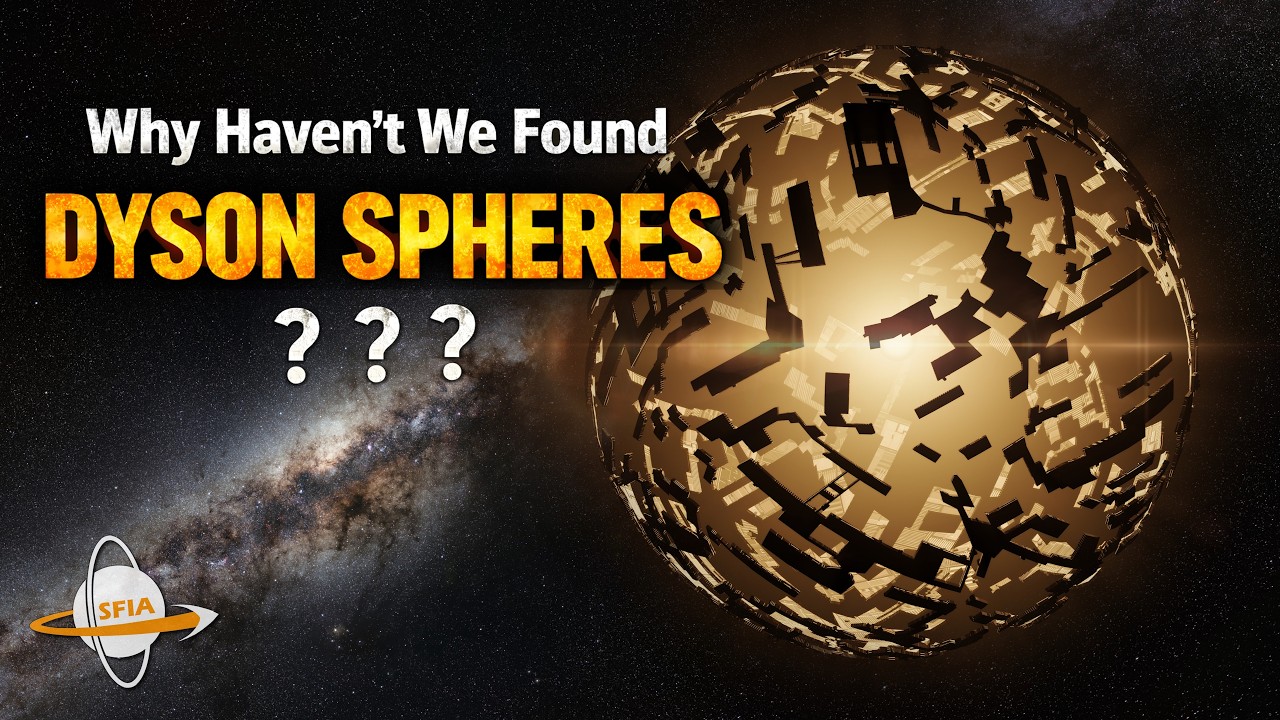
Why Haven’t We Found Dyson Spheres Yet?
Keywords
Summary
207 words
Critical Evaluation
Value of the Information & Strength of the Argument
The video provides a high value of information by systematically breaking down the assumptions behind the Dyson sphere concept and the Fermi paradox. It offers a clear and logical argument, building from observational expectations to theoretical implications. The argumentation is solid, as it carefully distinguishes between what is known (e.g., thermodynamics, light travel time) and what is speculative (e.g., alien behavior). It also addresses counterarguments, such as the possibility of civilizations not expanding or using alternative energy sources, which strengthens the overall reasoning.
Scientific Rigor, Source Quality, Title Accuracy
The scientific rigor is high for a popular science video. The content is consistent with current astrophysical knowledge, and the reasoning is sound. However, the video does not cite specific scientific papers or sources, relying instead on general knowledge and the presenter’s expertise. The title accurately reflects the content, and the video stays on topic throughout. The description provides links to the channel’s website and social media, but no direct references to scientific literature.
172 words
Title / Content Match
The title accurately reflects the content, which directly addresses the question of why Dyson spheres have not been observed, exploring both observational and theoretical reasons.
Quality & Reliability
8/10
The video presents a well-structured, scientifically grounded discussion of Dyson spheres, the Fermi paradox, and related concepts. It correctly explains physical principles (thermodynamics, light travel time, stellar evolution) and avoids unsupported claims, clearly distinguishing speculation from established science. The reasoning is logical and considers multiple hypotheses, though it remains a popular science presentation without formal citations.
Chapters
Cited Sources
- Isaac Arthur Website — Official website of the channel, providing additional resources and information.
- Nebula - Nearby Supernovae — Exclusive video on Nebula, mentioned as a related content.
- Reddit Community — Community discussion forum for the channel.
- Subscribestar — Platform for supporting the channel.
Concurring Sources
- Dyson sphere - Wikipedia — General reference on Dyson spheres, consistent with the video's description.
- Fermi paradox - Wikipedia — General reference on the Fermi paradox, which the video discusses.
External References
Contribution & Novelties
The video synthesizes existing ideas about Dyson spheres and the Fermi paradox into a coherent and accessible narrative, emphasizing the ‘Dyson dilemma’ and the importance of looking for transitional states. It offers a fresh perspective by framing the absence of Dyson spheres as a key observational constraint on the prevalence of advanced civilizations.
Pour aller plus loin :
- Dyson sphere — Wikipedia article providing background on the concept.
- Fermi paradox — Overview of the paradox and proposed resolutions.
- Kardashev scale — Explanation of the scale used to classify civilizations by energy consumption.
- Waste heat — Concept central to the detectability of Dyson spheres.
103 words
Radar Profile
The radar profile shows high scores in quantity of information and technical level, indicating a dense and detailed presentation. The quality of information and reliability are also high, reflecting a well-researched and logically consistent argument. The overall profile suggests a content that is both informative and scientifically sound, with a slight emphasis on technical depth.
💬 Très positif. Sur les 30 commentaires analysés, la grande majorité exprime une forte appréciation du contenu, saluant la qualité de la présentation et la clarté de l'explication, avec quelques remarques constructives sur les hypothèses.