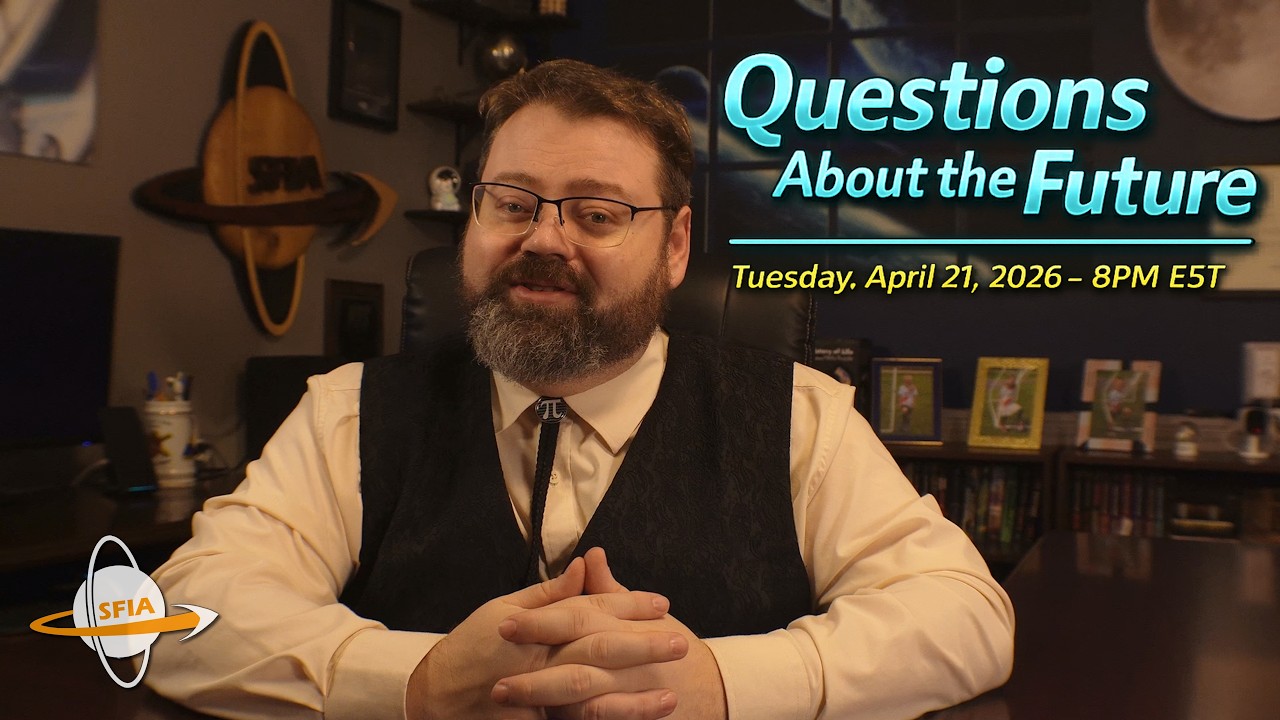
Talking the Future: Science, Space, and Civilization | April Live Q&A
Keywords
Summary
176 words
Critical Evaluation
Value of the Information & Strength of the Argument
The value of the information is high for a general audience interested in space futurism. Isaac Arthur provides reasoned arguments for each topic, often acknowledging uncertainties and the speculative nature of long-term projections. He grounds his answers in known physics and engineering principles, such as the mechanics of solar sails and the structural requirements for space elevators. His argumentation is coherent and logical, though it sometimes relies on personal opinion and ‘common sense’ rather than rigorous scientific evidence. He effectively communicates complex ideas in an accessible manner, making the content valuable for educational purposes.
Scientific Rigor, Source Quality, Title Accuracy
The scientific rigor is moderate; Arthur references his own past videos and general concepts but does not cite specific peer-reviewed studies during the live session. The description provides links to his website and social media, which serve as sources for further exploration but not direct citations. The title accurately reflects the content, as it is indeed a live Q&A about science, space, and civilization. The discussion is consistent with established scientific knowledge, though some speculative elements (e.g., life extension, Dyson swarms) are presented as plausible rather than proven.
197 words
Title / Content Match
The title accurately reflects the content: a live Q&A session covering science, space, and civilization topics.
Quality & Reliability
7/10
Isaac Arthur is a known science communicator with a background in physics and a consistent track record of well-researched content. The live Q&A format allows for spontaneous answers, which are generally accurate but sometimes speculative and based on personal opinion rather than peer-reviewed sources. The discussion covers established concepts (e.g., O'Neill cylinders, Dyson swarms) and reasonable extrapolations, but lacks formal citations during the talk.
Key Moments
Markers derived by PSI from the transcript: the creator did not define chapters.
- Introduction and technical difficulties; explanation of the Q&A format.
- Discussion on capturing solar wind magnetically; mentions star lifting and magnetic sails.
- Question about Mars gravity and readjustment; suggests rotating habitats for simulated gravity.
- Comment on Project Hail Mary and Andy Weir; mentions Pioneer Award.
- Answer on preferred sci-fi technology; life extension and fusion discussed.
- Comparison of lunar and Earth space elevators; explains Lagrange points and material requirements.
- Discussion on population trends and the dangers of extrapolation; mentions the population bomb and Dyson dilemma.
- Advice for science fiction writers on balancing realism and storytelling; references I Am Legend and Michael Crichton.
Cited Sources
- Isaac Arthur's Website — Official website with links to videos, articles, and additional resources.
- Nebula — Streaming platform where Isaac Arthur's content is available.
- Reddit Community — Community forum for discussion of topics covered in the video.
- Subscribestar — Platform for supporting Isaac Arthur's work.
Concurring Sources
- NASA - Solar Wind — Provides scientific background on solar wind, supporting the discussion.
- Wikipedia - Space Elevator — General information on space elevators, relevant to the lunar elevator discussion.
Dissenting Sources
- No direct discordant sources found — The video does not contradict established scientific consensus; however, some speculative claims (e.g., life extension) are not supported by current evidence.
Contribution & Novelties
The video provides a unique opportunity for viewers to engage directly with Isaac Arthur on a variety of speculative topics. While the content is not entirely novel, the live Q&A format allows for spontaneous and personalized responses that offer insights into his thought process and the reasoning behind his usual content. The discussion on solar wind capture and lunar elevators provides practical engineering considerations that are often glossed over in more general presentations.
Pour aller plus loin :
- Solar wind — Provides background on the phenomenon discussed.
- Space elevator — Explains the concept and challenges, relevant to the lunar elevator discussion.
- Fermi paradox — Central to the discussion on the silence of the cosmos.
- O’Neill cylinder — A key megastructure concept mentioned in the video.
- Dyson swarm — Another megastructure concept referenced.
132 words
Radar Profile
The radar profile shows balanced scores across all dimensions, with slightly higher scores in information quantity and quality, reflecting the informative yet speculative nature of the content. The technical level is moderate, suitable for a general audience, while reliability is solid due to the host's expertise.
💬 No comments were provided for analysis.