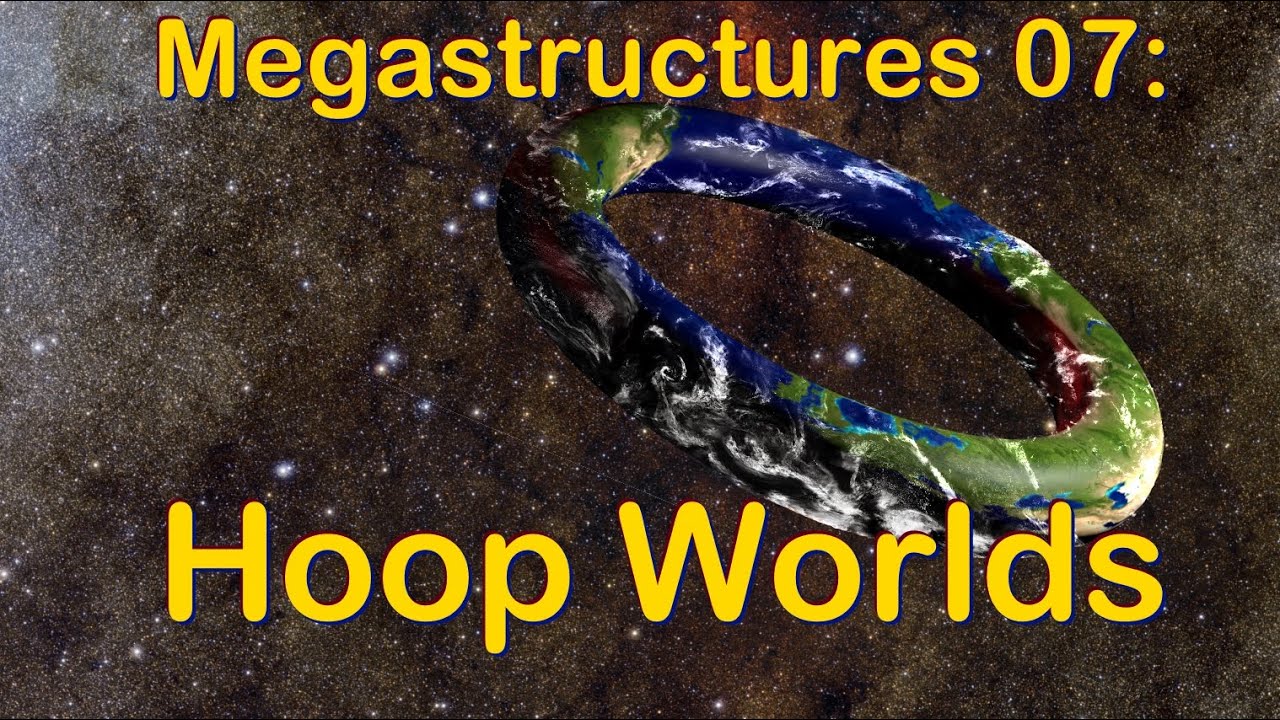
Megastructures: Hoopworlds
Keywords
Summary
146 words
Critical Evaluation
Value of the Information & Strength of the Argument
The video provides a comprehensive and coherent overview of hoopworlds, systematically addressing geometry, construction, gravity, weather, and potential applications. Arthur’s argumentation is logical and grounded in established physics, such as centrifugal force and orbital mechanics. He effectively uses analogies (e.g., Saturn’s rings) and references to prior episodes to build a cumulative understanding. The inclusion of Sandberg’s model adds credibility. However, the discussion remains qualitative, and some claims (e.g., magnetic field generation) are not deeply quantified. The speculative nature is clearly acknowledged, which strengthens the intellectual honesty of the presentation.
Scientific Rigor, Source Quality, Title Accuracy
The video demonstrates scientific rigor by referencing Anders Sandberg’s article on torus-shaped planets and the Orion’s Arm project, which are relevant and credible sources. The title accurately reflects the content, and the video stays on-topic throughout. The description provides links to further resources, including Sandberg’s analysis and the channel’s website. While the video is speculative, it clearly distinguishes between established physics and hypothetical engineering, which is appropriate for the genre. The production quality is high, with clear visuals and narration, though the lack of formal citations within the video itself is a minor limitation.
198 words
Title / Content Match
The title accurately reflects the content, which focuses exclusively on the concept of hoopworlds.
Quality & Reliability
8/10
The video presents a well-structured speculative analysis of hoopworlds, grounded in physics principles (gravity, rotation, orbital mechanics) and references the work of Anders Sandberg, a recognized researcher. The content is clearly presented as hypothetical and avoids overclaiming, though it lacks rigorous mathematical derivations and relies on qualitative explanations.
Key Moments
Markers derived by PSI from the transcript: the creator did not define chapters.
- Introduction to hoopworlds and torus geometry.
- Discussion on natural formation and construction using orbital rings.
- Advantages of hoopworlds, including terraforming gas giants and magnetic fields.
- Gravity variations across the hoopworld and implications for life.
- Weather patterns, seasons, and the underworld concept.
- Conclusion and teaser for future topics.
Cited Sources
- Torus Earth - Anders Sandberg's analysis — Referenced in the video as a detailed analysis of torus-shaped planets, used for gravity models.
- Isaac Arthur's Website — Official website for the channel, providing additional resources.
- Nebula — Streaming platform where Isaac Arthur's content is available.
- Reddit - r/IsaacArthur — Community discussion forum for the channel.
- Subscribestar - Isaac Arthur — Support platform for the channel.
Concurring Sources
- Torus Earth - Anders Sandberg's analysis — The video directly references this article for gravity models and natural formation, and it aligns with the presented concepts.
Contribution & Novelties
The video synthesizes existing concepts of megastructures and applies them specifically to hoopworlds, offering a clear and accessible explanation of their physics and potential applications. It builds on prior episodes and introduces the idea of using hoopworlds for terraforming gas giants and creating chainworlds. The reference to Anders Sandberg’s work adds depth, and the discussion of gravity variations is particularly insightful.
Pour aller plus loin :
- Torus (Wikipedia) — Provides mathematical background on torus geometry.
- Orbital ring (Wikipedia) — Explains the concept of active support structures used in the video.
- Anders Sandberg’s article on Torus Earth — Directly related to the video’s topic, offering a more detailed analysis.
- Dyson Sphere (Wikipedia) — Related megastructure concept mentioned in the video’s context.
120 words
Radar Profile
The radar profile shows high scores in quantity and quality of information, with a moderate technical level and high reliability. This indicates a well-balanced video that is informative and credible, though not extremely technical. The strong reliability score reflects the use of reputable sources and clear reasoning.
💬 Très positif. Sur les 30 commentaires analysés, la grande majorité exprime de l'enthousiasme et de l'appréciation pour la qualité du contenu, avec des discussions constructives sur les implications physiques et des suggestions créatives.