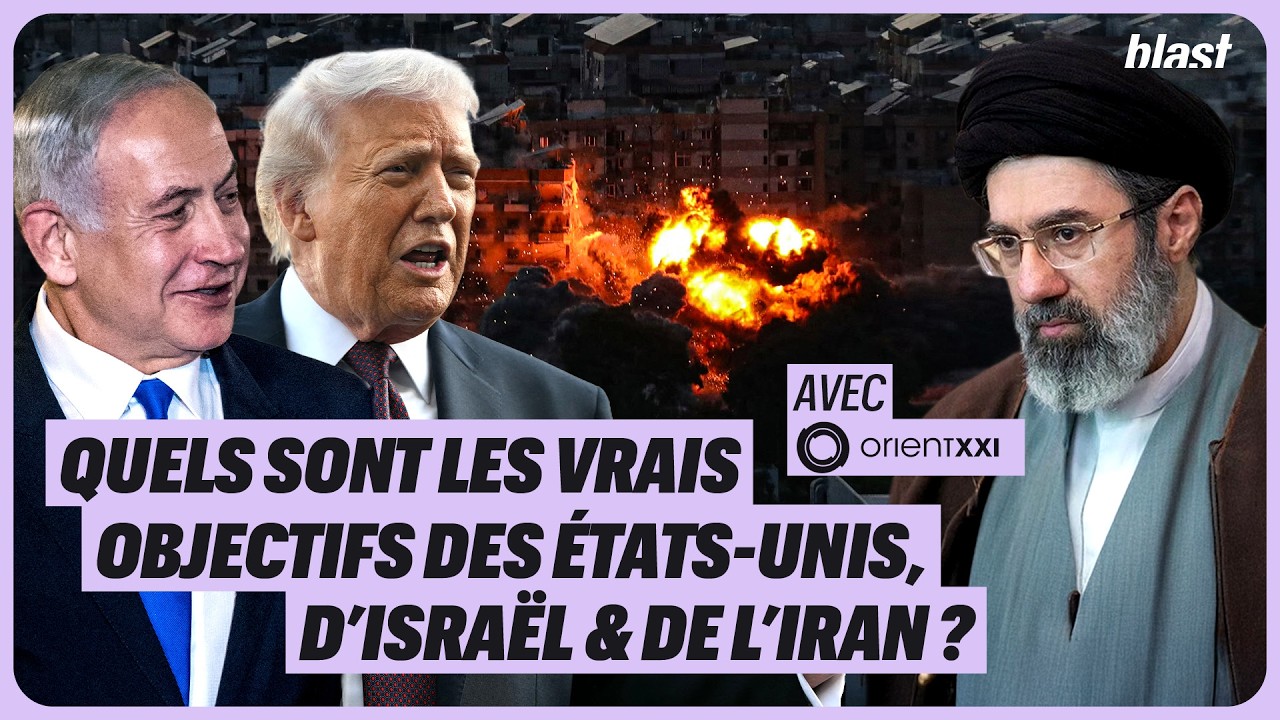
GUERRE AU MOYEN-ORIENT : QUELS SONT LES VRAIS OBJECTIFS DES ÉTATS-UNIS, D’ISRAËL ET DE L’IRAN ? — Note de synthèse
Note de synthèse · Post Singularity Institute
Vignette : GUERRE AU MOYEN-ORIENT : QUELS SONT LES VRAIS OBJECTIFS DES ÉTATS-UNIS, D’ISRAËL ET DE L’IRAN ?

GUERRE AU MOYEN-ORIENT : QUELS SONT LES VRAIS OBJECTIFS DES ÉTATS-UNIS, D’ISRAËL ET DE L’IRAN ?

🎙️ Yanis Mhamdi 👥 1.7M 📅 March 11, 2026 ⏱ 89 min 👁 341K 🔬 Geopolitics

Keywords

Iran Israel United States war nuclear

Summary

This video from Blast, in collaboration with Orient XXI, analyzes the motivations behind the US-Israeli strikes on Iran starting February 28, 2026. It features experts Sarra Grira, Sylvain Cypel, and Bernard Hourcade, who argue that the official justifications—preventing Iran from obtaining nuclear weapons and helping the Iranian people—are false. They claim that negotiations between the US and Iran were progressing, and that Israeli Prime Minister Netanyahu sabotaged them to pursue a war aimed at reshaping the Middle East. The video criticizes Western media for biased coverage and highlights the humanitarian toll, including over 1200 civilian deaths in Iran and displacement in Lebanon. It also discusses Iran's weakened position after internal protests and the role of proxies like Hezbollah. The experts conclude that the war serves Israeli expansionist goals and undermines diplomatic solutions.

Critical Evaluation

The video provides a coherent critical perspective on the US-Israeli military campaign against Iran, drawing on the expertise of three specialists. The argument that the war was not justified by an imminent nuclear threat is supported by reference to IAEA statements, though no specific report is cited. The claim that negotiations were on the verge of success is plausible but not substantiated with direct evidence. The experts effectively highlight the historical context of Israeli expansionism and Netanyahu's consistent opposition to any US-Iran deal. However, the analysis is one-sided, presenting no counterarguments from official US or Israeli sources. The humanitarian figures (1200 civilian deaths, 168 children in a school) are stated without attribution, weakening their credibility. The video's strength lies in its geopolitical framing and the diversity of expert opinions, but it lacks rigorous sourcing. The title accurately reflects the content, which is a critical examination of war objectives. The discussion of media bias is relevant but could be more nuanced. Overall, the video is informative for those seeking an alternative narrative but should be complemented with official sources for a balanced view.

Key Moments

Cited Sources

Contribution & Novelties

The video offers a critical perspective on the 2026 US-Israeli strikes on Iran, arguing that the war was not about nuclear non-proliferation but about Israeli regional dominance and derailing US-Iran negotiations. It brings together three experts with different specializations (geopolitics, journalism, Iranian studies) to provide a multi-faceted analysis. The claim that negotiations were near completion before the attack adds a novel angle, though it is not independently verified.

Pour mieux comprendre : - Iran–Israel relations — Provides historical context for the conflict. - Joint Comprehensive Plan of Action — Background on the 2015 nuclear deal and its collapse. - International Atomic Energy Agency — Official source for nuclear verification reports.

QuantityQualityTechnicalReliability

Radar Profile

The radar shows moderate scores across all dimensions, indicating a balanced but not highly rigorous analysis. The video is informative for its critical viewpoint but lacks strong empirical backing, resulting in a profile that is more opinion-driven than data-driven.

Reliability /10