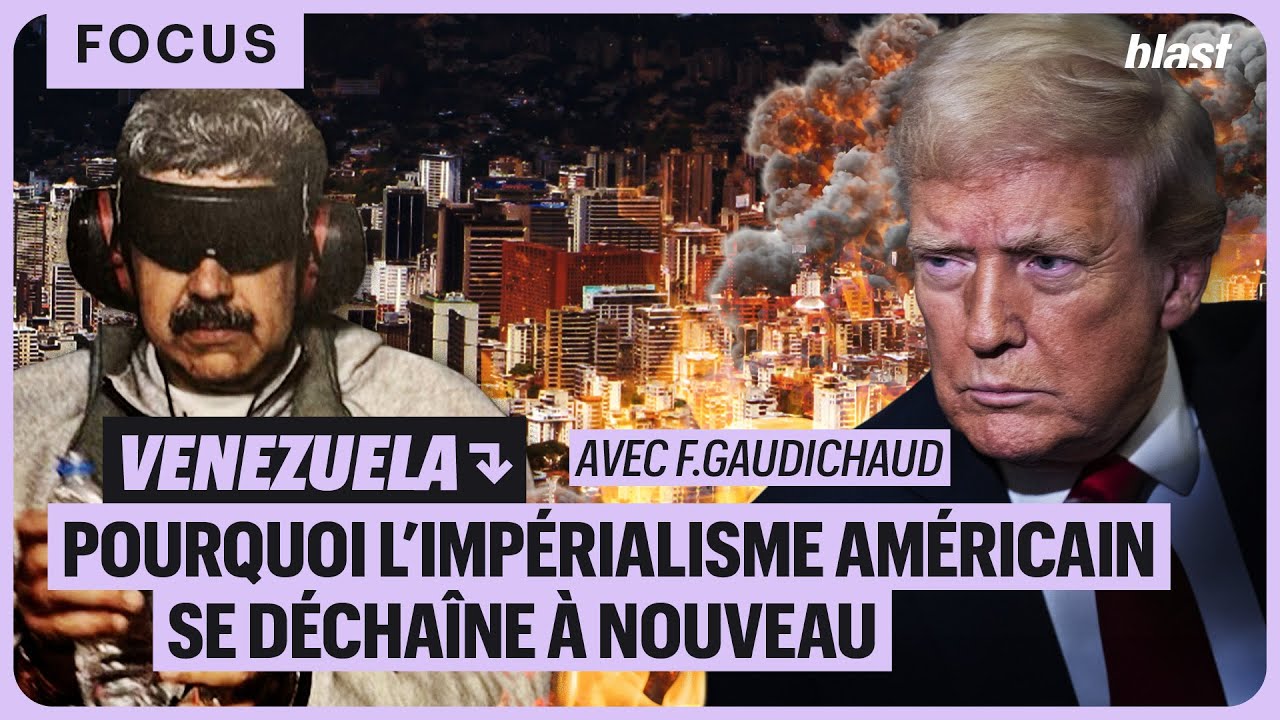
VENEZUELA : POURQUOI L’IMPÉRIALISME AMÉRICAIN SE DÉCHAÎNE À NOUVEAU — Note de synthèse
Note de synthèse · Post Singularity Institute
VENEZUELA : POURQUOI L’IMPÉRIALISME AMÉRICAIN SE DÉCHAÎNE À NOUVEAU
par Maxime Cochelin (journalist), Franck Gaudichaud (expert guest)
🎙️ Maxime Cochelin (journalist), Franck Gaudichaud (expert guest)👥 1.7M📅 January 5, 2026⏱ 16 min👁 294K🔬 Geopolitics
Keywords
VenezuelaUS interventionoilimperialismMaduro
Summary
The video discusses the alleged US military attack on Venezuela on January 3, 2026, claiming that US forces bombed Caracas and captured President Nicolás Maduro. It frames this as a renewed imperialist intervention driven by oil interests and the need to counter Chinese influence in Latin America. The host interviews Professor Franck Gaudichaud, who provides historical context on US interventionism in Venezuela, the role of oil, and the internal dynamics of the Maduro regime. Gaudichaud suggests that parts of the Venezuelan military and political elite may have colluded with the US, leading to a lack of resistance. He also analyzes the geopolitical implications, including the fragmentation of Latin American solidarity and the rise of right-wing governments aligned with the US. The video criticizes the international response, particularly the French government's stance, and calls for resistance against imperialism.
Critical Evaluation
The video presents a highly partisan and speculative account of events that, as of the knowledge cutoff, have not been confirmed by any credible news sources. The claim that the US bombed Caracas and captured Maduro on January 3, 2026, appears to be a hypothetical scenario or a work of fiction, as no such event has been reported. The analysis relies on this unverified premise to discuss US imperialism, oil interests, and geopolitical competition with China. While the historical context provided by Professor Gaudichaud is accurate and well-informed, the core narrative lacks factual basis. The video does not cite any primary sources for the alleged attack, and the links in the description are only to the Blast media platform and its social media, not to any news reports or official statements. The argumentation is internally consistent but built on a foundation of unsubstantiated claims. The video's strength lies in its historical overview of US-Venezuela relations and the role of oil, but its credibility is severely undermined by the lack of evidence for the central event. The title is representative of the content, but the content itself is not based on verifiable facts. The video would be more valuable as a discussion of hypothetical scenarios or as a critique of US foreign policy, but it presents the events as real, which is misleading. The analysis of internal Venezuelan politics, including potential collusion between the Maduro regime and the US, is speculative and not supported by evidence. The video also fails to mention any alternative perspectives or counterarguments. Overall, the video is more of a political commentary than a factual report, and its value is limited by its reliance on unverified claims.
The video provides a detailed historical and geopolitical analysis of US-Venezuela relations, emphasizing the role of oil and the Monroe Doctrine. It speculates on internal divisions within the Maduro regime and potential collusion with the US, offering a perspective that is often absent from mainstream media. However, the lack of verifiable evidence for the central event limits its contribution to factual knowledge.
The radar chart shows moderate scores in quantity and technical level, but lower scores in quality and reliability due to unverified claims. The video is informative in scope but lacks factual grounding, resulting in a balanced but cautious overall assessment.