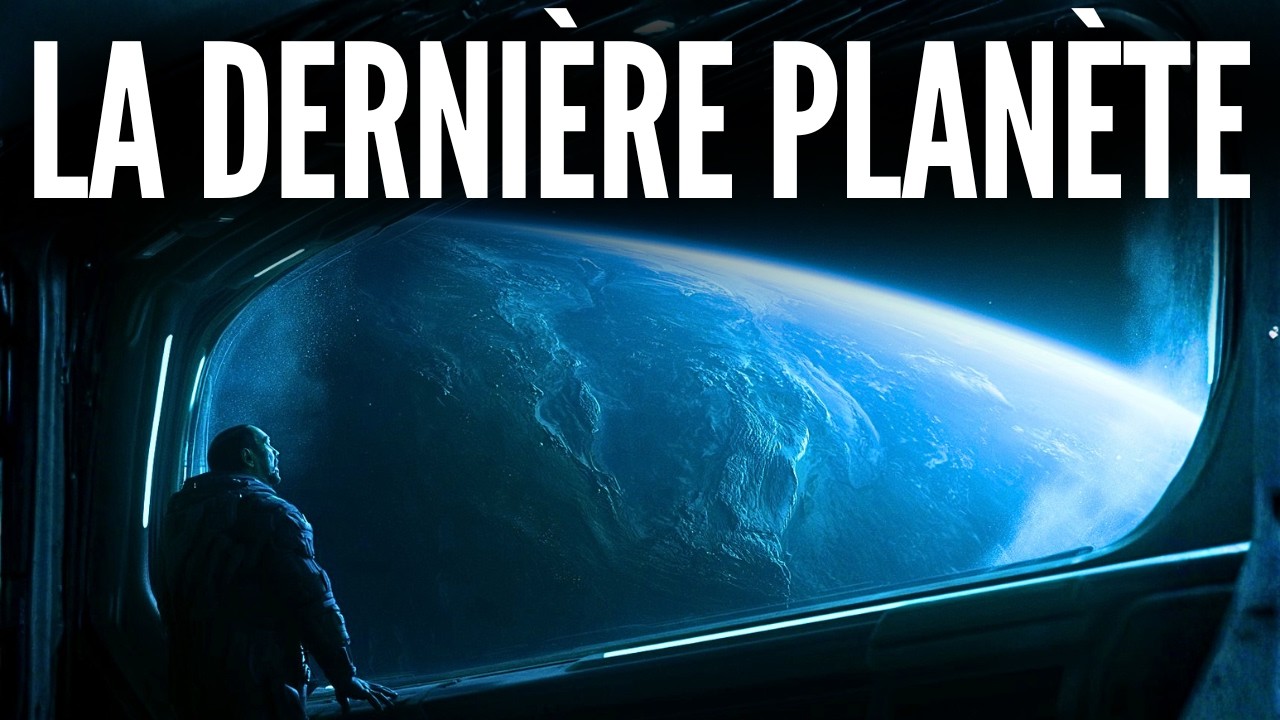
The video explores the possibility of finding a habitable exoplanet to replace Earth, using a narrative of a hypothetical interstellar voyage. It begins by highlighting Earth's degradation due to climate change and the human desire for a 'Planet B'. The host then examines Mars as a potential candidate, explaining why terraforming is impractical due to its thin atmosphere, low gravity, and lack of a global magnetic field. The focus shifts to exoplanets, starting with Proxima Centauri b, detected via radial velocity. The concept of the habitable zone is clarified as a necessary but insufficient condition for habitability. The video discusses the challenges of detecting exoplanets indirectly and the immense distances involved, using Proxima b's 4.24 light-year distance as an example. It also covers the dangers of red dwarf stars, such as flares and tidal locking, and briefly mentions TRAPPIST-1 and Kepler-452b. The conclusion emphasizes that Earth is a unique cosmic anomaly, and no known exoplanet can fully replicate its conditions. The video is well-structured and informative, but its sensationalist title and some oversimplifications detract from its scientific rigor.
Critical Evaluation
The video presents a compelling narrative about the search for a habitable exoplanet, effectively communicating the immense challenges involved. It correctly emphasizes that the habitable zone is not a guarantee of habitability, and that factors like stellar activity, atmospheric composition, and planetary rotation are critical. The discussion of Mars terraforming is scientifically sound, highlighting the insufficient CO2 reserves and the difficulty of maintaining an atmosphere without a magnetic field. The reference to the Biosphere 2 experiment is a good analogy for the complexity of closed ecological systems. However, the video has several shortcomings. The title is sensationalist, suggesting 'proof' of Earth's cosmic anomaly, which is not a novel scientific claim but a well-known fact. The content is largely a review of existing knowledge, with little original insight. The video does not delve into the latest exoplanet detection methods or the most recent discoveries (e.g., James Webb Space Telescope observations). The discussion of TRAPPIST-1 and Kepler-452b is superficial, lacking quantitative details. The video also fails to address the concept of the 'continuously habitable zone' or the role of plate tectonics. The sources cited include a peer-reviewed paper on Proxima b (Ribas et al. 2016), which is appropriate, but the video does not critically engage with its findings. The link to the book 'Mondes d'ailleurs' is a popular science book, not a primary source. The video's strength lies in its engaging presentation and clear explanations of complex concepts, making it accessible to a general audience. However, for a scientifically rigorous analysis, it lacks depth and critical evaluation of uncertainties. The video's narrative structure, while engaging, sometimes oversimplifies the scientific consensus. For instance, the claim that 'Mars cannot replace Earth' is accurate, but the video does not explore the possibility of large-scale terraforming using advanced technology, which remains speculative. Overall, the video is a good science communication piece but not a rigorous scientific analysis.
The video's main contribution is its engaging narrative that synthesizes known challenges in exoplanet habitability for a general audience. It effectively communicates the complexity of finding a true Earth analog, emphasizing that the habitable zone is just one of many requirements. The use of the Biosphere 2 experiment as an analogy for closed ecological systems is a useful pedagogical tool. However, the video does not present new research or original analysis; it is a review of existing knowledge.
Pour mieux comprendre :
- Habitable zone — Wikipedia article explaining the concept and its limitations.
- Exoplanet detection methods — Overview of radial velocity, transit, and other detection techniques.
- Terraforming of Mars — Detailed discussion of the scientific and engineering challenges.
Radar Profile
The radar profile shows moderate scores across all dimensions, with quantity of information and fiabilite_globale being the highest. This reflects a well-structured but not deeply original science communication piece. The lower niveau_technique score indicates the content is accessible but lacks technical depth.