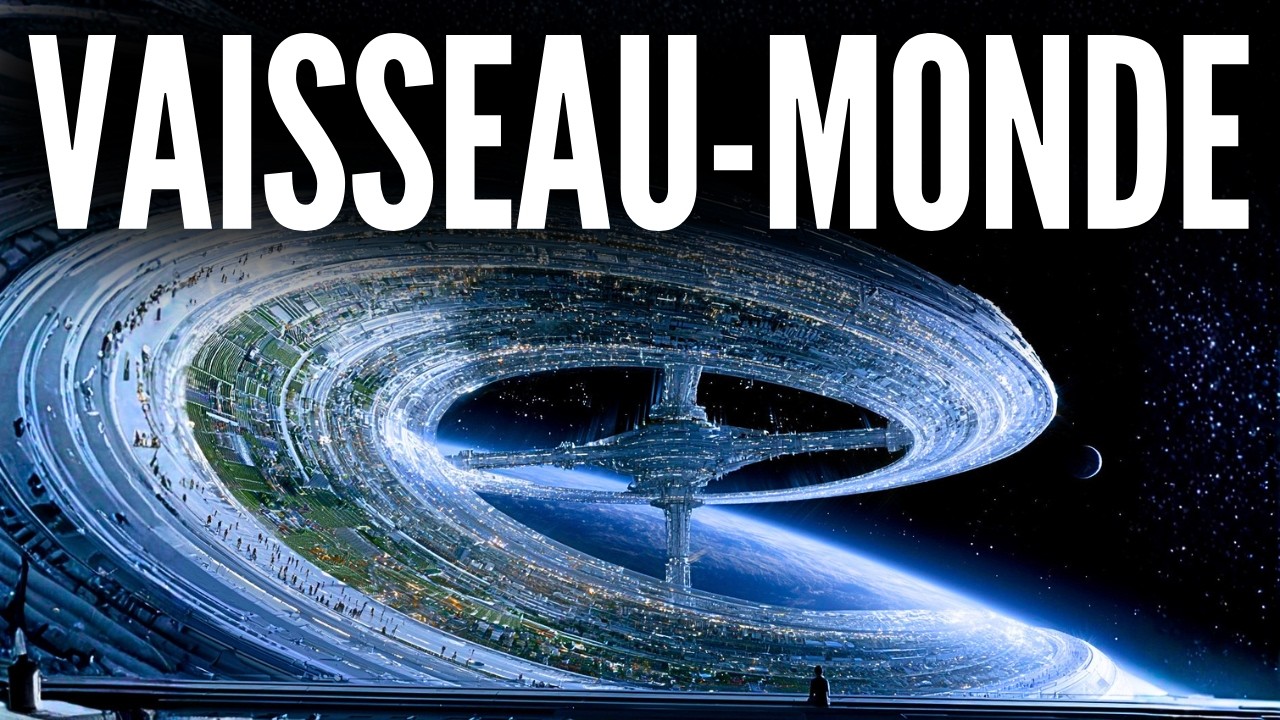
Peut-on CONSTRUIRE un VAISSEAU-MONDE ?
Keywords
Summary
Critical Evaluation
Key Moments
- Introduction: Can we create artificial gravity?
- Humans are not made for space: biological effects of microgravity.
- The body collapses without gravity: muscle atrophy, bone loss, vision problems.
- First solution: accelerate linearly (constant thrust).
- Rotating a spacecraft: centrifugal force as artificial gravity.
- The trap of artificial gravity: Coriolis effect and motion sickness.
- Building worlds in space: Stanford torus and O'Neill cylinders.
- The first real experiments: NASA's slow rotation rooms.
- The return of private stations: commercial space stations.
- Why Mars is changing everything: need for artificial gravity on long missions.
- Can we create real gravity? Magnetic tracks and other speculative ideas.
- The magnetic track: a possible future for artificial gravity.
- Science fiction or possible future? Conclusion.
Cited Sources
Contribution & Novelties
The video synthesizes well-known concepts (equivalence principle, centrifugal gravity, Coriolis effect) into an engaging narrative aimed at a general audience. Its main contribution is in clearly explaining the trade-offs between rotation rate and habitat size, and in highlighting the physiological challenges of rotating habitats. It also connects historical NASA experiments to current space exploration plans (Mars missions, private stations). However, it does not present new research or original insights; it is a compilation of existing knowledge.
Pour mieux comprendre : - Artificial gravity - Wikipedia — Comprehensive overview of artificial gravity concepts, including rotating habitats and linear acceleration. - Coriolis force - Wikipedia — Explanation of the Coriolis effect and its impact on motion perception. - O'Neill cylinder - Wikipedia — Detailed description of the O'Neill cylinder space habitat design.
Radar Profile
The radar profile shows high scores in quantity of information (8) and moderate scores in quality (7) and reliability (7), reflecting a broad but not deeply sourced presentation. The technical level (6) indicates accessibility to a general audience. The overall assessment is that the video is informative and accurate but lacks depth and critical engagement with recent research.