The Cash Flow Trap Behind Australia's Battery Boom
Keywords
Summary
298 words
Critical Evaluation
Value of the Information & Strength of the Argument
The informational value is concentrated in operational detail that is hard to obtain elsewhere in public form: how a wholesaler credit limit interacts with a third-party facility, why a deed of priority is needed only for invoice finance rather than trade finance, the practical consequence of a supplier being paid on day one (the credit risk transfers to the financier), and the arithmetic of the case study, which Kahn restates cleanly — a $6 million annual purchasing run-rate becoming $18 million and then $24 million as limits rise. The framing claim that ‘growth eats cash’ is sound and well illustrated by the battery-specific point that a single residential battery order of $10,000–20,000, multiplied across a few installs a week, alone absorbs a large share of a working-capital line. The argument is weaker where it matters most. The claim that insolvency in this sector is ‘often less about profitability and more so about cash flow’ is asserted rather than demonstrated; no failure statistics, no portfolio data, no counter-examples of well-capitalised firms that failed anyway. The central case study is anonymous and reported entirely by the party that approved the facility, with no independent confirmation of the growth outcome, and the assertion that the facility was ‘free’ depends on a supplier discount negotiated in one specific case and cannot be generalised. The cost figure of about 1.5% per 30 days is stated plainly but never annualised, which matters for a listener comparing it to a bank line; a one-off mention that unused facilities cost little is the only nod to total cost of ownership. Opportunity cost is addressed only in the single line that the alternative is turning down jobs. Overall the reasoning is internally coherent and practically grounded, but it is advocacy-shaped: every mechanism described is presented as a solution, and no scenario is offered in which additional leverage on top of an already stretched business would deepen the problem.
Scientific Rigor, Source Quality, Title Accuracy
On scientific rigour, the episode cites no external study, no industry report, no insolvency statistics and no third-party data of any kind; the evidentiary base is the personal experience of two consultants and one lender. Numbers are offered with the confidence of people who have seen many deals, but they are round, unattributed and uncheckable — the 1.5% per 30 days rate, the $500,000 minimum, the three-to-four-week approval window, the tripling of battery stock requirements. Nothing is quantified about how often credit constraints actually cause failure, which is the causal claim at the heart of the title’s ’trap’. The guest is the commercial provider of the product being explained, and no independent broker, accountant or insolvency practitioner offers a counterweight; the result is a vendor explainer embedded in an interview format, with the host explicitly acting as an advocate for the approach. On sources, the episode itself points to nothing beyond the channel’s own companion article and the financier’s website, both of which are first-party and self-interested rather than corroborating. On title/content fit, the battery-boom credit squeeze is genuinely the organising premise for the first section and returns periodically, so the title is not misleading, but the majority of the 57 minutes is a structured product walkthrough of trade and invoice finance, which the title does not signal.
552 words
Title / Content Match
The title's 'battery boom' framing occupies mainly the opening minutes and the recurring point that battery stock requirements have roughly tripled wholesaler credit needs; the bulk of the episode is a walkthrough of trade and invoice finance as a product, so the title promises a broader industry investigation than is delivered.
Quality & Reliability
5/10
The episode is an informed conversation between people with genuine industry experience, and it delivers specific, checkable-sounding mechanics (facility sizes, approval timelines, how a deed of priority works, how supplier discounts can offset facility cost). However, every substantive claim about cost, qualification and outcomes comes from a single commercial provider of the product being discussed, no independent data or third-party figures are cited, and the central case study is anonymous and unverifiable. It is credible as a description of how one lender structures deals, weaker as evidence about the industry as a whole.
Chapters
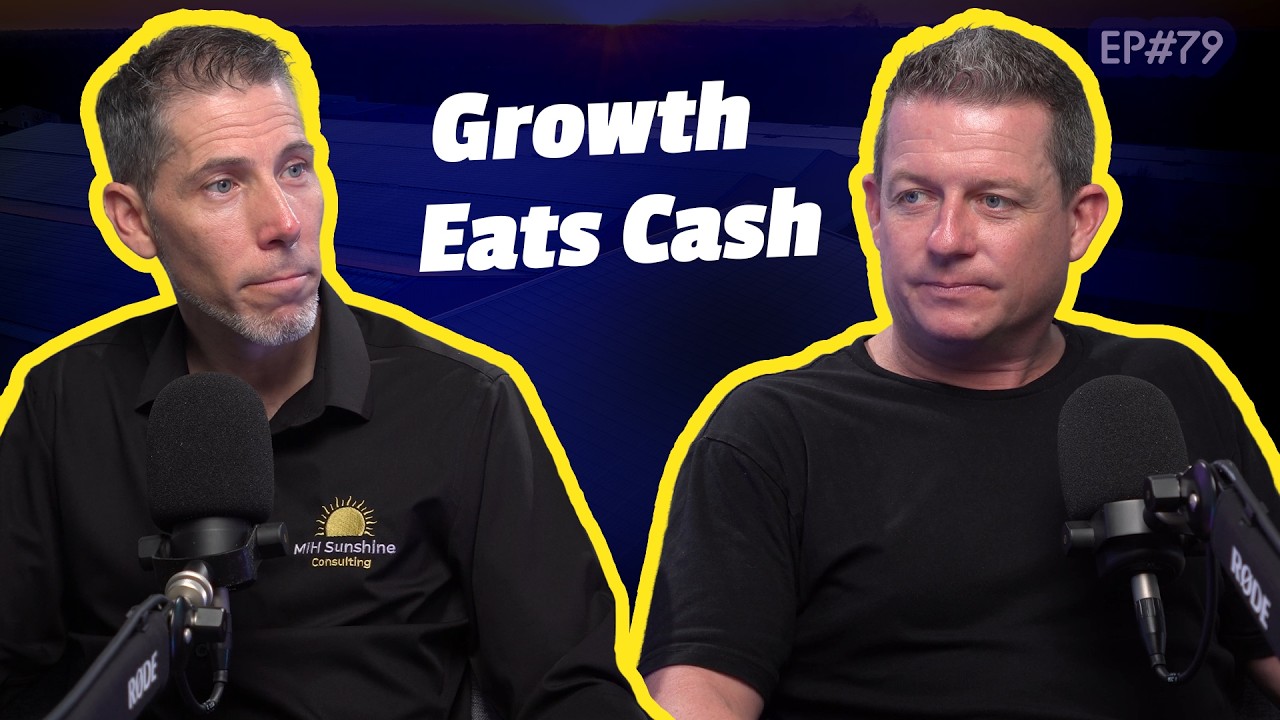
- Growth eats cash: the credit squeeze behind the battery boom
- Meet Tim Bowring and what Octet does
- The three biggest cash flow problems for solar businesses
- Case study: from $1M to $4M of stock every 60 days
- Why solar companies go into administration
- Longer payment terms, day one payment and waiting on rebates
- What it costs: about 1.5% for 30 days
- Who qualifies and how to fund a big job
- Earning Qantas and Velocity points, and final takeaways
Cited Sources
- The Cash Flow Trap Behind Australia's Battery Boom (companion article, Your Energy Answers) — The channel's own written treatment of the topic discussed in this episode, referenced in the description as further reading.
- Your Energy Answers — Publisher of the podcast; first-party source for the channel's wider content on the Australian solar and battery market.
- Find a local installer (Your Energy Answers directory) — Installer directory linked in the description, indicating the channel's commercial positioning within the residential market discussed in the episode.
- Your Energy Media — LinkedIn page — Corporate page of the media outlet producing the podcast, listed among the description links.
- Octet — Website of the trade and invoice finance provider whose products and case study form the substance of the interview; flagged in the description as the place to learn more.
Concurring Sources
- Working capital — General background on the cash conversion cycle that underpins the episode's central claim that revenue growth consumes cash before it generates it.
- Supply chain finance — Describes the category of financing Octet operates in, including the practice of a financier paying a supplier earlier and being repaid later by the buyer.
- Factoring (finance) — Explains invoice finance and lending against a receivables ledger, the mechanism Bowring describes when he says Octet will advance against a customer ledger without wider financial analysis.
- Insolvency — Background on administration and cash-flow versus balance-sheet insolvency, relevant to the episode's discussion of why solar firms enter administration.
- Clean Energy Regulator (Australia) — Administers the small-scale renewable energy certificate scheme referenced in the episode as a reason why rebate timing distorts installer cash flow.
Dissenting Sources
- No independent benchmark supplied for the stated cost of credit — The quoted price of about 1.5% per 30 days is never annualised in the episode. Compounded on a rolling basis that is roughly an 18–20% annual cost of funds, materially above secured bank lending, and no independent comparison of SME trade-finance pricing is offered to let a listener judge whether that is competitive or expensive for the risk taken.
Contribution & Novelties
The episode’s original contribution is not a new finding but a rare public look at the plumbing of small-business finance in the Australian solar and battery sector. It makes explicit a mechanism that is usually invisible: wholesaler credit limits were sized for a panel-and-inverter business and are now inadequate for battery-heavy inventory, and the shortfall is being bridged not by banks but by specialist financiers who sit behind the bank’s security and are repaid out of the sales cycle. The detailed account of a supplier being paid on day one, with the risk transferring to the financier, and the use of a supplier discount to subsidise the installer’s facility cost, is a concrete illustration of how trade finance can be structured so that all three parties gain. Less novel but useful is the explanation of why profitability and solvency diverge in a fast-scaling installer, and the practical advice to put a facility in place before it is needed rather than after wages are at risk.
Further reading:
- Supply chain finance — Background on the financing category Octet operates in and on early-payment structures in which a third party settles a supplier invoice and is repaid later by the buyer.
- Factoring (finance) — Explains invoice finance and lending against a receivables ledger, the mechanism described when the guest says Octet can advance against a customer ledger.
- Working capital — The cash conversion cycle concept that underlies the episode’s core argument that rapid revenue growth consumes cash before it produces it.
- Clean Energy Regulator (Australia) — Administers the certificate and rebate schemes whose processing timing the speakers identify as a recurring source of installer cash-flow strain.
- Deed of priority (Australian secured-lending practice) — The instrument the guest describes when explaining how a financier can rank behind a customer’s main bank while still taking an interest in the invoice book; cited here by name only because no single authoritative public reference was identified with confidence.
322 words
Radar Profile
The profile is that of a niche, practitioner-level conversation: moderate information density concentrated in concrete deal mechanics rather than breadth, and a technical level that assumes some familiarity with business finance but explains its own terms. Reliability sits in the middle because the content is coherent and operationally specific yet rests entirely on the testimony of an interested party, with no external data behind the causal claims.