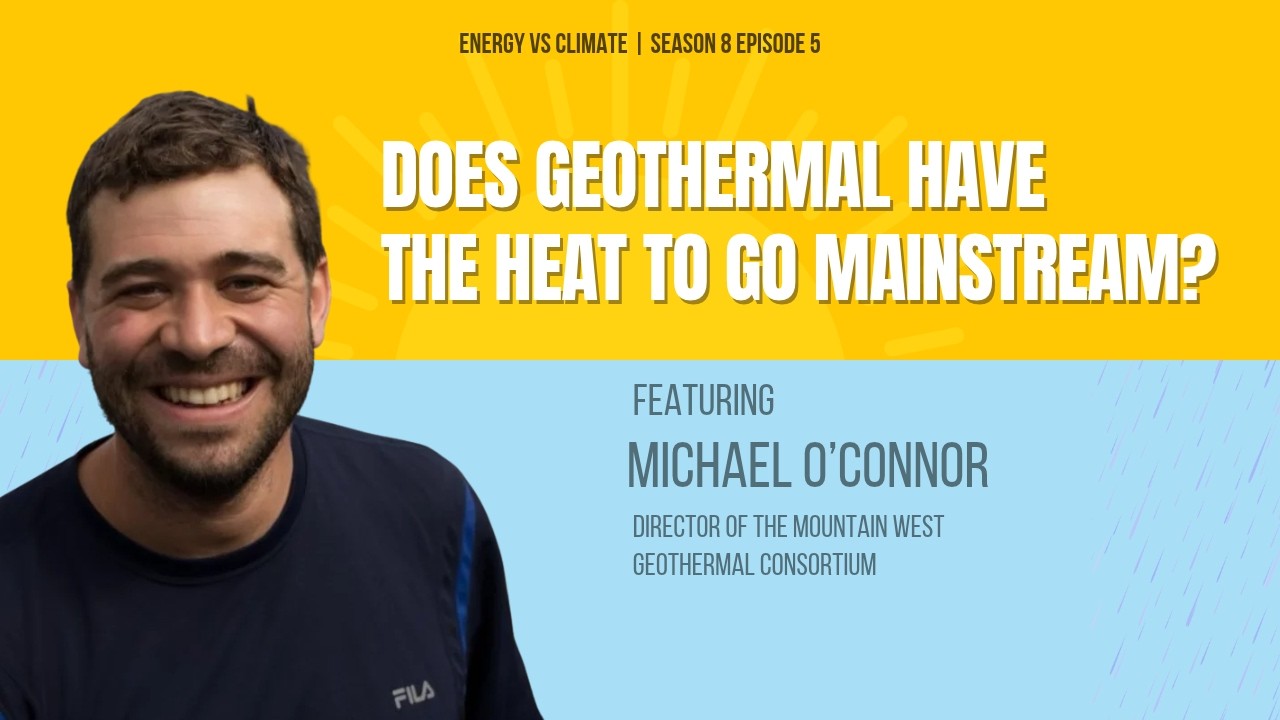
Why Geothermal Energy Has Been Stuck at 0.04% of the US Grid | With Michael O’Connor
Keywords
Summary
237 words
Critical Evaluation
Value of the Information & Strength of the Argument
The value of the information is high for understanding why geothermal has remained marginal in North America despite decades of technical promise. O’Connor brings a practitioner’s view from both the Department of Energy and a multi-state consortium, and he makes several useful distinctions that are often blurred in public debate: geothermal heat pumps versus hydrothermal power versus enhanced geothermal systems; fracking for hydrocarbons versus creating permeability for heat extraction; and oil-and-gas exploration economics versus utility-scale renewable annuity economics. The argument is structured around a clear causal chain: oil-and-gas drilling technology has reduced some subsurface uncertainties, but the appraisal stage still requires large sunk costs before a reservoir can be validated, and neither venture capital nor traditional project finance is well suited to that risk-return profile. That “missing middle” argument is coherent and is supported by concrete examples such as appraisal costs, Fervo’s capital path and proposed state revolving funds. The main weakness is that the discussion remains qualitative: it gives few reservoir-level performance numbers, no systematic cost comparison and limited treatment of competing clean firm options. Some claims, such as the scale of future geothermal deployment or the precise cost advantage over overbuilt wind and solar, are asserted rather than demonstrated in the conversation. The argument is therefore credible and well reasoned, but it is not a fully evidenced technical or economic assessment.
Scientific Rigor, Source Quality, Title Accuracy
The episode’s sourcing is typical of an expert podcast: it relies on the guest’s professional experience and on reports he knows, rather than on a formal reference list. The discussion mentions the US Department of Energy’s Pathways to Commercial Liftoff report on next-generation geothermal, a Clean Air Task Force analysis of California’s grid with and without geothermal, a paper titled “The Dealer Always Wins” on appraisal economics, and a Project Innerspace de-risking model for Texas. These are relevant and specific enough to allow follow-up, but most are not linked or fully cited in the episode itself. The show notes page is the main navigational source, and the description does not provide direct links to the reports discussed. The title is well matched to the content: the 0.04% figure is explained and contextualised, and the episode spends most of its time on the financial, subsurface and procurement barriers that keep geothermal at that level. The main reservation is that the conversation does not present opposing cost estimates or a detailed comparison with other clean firm resources, so the listener receives a practitioner’s perspective rather than a balanced review of the evidence.
428 words
Title / Content Match
The title accurately frames the episode: it asks why geothermal remains at 0.04% of US capacity and the conversation focuses on subsurface risk, finance and utility procurement. The episode is broader than the headline number, but the central question is genuinely addressed.
Quality & Reliability
8/10
The guest has direct experience at the US Department of Energy and now leads a multi-state geothermal consortium, and the discussion is technically grounded and appropriately caveated. However, it is a conversational interview rather than a sourced review: several figures and reports are cited from memory without full references, and forward-looking cost and deployment claims remain uncertain.
Chapters
- Intro to Michael O’Connor
- What is geothermal?
- Why now? Next-generation geothermal explained
- Fracking, earthquakes and the traffic light system
- Why so little geothermal? Subsurface risk and the appraisal gap
- Clean firm power: why grids want geothermal
- Hype cycle or real turning point? What has changed
- Fervo, FORGE and the role of government
- The missing middle: who pays to prove up a resource?
- How long does a geothermal reservoir last?
- Utilities as buyers: resource plans, data and procurement
- What is shifting for utilities and policy
- Alberta and Canada
- Can oil and gas companies pivot to geothermal?
- What would need to change in Alberta
- Audience Q&A
Cited Sources
- Energy vs Climate — episode page and show notes — Official episode page with the full episode, transcript and show notes.
- Pathways to Commercial Liftoff: Next-Generation Geothermal Power (US Department of Energy) — Report co-led by Michael O’Connor while at the US Department of Energy; cited for grid modelling and commercialisation pathways.
- Clean Air Task Force report on California’s grid with and without geothermal — Cited by O’Connor for the claim that a California grid without geothermal would cost $44 billion more because of wind and solar overbuild.
- “The Dealer Always Wins” paper — Paper referenced to explain why oil-and-gas business models do not fit geothermal appraisal economics.
- Project Innerspace appraisal de-risking model for Texas — Described as a similar public risk-assurance mechanism, capitalised at about $400 million, for appraisal-stage geothermal.
External References
Contribution & Novelties
The episode’s original contribution is to frame geothermal’s bottleneck as an appraisal-finance problem rather than a resource or drilling-technology problem. It gives a practitioner’s account of the “missing middle”: the gap between early subsurface risk capital and bankable utility-scale project finance. It also connects enhanced geothermal systems to oil-and-gas capability without overselling the analogy, and explains why clean firm power is increasingly valued by grids with high wind and solar shares and by data-centre loads.
Further reading:
- Enhanced geothermal systems — Background on EGS concepts and hydraulic stimulation for heat extraction.
- Geothermal power — Overview of conventional geothermal electricity, capacity and global deployment.
- Induced seismicity — Context for traffic-light monitoring and seismic risk in subsurface operations.
- US DOE Pathways to Commercial Liftoff: Next-Generation Geothermal Power — The report co-led by the guest; useful for detailed cost and deployment scenarios.
- Project Innerspace — Organisation mentioned as developing appraisal de-risking models; concept worth following for geothermal finance.
155 words
Radar Profile
The profile is strongest on reliability and information quality, with solid technical depth and a moderate quantity of information. It is a conversation rather than a data-heavy review, so the radar shows a reliable but not exhaustive treatment.