Keywords
Summary
359 words
Critical Evaluation
Value of the Information & Strength of the Argument
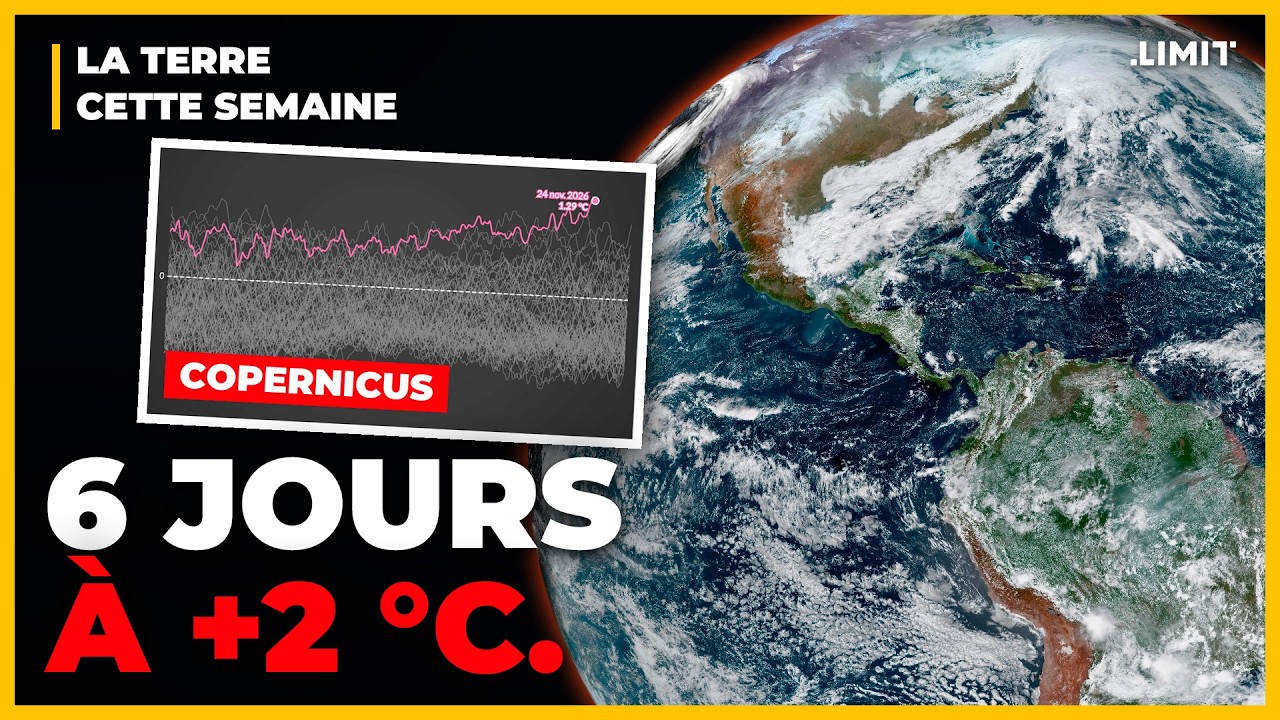
The informational value is high and comes from aggregation rather than from original research: within 27 minutes the episode compresses roughly twenty distinct items spanning climate monitoring, European legislative procedure, energy logistics, biodiversity science and behavioural economics, most of them reduced to their key figure and their caveat. The strongest passages are those where a number is immediately put in context — the six-day run above +2 °C is compared with the previous four-day maximum of February 2024, the November tide record with 1982, French gas storage with both the previous year and the five-year average, the quetzal’s 51 % habitat loss with its IUCN category, and the carbon-tax experiment with its actual effect size (about two percentage points, only a handful of the 55 interventions showing a measurable effect). The argumentation is at its best when it separates scales: the presenter repeatedly insists that a cold snap in France is local weather while the global mean is a planetary average, and that a single week above +2 °C does not mean the Paris threshold has been breached. The treatment of the North Atlantic circulation is similarly careful, presenting model thresholds for salinity without claiming an observed collapse. The weakest passages are the compressed one-liners, where causal claims are asserted rather than argued — the inevitable decline of oil because the resource is finite, or the reading of the European vote as a straight substitution of GDP growth for ecosystem regeneration; these are clearly marked as opinion but are not supported by evidence in the episode. The author also volunteers his own methodological doubts instead of hiding them, explicitly flagging the single-model, single-year AI training set behind the lightning projection, the non-peer-reviewed status of the OceanICU policy note, and an author’s employment at a food multinational in the diet study — a level of self-disclosure that strengthens rather than weakens the overall case. The rapid-fire format inevitably trades depth for breadth: several studies receive one sentence of result and no discussion of sample, design or limits, so the viewer leaves with a catalogue of findings rather than an understanding of how contested each one is.
Scientific Rigor, Source Quality, Title Accuracy
The sourcing discipline is well above the norm for the genre: every item is named with its issuing body or journal and dated, the description lists the corresponding URLs, and the presenter distinguishes between reanalysis-based calculations performed in-house (the global mean figure recomputed on the Copernicus file, the sea-ice and ocean series derived from NOAA OISST and NSIDC) and values simply quoted from the press. He also distinguishes degrees of evidentiary strength, stating plainly that the OceanICU ocean-carbon note is a policy brief not yet peer-reviewed and that the lightning projection rests on one AI model trained on one year of data and should therefore be handled with caution. One conflict of interest, undeclared in the original paper, is disclosed on air. The remaining reservations concern the absence of any independent check on figures reported by third parties, the occasional reliance on press relays rather than the underlying report (the air-quality figures reach the programme through a Belgian outlet), and the fact that the political segment mixes documented voting records with the presenter’s own editorial reading, even though the two are verbally separated. On the title: it is a question-mark headline built on one segment of a multi-topic roundup, and the episode as a whole covers far more than the reopening of the nature directives, so the fit is partial at best even though that segment is the longest and most developed.
602 words
Title / Content Match
The title foregrounds one segment (the European Parliament vote on the Birds and Habitats Directives) and frames it as a dramatic question, whereas the episode is a broad weekly news roundup also covering weather, energy and a dozen studies. The flagship segment does match the title, but the title covers only a fraction of the content.
Quality & Reliability
7/10
Each item is tied to a named primary source or dataset (Copernicus, NOAA/NSIDC, PNAS, Nature, Science Advances, Mongabay, Euronews), the URLs are listed in the description, and figures are usually attributed with date and magnitude. The presenter openly flags uncertainty (the AI lightning model, the OceanICU policy note not yet peer-reviewed, the non-binding nature of the European Parliament amendment) and discloses a potential conflict of interest in the Nature Food study. Limits: single-presenter rewriting of results without independent verification, some figures restated without stating the underlying method, and political commentary mixed with factual reporting.
Chapters
- Introduction
- Au programme
- Le pouls de la planète
- Météo : Thanksgiving sous la tempête
- Cyclones : le Pacifique record
- Chez nous : la pluie, puis le grand froid
- L'Inde a soif, l'Amazonie à sec
- Lois Nature : le vote du Parlement européen
- Qui a voté quoi ?
- Après l'échec de la COP31
- Le bras de fer du GIEC
- Énergie : nos stocks de gaz fondent
- Raffineries russes : Lukoil bradé
- Vivant : Bornéo brûle
- Requins : la fin du finning ?
- Le quetzal perd la moitié de sa forêt
- Panama : la mer ne nourrit plus
- Études en rafale : Delhi
- Taxe carbone : 55 équipes
- Les alertes canicule sauvent des vies
- L'Atlantique Nord et l'AMOC
- Moins de glace, plus de blé
- Bonus : ce que notre assiette détruit
- Une raison d'agir : la terre de Raoni
Cited Sources
- Copernicus Climate Pulse — Six consecutive days at or above +2 °C above the pre-industrial baseline, 18-23 November; daily anomaly of +2.24 °C on 23 November.
- NOAA OISST and NSIDC sea-ice data (LIMIT calculations) — Daily record ocean surface temperatures and the slow November Arctic sea-ice growth.
- Mongabay (25 November 2026) — Kalimantan fires, the ICCAT decision on shark finning, the quetzal habitat study and the Raoni territory.
- Sellers et al., PNAS — Panamanian anchovy collapse — Anchovy catch fallen to 11 % of normal in the Gulf of Panama after the failure of the cold-water upwelling.
- PNAS — air quality in villages around Delhi — 49 sensors deployed around Delhi showing rural air roughly 20 % more polluted than the city.
- PNAS — cadmium accumulation in Chinese rice soils — Near doubling of toxic cadmium in cultivated soils and rice over 40 years, with 138 million people above the risk threshold.
- Nature Human Behaviour — 55-team carbon tax persuasion trial — Simultaneous tests of 55 interventions on about 20,000 Americans, with an average gain of roughly two points of support.
- Environmental Health Perspectives — heat alerts and mortality in France — Alert days associated with about 3.7 % lower mortality among the over-85s, 2004-2022, with a fading effect as alerts repeat.
- Science Advances — North Atlantic salinity thresholds — Bordeaux-based team finds salinity still above the threshold used by models that simulate an abrupt AMOC weakening.
- Science Advances — Barents sea ice and wheat yields — Low winter sea ice linked to up to +16.5 % wheat yields in European Russia and about -5 % in Spain.
- Nature Food — diets and biodiversity footprints in 158 countries — Biodiversity impact of diets, 1995-2020, with offshoring of impacts and beef and mutton as exceptions.
- Nature — tree range shifts in western US forests — More than 44,000 plots showing forest cores moving downslope as drought, fire and insects kill high-elevation trees.
- Euronews — reform of the COP process — European push to change the consensus rule after the failure of COP31.
- CNBC — Lukoil asset sale — Sale of Lukoil's foreign holdings to a group led by Todd Boehly, pending US Treasury approval.
- LIMIT — video on the polar vortex — Companion explainer on the stratospheric polar vortex referenced during the cold-snap segment.
- LIMIT — interview with oceanographer Julie Deshayes on the AMOC — Longer treatment of the Atlantic circulation and its modelled tipping behaviour.
Concurring Sources
- IPCC AR6 Synthesis Report — Confirms that individual hot days or weeks do not by themselves constitute a breach of the Paris temperature goal, consistent with the presenter's caveat.
- Copernicus Climate Change Service — Institutional source of the daily global temperature series and reanalysis used for the 2 °C record claim.
External References
Contribution & Novelties
The episode’s value lies less in any single revelation than in its compression and cross-linking: it puts a legislative vote, a global temperature record, a gas storage figure and a dozen peer-reviewed results side by side within half an hour, and it explicitly ties the closing item on the Raoni territory to the opening item on European nature directives, framing both as the same question of whether legal protection is enforced. Two elements are genuinely additive. First, the recalculation of the Copernicus daily file to identify 23 November as the largest daily anomaly since 1940, which is an in-house computation rather than a quoted press figure. Second, the systematic flagging of the epistemic status of each claim — non-peer-reviewed policy note, single-model AI projection, undeclared industrial author — which is unusual in science news and gives the viewer the tools to discount appropriately. The weak point of the novelty claim is that almost everything else is a restatement of published work or reported news, with no interviews or original reporting in this episode.
Pour aller plus loin :
- Natura 2000 — Background on the network founded by the Birds and Habitats Directives at the centre of the European Parliament vote.
- Atlantic meridional overturning circulation — Context for the salinity-threshold and AMOC tipping-point discussion in the studies segment.
- Copernicus Climate Change Service — The European programme behind the daily temperature and reanalysis data used for the +2 °C record.
- Shark finning — Background on the practice and on the ICCAT measures described in the episode.
- Carbon price — Conceptual background for the 55-team experiment on public acceptance of carbon taxes.
- Raoni Metuktire — Profile of the Kayapo leader whose territory was recognised by decree.
- Special Report on the Ocean and Cryosphere in a Changing Climate (IPCC) — Reference for the ocean-cryosphere interactions and sea-ice feedbacks discussed.
305 words
Radar Profile
The profile is lopsided towards information quantity, with a high density of dated, attributed items across climate, energy and biodiversity. Technical depth sits in the middle: the episode explains mechanisms when it has time (AMOC thresholds, polar vortex versus cold snap) but compresses most studies to a single result. Perceived reliability is solid but not maximal, reflecting the reliance on third-party figures and the interleaving of clearly labelled editorial commentary with factual reporting.