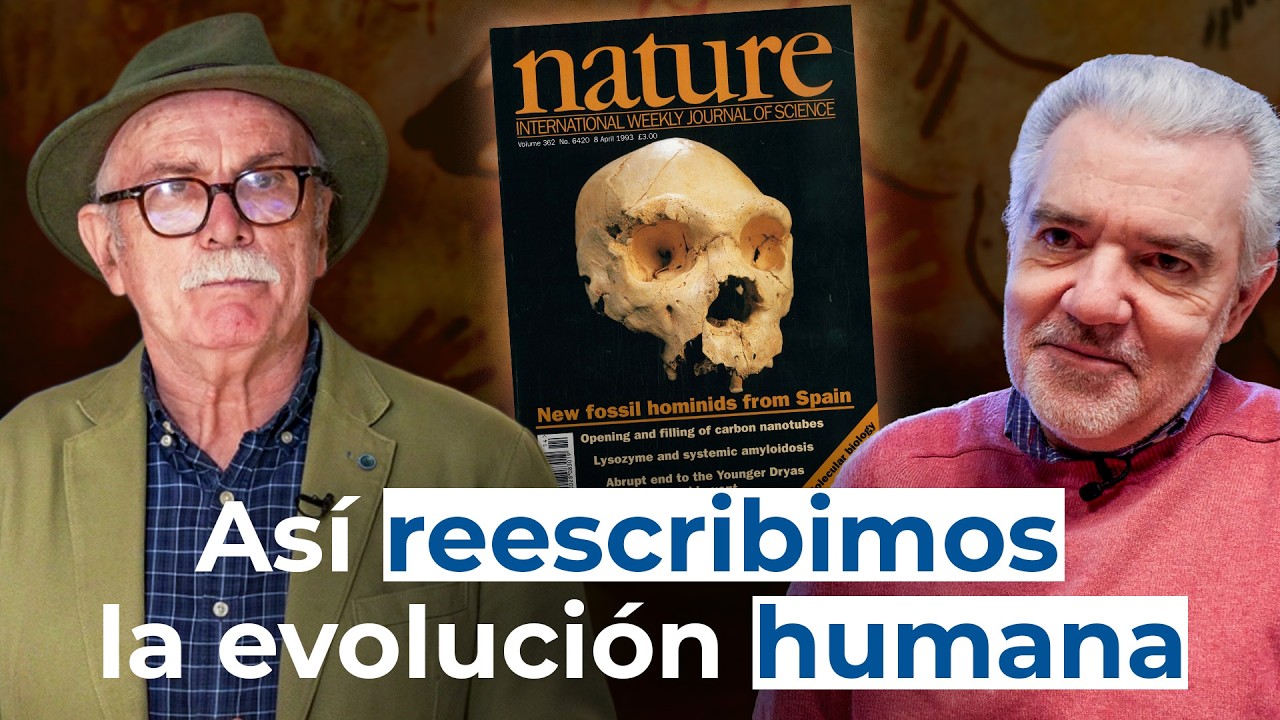
La ciencia que ha hecho historia en Atapuerca | Con Eudald Carbonell y José Miguel Carretero
The science that has made history in Atapuerca | With Eudald Carbonell and José Miguel Carretero
Keywords
Summary
286 words
Critical Evaluation
Value of the Information & Strength of the Argument
The documentary value lies in the density of first-hand testimony on how a long-term research programme is actually built: funding negotiations with regional authorities, the creation of the I+D building, the recruitment of excavators by letter and fax, the transition of co-direction in 2025 to a college of former students. On the argumentative side, the two speakers advance a small number of explicit theses rather than a single demonstration. The first is that research, socialisation and training are three inseparable pillars, and that the early accusation of ‘showing off’ levelled at those who communicated their results was mistaken; the argument is supported by the observable outcome (museum, interpretation centres, academic programmes) rather than by formal evidence, and is therefore more a retrospective rationalisation than a testable claim. The second thesis is strategic: that a peripheral scientific community must aim at the most widely read general journals in order to escape disciplinary confinement, and that temporary national exclusivity in authorship was a condition for acquiring an autonomous voice; here the reasoning is causal and internally consistent with the chronology they recount, though it remains an actor’s account rather than an assessed counterfactual. The third thesis concerns prudence before publication: the speakers repeatedly insist on the time required to study a specimen, on error, responsibility and peer review, which gives the discussion methodological substance. Weaker passages appear when the conversation turns to the emotional register (what the project ‘feels like’) or to humorous anecdotes, where the argumentative thread thins. A recurrent limitation is the asymmetry of treatment: favourable outcomes are narrated in detail, whereas funding conflicts, internal tensions and rejected hypotheses are alluded to only in passing, without systematic analysis of what failed and why. The discussion of the publication economy near the end is the most argumentatively dense section, moving from the observation of a 7–8% acceptance rate at top journals to a normative proposal for publicly owned publishing infrastructure, a normative leap that is stated rather than argued. Overall, the value is high as an insider chronicle and moderate as an argument, since the speakers assert more than they demonstrate.
Scientific Rigor, Source Quality, Title Accuracy
Scientific rigour is high on the empirical core: the speakers distinguish between what a fossil directly shows, what dating methods establish, and what is inferred, and they explicitly acknowledge the difficulty of dating European sites, the role of microfauna as an independent check, and the accumulation of independent evidence required before proposing a new species. The account of how Homo antecessor was formulated, its age bracket and the reasons why the attribution is not unanimous shows a genuinely scientific register, and the same applies to the cautious phrasing used about auditory capacity and the emergence of language, where anatomy is presented as a necessary but not sufficient condition. On the DNA sequence, the narrative correctly credits the incremental path from cave-bear DNA to human mitochondrial genomes, to nuclear DNA and Neanderthal lineage questions, and the Max Planck collaboration. Sources are, however, invoked orally and never cited formally: the speakers name journals (Nature, Science, PNAS, Journal of Human Evolution) and one institutional collaboration but no article titles, authors or years, and several dates and personal names are given from memory, with occasional hesitation and self-correction. The only documentary material offered in the video description is the researcher’s institutional page and the channel’s own blog, so the bibliographic exhibition itself is not reproduced in accessible form. Where interpretation goes beyond measurement — the intentional character of the Sima de los Huesos accumulation, the funerary reading of ‘Excalibur’, the symbolic or linguistic implications — the speakers present their own hypothesis with conviction without laying out the alternative explanations favoured by other specialists, so the viewer receives a well-informed but one-sided picture. The title-to-content match is good: the promise of a review of the science that made history at Atapuerca, with the two named researchers, is honoured, even if the final quarter shifts to a general critique of academic publishing.
671 words
Title / Content Match
The title is faithful: the colloquium reviews the publications that made Atapuerca known, with the two researchers named in the title. Only the first third is explicitly organised around the bibliographic exhibition; the rest drifts into broader research history and publication-system commentary, which remains within the announced scope.
Quality & Reliability
8/10
The content is delivered first-hand by two of the scientists who built the Atapuerca project (Eudald Carbonell, 33-year co-director; José Miguel Carretero, current co-director and director of the Human Evolution Laboratory at the University of Burgos), in an institutional setting (University of Burgos Library exhibition on 50 years of Atapuerca publications). Statements are largely verifiable against the published record (Nature, Science, PNAS, Journal of Human Evolution). The main limitation is the absence of citations given verbally, the oral and often anecdotal register, a few imprecise dates and names delivered from memory, and the fact that contested interpretations (funerary behaviour, species validity, dating) are presented by their proponents without confronting opposing views.
Chapters
- Introducción: el árbol de la evolución y 50 años de Atapuerca
- Publicaciones científicas como hilo conductor
- Eudald Carbonell y José Miguel Carretero
- Relevo en la codirección del Proyecto Atapuerca
- Universidad de Burgos y el Laboratorio de Evolución Humana
- Balance de medio siglo de investigación y socialización
- De pequeño proyecto a equipo internacional
- Emiliano Aguirre y los primeros años
- Apuesta por publicar en revistas de impacto
- Divulgación y difusión científica
- Primeros fósiles humanos y la llegada a Nature
- Miguelón y la portada que dio proyección internacional a Atapuerca
- La Sima de los Huesos
- La década prodigiosa
- La estrategia para publicar en las principales revistas científicas
- Las grandes publicaciones en la consolidación del proyecto
- Cómo se consigue una portada en Nature
- Homo antecessor: la competencia por los primeros europeos
- Estrategia de excavación. El mito de los hallazgos reservados
- Cómo se formula una nueva especie humana
- Antigüedad de Homo antecessor
- Dataciones y solidez de las evidencias
- Aceptación científica de Homo antecessor
- Industrias líticas y presencia humana más antigua
- Por qué es difícil fechar los yacimientos europeos
- Microfauna y verificación de las dataciones
- Qué pruebas exige una publicación científica
- Mandíbula de la Sima del Elefante y el primer europeo
- Nuevas especies, neandertales y potencial de los yacimientos
- Monográficos internacionales sobre Atapuerca
- La pelvis Elvis y el valor de los nombres
- Excalibur y la conducta funeraria
- El cuidado de los muertos
- Una acumulación intencional en la Sima de los Huesos
- El origen del lenguaje
- Miguelón: base del cráneo y huesos del oído
- Tomografía computarizada
- Capacidad auditiva hace 430.000 años
- Lenguaje articulado y simbolismo
- La imagen de los humanos del pasado
- Mandíbula de 2008 y revolución del ADN antiguo
- Estudio pionero: ADN de los osos de la Sima
- Recuperación de ADN humano
- ADN mitocondrial
- ADN nuclear y linaje de los neandertales
- Colaboración con Instituto Max Planck
- Homo antecessor: anatomía singular y canibalismo
- Una nueva especie
- Cómo se define una especie
- Crecimiento y el desarrollo de Homo antecessor
- Pink, el rostro humano más antiguo de Europa occidental
- Origen de las primeras poblaciones europeas
- Excavación, financiación e investigación interdisciplinar
- Cómo se construyó la autoridad científica de Atapuerca
- Prudencia, error y responsabilidad antes de publicar
- Cuánto tiempo requiere estudiar y publicar un hallazgo
- Revisión por pares, rechazos y trabajo editorial
- Prestigio de las revistas y control de calidad científica
- Investigación, socialización y formación como pilares del proyecto
- Luces y sombras del sistema de publicación científica
- Evaluación académica y revistas de impacto
- Coste de publicar en acceso abierto
- Hacia un sistema público de publicación científica
- Despedida y agradecimientos
- El legado de Atapuerca
Cited Sources
- José Miguel Carretero — researcher profile, University of Burgos — Institutional page of one of the two speakers, linked in the video description and presented as the official reference for his research activity.
- UBUinvestiga — science communication blog of the University of Burgos — Channel blog linked in the description, source of the institution's science-communication output and of the exhibition context.
- Nature — publication of Cranium 5 ('Miguelón') and the Sima de los Huesos assemblage — Journal repeatedly named as the target and the venue of the cover publication that gave the project international projection; no article reference is given in the video.
- Science — publication on Homo antecessor — Named as one of the three target journals; the speakers describe the strategy of publishing the new species there after the Nature cover, without citing the article.
- PNAS — Proceedings of the National Academy of Sciences — Cited among the high-visibility journals used for the 'socialisation' of results, notably in connection with the ear-bone and auditory-capacity work.
- Max Planck Institute for Evolutionary Anthropology — Named as the partner institution for the ancient-DNA work on human remains from the Sima de los Huesos.
- Emiliano Aguirre's early publication in Science on proboscideans — Invoked as the founding example of high-impact publishing that Aguirre transmitted to the first Atapuerca team; no reference given.
- Early report on the first human fossils, published in a Salamanca journal — Mentioned as the first scientific outlet for the initial human remains; the journal name is given imprecisely in the oral account and is not reproduced here.
Concurring Sources
- Atapuerca Mountains — site and research history — Concordant with the chronology and institutional milestones described by the speakers.
- Homo antecessor — species description and dating — Concordant with the account of the Gran Dolina discovery, the naming of the species and the debate over its age and validity.
- Sima de los Huesos — accumulation and hominin remains — Concordant with the description of the cranium, the in situ sediment and the discussion of the deposit's origin.
- Ancient DNA — methods and milestones — Concordant with the sequence of advances described, from faunal to hominin mitochondrial and nuclear genomes.
Dissenting Sources
- Interpretation of the Sima de los Huesos accumulation as intentional funerary behaviour — The speakers endorse the reading of a deliberate deposition of the dead and of 'Excalibur' as a symbolic object; alternative explanations involving natural processes, carnivore activity or sediment transport have been defended by other specialists and are not addressed in the colloquium.
- Specific status of Homo antecessor — The species is presented as firmly established, whereas part of the literature questions its distinctiveness relative to other European Middle Pleistocene populations and debates its position in the Neanderthal/modern-human split.
- Chronology of the earliest European occupation — The dating of the Sima del Elefante mandible and of the Gran Dolina levels is discussed as robust, while independent studies have proposed divergent age estimates depending on the method and the calibration used.
- Inferences on language from the bony labyrinth and ear structures — The auditory and symbolic argument is presented as strong support for articulated language, whereas the inference from anatomy to linguistic capacity remains contested in the wider literature.
Contribution & Novelties
The distinctive contribution is not new data but an unusually explicit account of the mechanics of scientific authority-building in a long-duration project. Viewers get a rare description of publication sequencing as a deliberate strategy — targeting generalist journals rather than disciplinary ones, holding exclusive Spanish authorship for eight to ten years before opening to foreign collaboration, and treating a cover in Nature as a political instrument for consolidating institutional support and the creation of the Atapuerca Foundation. Equally valuable is the insider view of peer review as an experience of rejection and delay rather than a ritual, together with the closing critique of prestige hierarchies, the economics of open access and the proposal for a publicly funded publishing system. The archaeological content is largely synthetic, restating well-established results on Homo antecessor, the Sima de los Huesos and the ancient-DNA programme, but it is enriched by the reconstruction of the decision chain behind each announcement.
Further reading:
- Atapuerca Mountains — Overview of the Sierra de Atapuerca sites, their stratigraphy and UNESCO status, useful for situating the sites discussed.
- Homo antecessor — Summary of the Gran Dolina TD6 material, its age bracket and the ongoing debate on its phylogenetic position.
- Sima de los Huesos — Presentation of the accumulation, the ‘Miguelón’ cranium and the interpretations of the deposit discussed in the video.
- Emiliano Aguirre — Biographical entry on the initiator of the Atapuerca project and his role in Spanish paleontology.
- Ancient DNA — Technical and historical background to the sequencing work described, from faunal DNA to hominin nuclear genomes.
- Peer review — Context for the discussion of evaluation, rejection rates and the limits of the current editorial model.
276 words
Radar Profile
The profile is dominated by information quantity and reliability, reflecting a long, densely documented conversation between two actors with direct knowledge of the events. Technical level is moderate: methodological reasoning on dating, ancient DNA and species definition is present but delivered in an accessible register rather than in specialist detail. Quality tracks the same pattern, slightly below quantity because references are given orally and without article-level citations.